

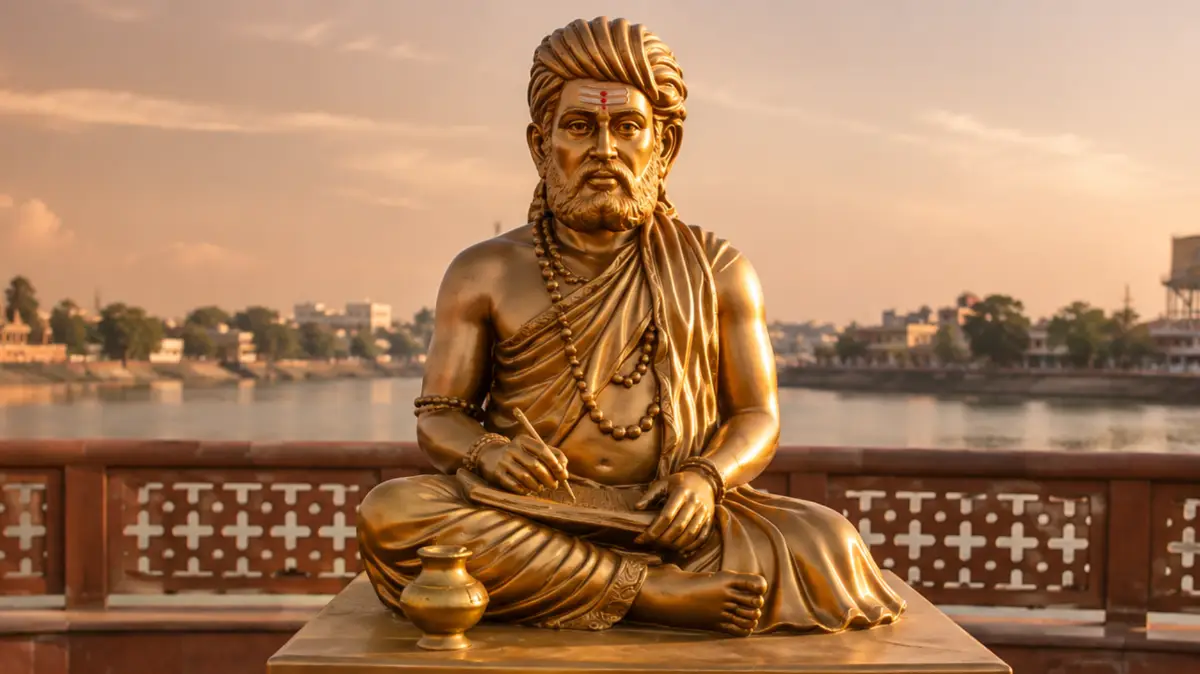
Key highlights
- Varahamihira lived and worked in Avanti (Ujjain) in the 6th century CE, most likely under the Aulikara dynasty. Encyclopaedia Britannica dates him approximately 505 to 587 CE.
- He is traditionally listed among the Navratnas (nine gems) of King Vikramaditya's court. That tradition comes from the Jyotirvidabharana, a text scholars regard as a 12th-century forgery. Present it as legend, not history.
- His Panchsiddhantika compared and corrected five earlier astronomical schools. The discipline of cross-checking planetary positions across multiple systems underlies how Simhastha bathing dates are projected years in advance.
- The Brihat Samhita covers approximately 106 chapters and fewer than 4,000 verses, spanning architecture, gemology, weather forecasting, iconography and groundwater detection. It describes the Buddha as "the father of the world" and includes Jaina Tirthankara iconography.
- Chapter 54 of the Brihat Samhita, the Dakargala, describes groundwater detection using trees, termite mounds and terrain. A 1986 paper in the journal Groundwater by E.A.V. Prasad confirmed its bioindicator methods as scientifically valid.
- The 11th-century Arab scholar al-Biruni praised Varahamihira's scientific honesty but also called him self-lauding. He read, translated and cited the Brihat Samhita in his Kitab al-Hind.
Who was Varahamihira, and when did he live?
Encyclopaedia Britannica dates Varahamihira to approximately 505 to 587 CE. The 505 CE anchor comes from the Panchsiddhantika itself, which uses Shaka year 427 as its computational epoch, corresponding to roughly 20 to 21 March 505 CE. The 587 CE death date comes from a single later source: the commentator Amaraja, writing roughly a thousand years after Varahamihira in a commentary on Brahmagupta's Khanda-khadyaka. Scholars treat Amaraja's dating as traditional rather than independently verified. What is certain is that Varahamihira postdates Aryabhata (born 476 CE), since his works refer to Aryabhata's calculations.
About himself Varahamihira was concise. One biographical verse in the Brihat Jataka states he was a native of Avanti (the ancient name for the Ujjain region), son of Adityadasa, and educated at Kapitthaka by the grace of the Sun-god. In the Panchsiddhantika he calls himself Avantyaka, meaning "one of Avanti." The commentators Utpala and Mahidhara later called him Avantikacharya, "teacher of Avanti." His name Mihira shares roots with the Iranian solar deity Mithra, and his father's name Adityadasa means "servant of the Sun," both consistent with the tradition of sun-worshipping Maga Brahmin priests that his commentator Utpala associates with him.
The claim that Varahamihira was one of the nine gems of King Vikramaditya's court at Ujjain comes entirely from the Jyotirvidabharana, a text traditionally attributed to Kalidasa. Scholars including V.V. Mirashi date it to the 12th century and call it a later forgery; D.C. Sircar called the whole Navratna tradition absolutely worthless for historical purposes. More specifically, Varahamihira (6th century CE) could not have been a court contemporary of a 1st-century-BCE Vikramaditya. "Vikramaditya" was itself a title carried by many rulers, not the name of one specific king. The historically plausible setting for Varahamihira is the Aulikara dynasty of Malwa, probably in the reign of Yashodharman or a successor, the rulers who controlled the Avanti region in the mid-6th century. Present this as a scholarly inference, not a confirmed fact, since no inscription directly links Varahamihira to any named patron.
The Panchsiddhantika: five schools of astronomy in one cross-checked system
Varahamihira's most important astronomical work is the Panchsiddhantika, composed roughly in the second half of the 6th century CE. The title means "five siddhantas," five astronomical schools or doctrines. Rather than inventing a new system, Varahamihira compared the five that were circulating in India at his time, identified where their planetary calculations agreed and diverged, and corrected inconsistencies between them. The critical editions are those of Thibaut and Sudhakara Dvivedi (1889) and Neugebauer and Pingree (1970).
| Siddhanta | What it covers | Distinctive feature |
|---|---|---|
| Surya Siddhanta | Solar and planetary motion, calendar systems | The most developed and accurate; the only one to survive as an independent text. Widely used for panchang calculation. |
| Paitamaha Siddhanta | Cosmological framework, early computational methods | The most archaic; closest to the Vedanga Jyotisha tradition. Varahamihira used it as a historical baseline. |
| Vasishtha Siddhanta | Planetary positions, tithis, conjunctions | Standard planetary-period computations; Varahamihira reconciled its cycle lengths with other systems. |
| Romaka Siddhanta | Luni-solar motion using a tropical framework | The only Indian siddhanta on the tropical system, built on Western astronomical parameters including the 19-year Metonic cycle. The name "Romaka" refers to Rome or the Romans. |
| Paulisha Siddhanta | Planetary longitude computations | Reflects Hellenistic astronomical methods. The attribution to a Greek author named Paul of Alexandria has been rejected by David Pingree; it reflects Greek-influenced astronomy generally. |
Sources: Encyclopaedia Britannica, MacTutor History of Mathematics (University of St Andrews), and the Thibaut and Dvivedi (1889) and Neugebauer and Pingree (1970) critical editions, checked August 2026. Siddhanta descriptions reflect the scholarly consensus on their content and origins.
The Romaka and Paulisha siddhantas reflect the influence of Hellenistic astronomy on Indian science. Varahamihira incorporated their methods into the Indian framework, and he acknowledged elsewhere that some of his terminology had Western roots. Greek loanwords that made their way into Indian astral science during this period include horā (from the Greek hōra, "hour"), kendra (from kentron) and liptā (from lepton, "minute"). One important correction to some popular accounts: the Sanskrit word jyā, for the chord or sine function, is not a Greek borrowing. On the contrary, the Arabic and Latin word "sine" ultimately derives from Sanskrit jyā, which Arab mathematicians transliterated and then Latin translators mistranslated. The flow of influence ran in both directions.
The significance of this cross-checking method for Simhastha pilgrims is direct. The discipline of verifying planetary positions against multiple calculation systems (rather than relying on a single tradition) is precisely what panchang-makers and temple astrologers use today to project auspicious bathing dates years ahead. The Surya Siddhanta, one of the five systems Varahamihira compiled, remains the most widely used basis for traditional Hindu almanac calculation. When you read that the Amrit Snan dates for Simhastha 2028 are already known, you are reading the output of a calculation tradition this city formalised in the 6th century.
The Brihat Samhita: everything from comets to groundwater
Varahamihira's most encyclopaedic work is the Brihat Samhita, in approximately 106 chapters and fewer than 4,000 verses. Varahamihira himself says in the final chapter (106.13) that the work contains fewer than 4,000 shlokas in roughly 100 chapters; modern printed editions count 106. It's the most cited of his works across non-astronomical fields.
The range of subjects is exceptional. The Brihat Samhita covers planetary and stellar omens, a catalogue of 101 types of comets and their associated predictions, earthquake forecasting, rainfall and weather prediction, vastu (architectural orientation), gemology, tree medicine and plant science, marriage muhurta, and the iconographic specifications for sculpting images of deities. It also includes early descriptions of what we would now call applied ecology: using the behaviour of plants and animals as indicators of natural conditions.
The iconography chapters: a note on religious inclusivity
The Brihat Samhita's iconography sections describe the correct forms for images of Vishnu, Baladeva, Brahma, Skanda, Indra, Shiva, Surya, the Matrikas, Yama, Varuna, Kubera and other deities of the Brahmanical tradition. What makes the text remarkable is that it extends the same detailed, respectful treatment to the Buddha and to Jaina Tirthankaras. Varahamihira calls the Buddha "jagat-pita," the father of the world, devoting a full stanza to the correct iconographic forms of Buddhist images. A.M. Shastri characterises this as religious eclecticism rather than strict sectarianism, and it's one of the most frequently cited examples of 6th-century Indian intellectual openness.
A separate note on a Ganesha-related verse: this appears in only one or two manuscripts of the Brihat Samhita and is regarded by scholars as a later interpolation, not part of the original text.
The Dakargala: Varahamihira's chapter on groundwater
Chapter 54 of the Brihat Samhita (numbered 55 in some editions) is called the Dakargala. The name joins daka (from udaka, water) and argala (bolt or bar), suggesting water locked within the earth, or undercurrents. In roughly 125 verses, Varahamihira describes how to locate groundwater by reading natural indicators: specific tree species, termite mounds, unusual plant features such as twin trunks, thornless thorn trees or twin-crowned palms, soil colours, and terrain features.
The opening verse of the chapter draws an analogy between the earth and the human body: underground water-streams run through the earth as veins (nāḍīs) run through the human body. About 56 of the chapter's verses concern termite mounds specifically, using their location, shape and orientation to infer the position, depth and likely volume of groundwater below.
In 1986, E.A.V. Prasad, professor of geology at Sri Venkateswara University in Tirupati, published a paper titled "Bioindicators of Ground Water in Varahamihira's Brihat Samhita" in the journal Groundwater (NGWA/Wiley), volume 24, number 6, pages 824 to 828 (DOI 10.1111/j.1745-6584.1986.tb01703.x). He examined the bioindicator method (using plants and organisms) to locate water, finding Varahamihira's descriptions scientifically valid and consistent with modern hydrogeology. A 2020 peer-reviewed review in Hydrology and Earth System Sciences (Copernicus) confirmed that the Dakargala's bioindicators locate groundwater at depths ranging from 2.29 metres to as much as 171.45 metres. Separately, K.S. Murty called Varahamihira "the earliest hydrologist" in a comparison with Leonardo da Vinci's water studies.
The Brihat Jataka: the astrology canon
The Brihat Jataka is Varahamihira's foundational work on predictive astrology, specifically natal-chart interpretation. It runs to more than 407 verses across 28 chapters. (Varahamihira's original structure had 25 or 27 chapters; the 10th-century commentator Bhattotpala split one chapter into three, bringing the count to 28.)
The text's standing in South Indian astrological practice is particularly strong. For several centuries the Brihat Jataka held a position above other jyotisha texts in South India, with the saying that one was not considered a scholar of astrology unless the Brihat Jataka was memorised. Bhattotpala's commentary and Govinda Bhattathiri's Dasadhyayi further established it as a foundational reference. It remains a standard citation in practicing Indian astrologers' libraries.
Varahamihira also wrote the Laghu-jataka, a condensed companion work (13 chapters, 155 Arya-metre verses), following his characteristic pattern of paired greater and lesser works: Brihat/Laghu Jataka, Brihat/Laghu Yogayatra, and Brihat/Laghu Vivaha-patala.
What al-Biruni said about Varahamihira: the full picture
The 11th-century Arab scholar al-Biruni (Abu Rayhan Biruni, 973 to 1048 CE) visited India in the early 11th century and wrote the Kitab al-Hind (known in English as Alberuni's India), one of the most detailed accounts of Indian science and society written by any non-Indian observer. He read, translated and cited the Brihat Samhita extensively, an act of serious scholarly engagement, not casual mention.
Al-Biruni's assessment of Varahamihira is two-sided, and any single-sentence summary misrepresents it.
On the positive side: in a passage comparing Varahamihira favourably with Brahmagupta, al-Biruni writes that "his foot stands firmly on the basis of truth, and he clearly speaks out the truth." This praise comes specifically because Varahamihira stated plainly that eclipses have natural causes (shadow geometry) rather than being caused by the demon Rahu, a position al-Biruni respected as scientific honesty. The contrast is with Brahmagupta, whom al-Biruni condemned for suppressing the scientific truth to appease religious orthodoxy.
On the critical side: al-Biruni also quotes Varahamihira's verse in which he says, in effect, that the Greeks, though ritually impure, must be honoured because they excelled in sciences, and that a Brahman who combines purity with such excellence would be greater still. Al-Biruni calls the author of this verse "a self-lauding man" for the way he positions Brahmans above foreign scholars while appearing to honour foreigners. So al-Biruni's view was respectful about Varahamihira's scientific integrity and mixed about his attitude.
The Varahamihira verse al-Biruni quotes is itself worth noting for what it says about the transmission of Greek astronomy into India: Varahamihira acknowledged that Greek astronomical science was worth learning from, which is consistent with the Romaka and Paulisha siddhantas he compiled.
Ujjain as astronomical reference point: the science and the myth, separately
Ujjain's sacred status rests on two distinct foundations that are often presented as one. They deserve to be stated separately, because they are.
The first is astronomical. Ujjain served as the zero meridian (prime meridian, reference longitude) of classical Indian astronomy. The Surya Siddhanta, one of the five systems Varahamihira compiled, places the prime meridian through Ujjayini (Avanti) and Rohitaka (Rohtak). The Aryabhatiya, Brahmagupta's Brahmasphutasiddhanta, Bhaskara II's Siddhanta Shiromani, and other foundational texts all use Ujjain as their baseline reference longitude. Traditional panchang calculation and horoscope computation are referenced to Ujjain time, roughly 29 minutes behind IST. The city was India's measurement point for the sky, which made it the natural centre of astronomical scholarship.
The second is mythological. Ujjain is one of the four places where drops of amrit (the nectar of immortality) are believed to have fallen during the Samudra ManthanThe epic mythological churning of the ocean that led to Kumbh Mela., or churning of the cosmic ocean. That is the popular origin story of the Kumbh and Simhastha traditions. As noted in this site's article on Dhanvantari and Ayurveda, historians observe that this "four drops" story is not found in the Puranas themselves and appears to be a later tradition. The festival's actual timing is set by a planetary alignment: Jupiter entering Leo.
Both reasons are real in the sense that matters for a pilgrimage: the astronomical tradition gives the city its technical identity as a timekeeping centre, and the mythological tradition gives it its devotional identity as a place where the sacred and the earthly met. Varahamihira belongs to the first. He did not cause Ujjain to host Simhastha; the mythological and astronomical conditions for that predate him. What he did was place the city's astronomical tradition in a canonical written form that has been in continuous use ever since.
Varahamihira did not write the rule that Simhastha falls when Jupiter is in Leo. That rule derives from the siddhantic tradition of Vedic astrology more broadly. What he did was compile and cross-check the planetary calculation systems that underlie how jyotishis and panchang-makers project and verify that alignment centuries in advance. The Surya Siddhanta, which he treated as the most accurate of the five, is still the primary computational basis for traditional Hindu almanacs, including those used to fix Simhastha dates. The connection is methodological and transmitted, not direct authorship.
How Simhastha 2028 dates connect to this tradition
Simhastha 2028 is scheduled from 27 March to 27 May 2028. The astronomical trigger is Jupiter entering Simha Rashi (Leo), giving the event its name "Simhastha." The specific Amrit Snan dates within the window are fixed by the position of the Sun (in Mesha, Aries) and Moon alignments on specific tithis. Both Jupiter's position and the Sun-Moon configuration are calculated using the same planetary-position tradition the Panchsiddhantika systematised.
| Date (2028) | Snan type | Astronomical basis |
|---|---|---|
| 27 March | Parva Snan (opening) | Start of the Simhastha window: Jupiter in Leo confirmed |
| 9 April | Amrit Snan (Shahi Snan) | Chaitra Purnima (full moon); first royal bath |
| 23 April | Amrit Snan (Shahi Snan) | Second royal bath (see note below) |
| 8 May | Amrit Snan (Shahi Snan) | Vaishakha Purnima; third and final royal bath |
| 27 May | Parva Snan (closing) | End of the Simhastha window |
Sources: Daily Pioneer reporting on the official announcement by Simhastha Mela Officer Ashish Singh; simhastha.org.in. NOTE: the second Amrit Snan date is cited as 23 April in most sources used by this site (simhastha.org.in and our own dates page) but as 27 April in some others. The discrepancy likely relates to whether Akshaya Tritiya (27 April 2028) is treated as a qualifying snan tithi. Confirm against the final government gazette notification before booking non-refundable travel. The 27 March to 27 May window and the 9 April and 8 May dates are consistently reported across sources.
Experiencing Varahamihira's Ujjain during Simhastha 2028
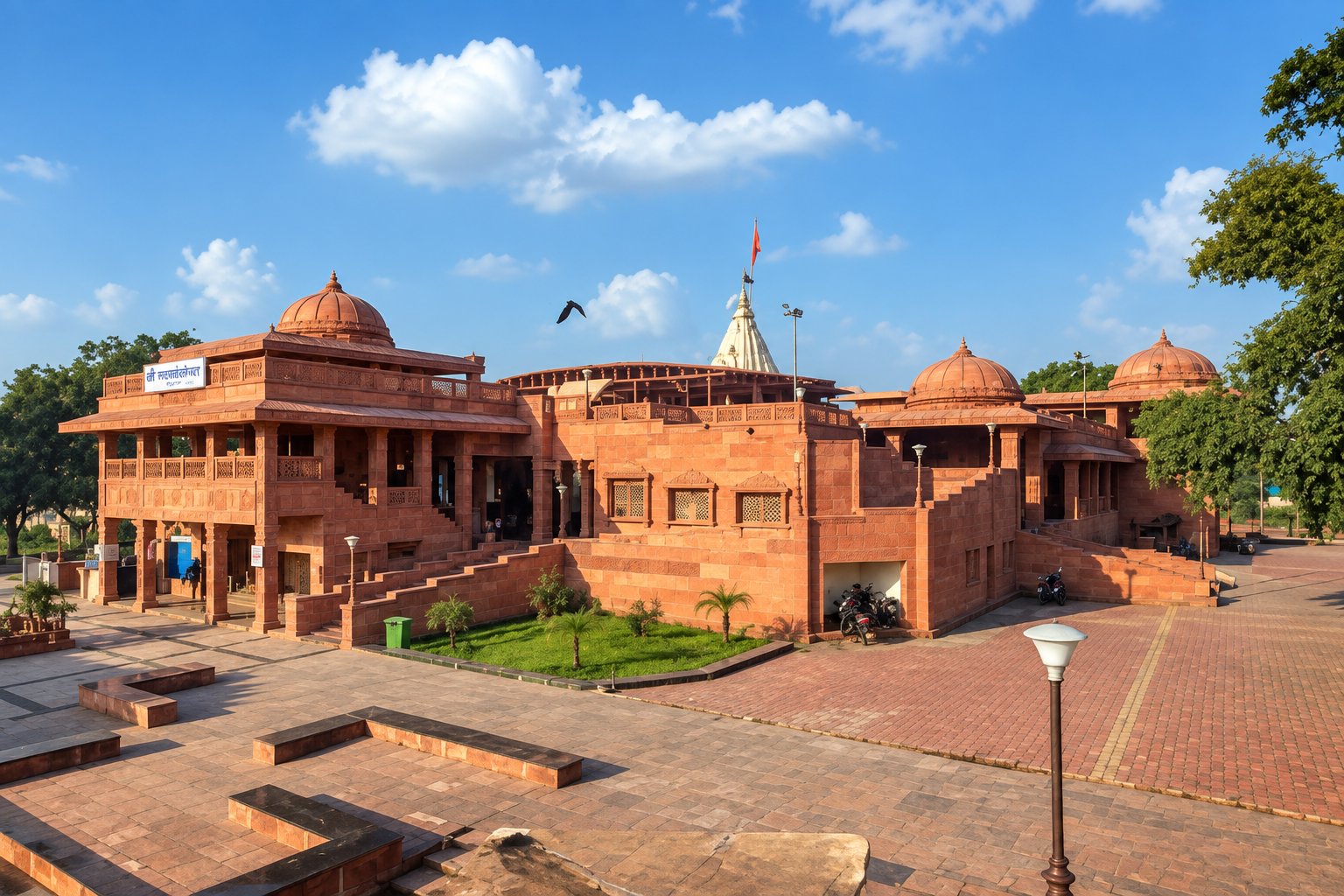
There's no preserved Varahamihira temple or monument in Ujjain the way there's a MahakaleshwarExplore the divine Mahakaleshwar Jyotirlinga in Ujjain. or a Ram Ghat. His legacy is woven into the city's identity as a place where the sky was observed, recorded and transmitted. For pilgrims who want to trace that thread, two stops are worth building into the itinerary.
Who should go deeper into this, and who should focus on the rituals
This history works well for
- Foreign visitors looking for a scientific frame: the groundwater chapter with its 1986 peer-reviewed validation, the Hellenistic astronomy connections, and al-Biruni's engagement give intellectual hooks that work without a faith background.
- Pilgrims who want to know why the dates are where they are: the Jupiter-in-Leo explanation and the panchang calculation tradition answer the "how do they know?" question directly.
- Students of Indian science history: Varahamihira is one of the most documented scientists of the early medieval period, with multiple authenticated works and a verifiable date range.
- Anyone visiting the Vedh Shala observatory: knowing Varahamihira's context makes the masonry instruments legible rather than decorative.
Focus differently if you are
- On a single Amrit Snan day: your time on those days (9 April, 23 April or 8 May 2028) is better spent at the ghats and Mahakaleshwar. The history circuit is a second-day addition.
- Looking for a dedicated Varahamihira temple: there isn't one. His legacy is textual and institutional, not architecturally concentrated in Ujjain the way a deity's shrine would be.
- Travelling with elderly family members or small children in summer heat: the Vedh Shala is a good morning stop, but plan for shade and water. Ujjain regularly exceeds 40°C in May.
Quick summary of Varahamihira's works
| Work | Subject | Why it matters today |
|---|---|---|
| Panchsiddhantika | Astronomy: five canonical schools cross-checked and corrected | The basis for verifying planetary positions; underpins panchang calculation methods including Simhastha date projection |
| Brihat Samhita | Encyclopaedic: comets, weather, vastu, gemology, iconography, groundwater, marriage timing and more | Still cited for traditional weather prediction, architectural orientation, and the Dakargala bioindicator method |
| Brihat Jataka | Predictive astrology: natal-chart interpretation | A standard reference text for practicing Indian astrologers, particularly in South India |
| Laghu-jataka | Condensed natal astrology | Companion volume, used alongside the Brihat Jataka |
| Yogayatra / Brihat-yatra | Electional astrology for journeys and military expeditions | Historical record of applied Vedic astrology for timing |
| Vivaha-patala | Marriage astrology | Auspicious timing for weddings; still consulted in traditional almanac traditions |
Sources: Encyclopaedia Britannica, MacTutor (University of St Andrews), and the standard critical editions of each work, checked August 2026.


Comments
No comments yet. Be the first to share your thoughts!
Leave a Comment