

What is Guheshwar Mahadev in Ujjain?
Guheshwar Mahadev is the second of Ujjain's 84 Mahadev lingas. Its story is told in the Skanda Purana, Avantya Khanda, in the second chapter of the Chaturashiti Linga Mahatmya. The Purana says the linga has stood in a cave in Mahakalavana for seven kalpas and was named Guheshwar after sage Mankanaka saw it.
Hindi lists often write it as "Ling Guheshwar." That is not a separate name; it comes from list entries such as "(2) Ling Guheshwar Mahadev."
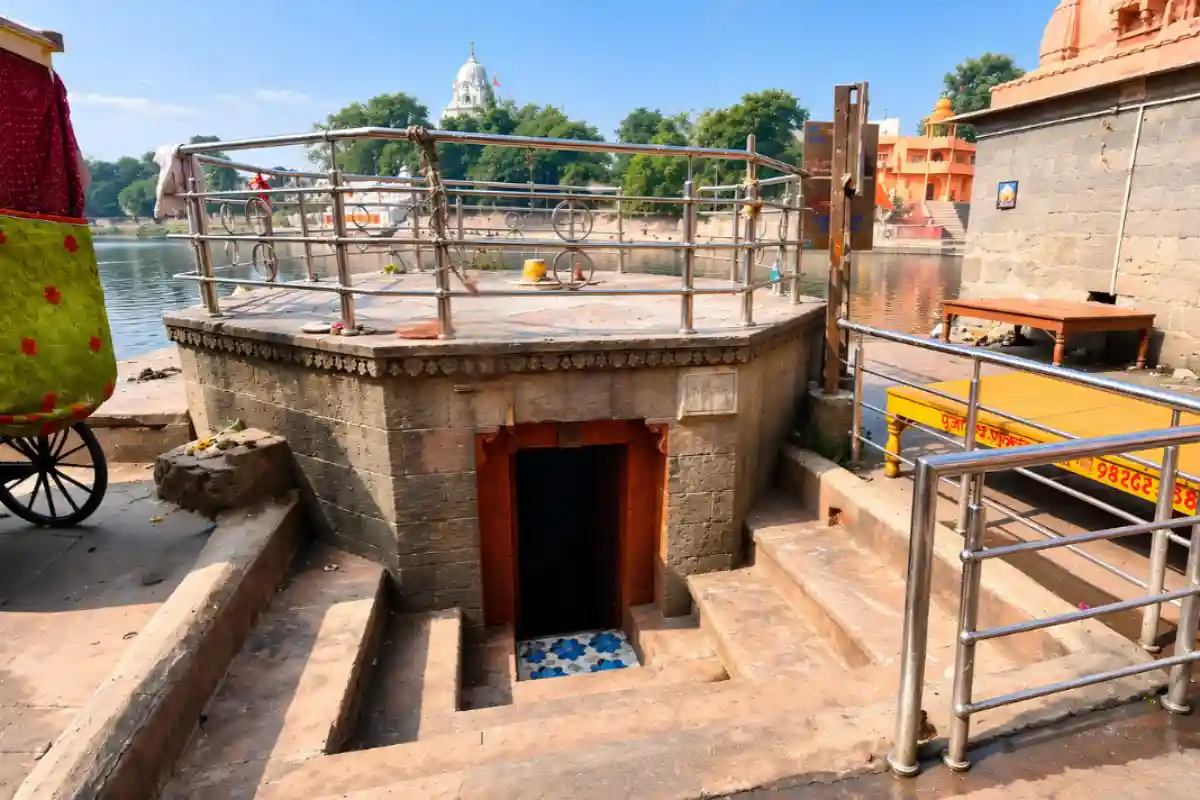
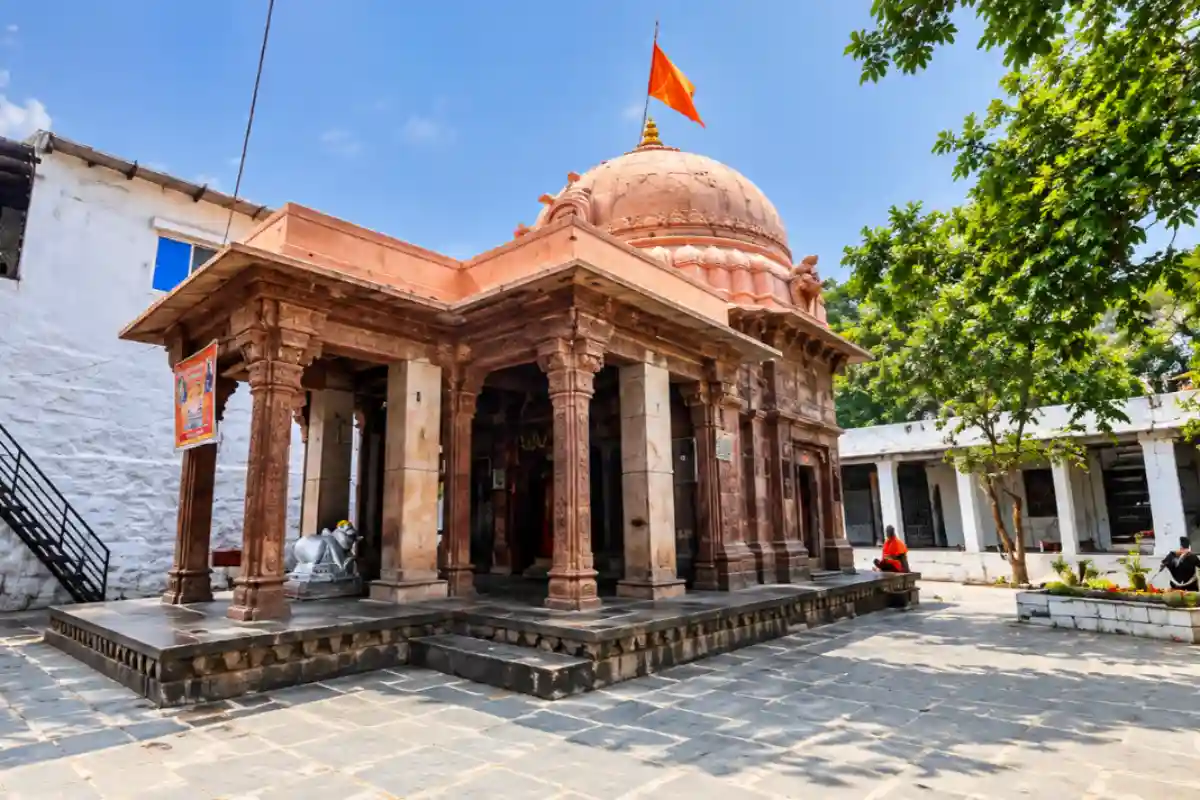
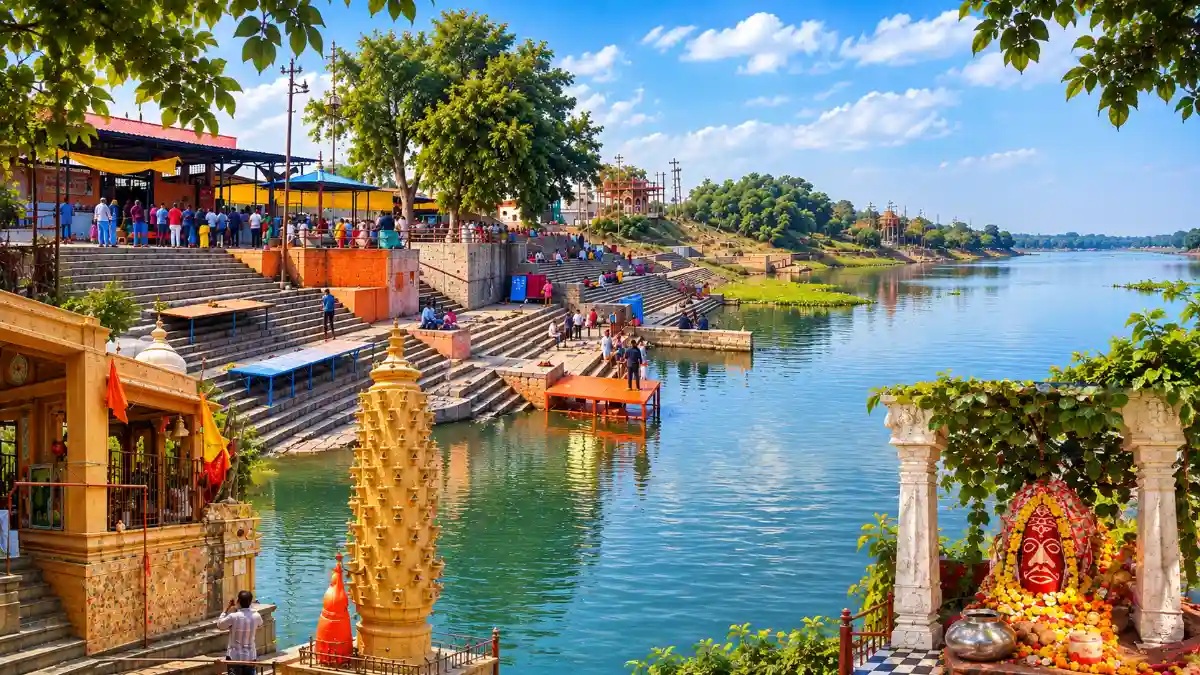
Local accounts place the shrine at Ramghat near Pishachmukteshwar, with the linga inside a tunnel-like chamber.
At a glance
- Mankanaka grew proud when vegetable juice came out of his body, and his dance threw the world into chaos.
- Shiva came disguised as a Brahmin and silenced him by making ash fall from his own thumb.
- Shiva sent the ashamed sage to Mahakalavana, and the gods announced the linga's name from the sky.
- The same story appears in the Mahabharata, set on the banks of the Sarasvati.
Guheshwar Mahadev: quick facts
| Topic | Detail |
|---|---|
| Meaning of the name | Lord of the cave (guha) |
| Deity | Shiva, in linga form |
| Source text | Skanda Purana 5.2.2 (Avantya Khanda, Chaturashiti Linga Mahatmya, Chapter 2) |
| Verses in the chapter | 48 |
| Position among the 84 Mahadevs | Second |
| Sage in the story | Mankanaka |
| Sacred zone in the text | Mahakalavana |
Many retellings say Shiva pressed his thumb and drew ash from his fingertip. Both the Skanda Purana and the Mahabharata have it the other way round: Shiva strikes his thumb with the tip of his finger, and ash as white as snow pours from the thumb.
What is the story of Guheshwar Mahadev in the Skanda Purana?
The Guheshwar Mahadev chapter opens with Rudra speaking. In the very first verse he calls it "dvitiyam papanashanam," the second linga, destroyer of sins, whose mere sight brings the highest siddhi. Then he explains how it got its name.
An ascetic in the deodar forest
In the Rathantara kalpa, a sage named Mankanaka lived in the deodar forest. He had mastered the Vedas and Vedangas and spent his days in yoga.
Wanting spiritual powers, he practised penance for thousands of years.
Juice instead of blood, and a proud dance
One day the tip of a kusha blade pricked his hand. What came out of the wound was not blood but vegetable juice.
Mankanaka took this as proof of his siddhi. He declared that no Brahmin was his equal and began to dance for joy. His power made the whole world, moving and unmoving, sway and dance with him, and Vedic study and sacrifices came to a halt.
The gods call for help
Led by Brahma and Vishnu, the gods went to Shiva. What they described sounded like the end of the world: mountains shaken from their bases, clouds scattered, peaks crumbling and the earth in pain.
The great rivers had shrunk to mere trickles, and the planets had slipped out of their orbits.
Shiva in disguise
Shiva took the form of a Brahmin and went to Mankanaka. He told him that dancing like this goes against a sage's dharma and makes one fall from penance.
Mankanaka showed him the juice on his hand. Shiva laughed, struck his own thumb with the tip of his finger, and ash began to fall from it. Then he said: look, ash is pouring from my thumb, and still I neither boast nor dance.
Shame, and a boon
Mankanaka was ashamed. Folding his hands, he said he honoured no god but Shiva. Asking forgiveness, he admitted that this dance had wiped out the merit he had built up over years.
Shiva was pleased with this understanding and offered him a boon (Skanda Purana 5.2.2.29):
ज्ञानेनानेन विप्रेंद्र कं ते कामं करोम्यहम्
Meaning: O best of Brahmins, pleased with this wisdom of yours, what wish of yours shall I fulfil?
The cave in Mahakalavana
Mankanaka asked only that the loss of his penance be stopped. Shiva told him to let his penance grow, to go to Mahakalavana, and gave him directions (Skanda Purana 5.2.2.32):
तत्रास्ते सर्वदा पुण्या सप्तकल्पोद्भवा गुहा ।
पिशाचेश्वरदेवस्य उत्तरेण व्यवस्थिता ॥
Meaning: There stands an ever-holy cave that has existed for seven kalpas, located to the north of the deity Pishacheshwar. The next verse says a splendid linga has stood in that cave for seven kalpas.
According to Shiva, seeing that linga makes penance grow and renders powerless the sins born of lust, anger, greed, delusion and envy. Mankanaka went there, saw the linga, and became as radiant as the twelve Adityas.
A name announced from the sky
Unlike Agastyeshwar, this linga was named by the gods. From the sky they proclaimed that Mankanaka had seen this secret linga that rose from the cave, so it would be known on earth as Guheshwar.
Mankanaka built a hermitage there and carried on with his penance.
How does the Guheshwar story differ from the Mahabharata's Mankanaka story?
The Mankanaka story appears in the Mahabharata's Shalya Parva, during Balarama's pilgrimage along the Sarasvati. The pilgrimage list in the Vana Parva (chapter 83) also tells it briefly, linked to Saptasarasvata tirtha.
The outline of both stories is almost the same; they differ in setting and ending. The Skanda Purana took the Mahabharata story and tied it to Ujjain's Mahakalavana.
| Aspect | Mahabharata (Shalya Parva) | Skanda Purana 5.2.2 |
|---|---|---|
| Setting | Saptasarasvata tirtha on the Sarasvati | Penance in the deodar forest, then Mahakalavana |
| Who Mankanaka is | Son of Vayu and Sukanya, lifelong celibate; the seven Marut groups are born from him | A yogi learned in the Vedas and Vedangas; no birth story |
| The gods' appeal | The gods pray to Mahadeva | The gods, led by Brahma and Vishnu, describe signs of cosmic collapse in detail |
| Shiva's form | Shiva comes as himself | Shiva comes disguised as a Brahmin |
| Ending | Shiva grants growth of penance and promises to dwell at Saptasarasvata | The sage is sent to see the cave linga, which becomes known as Guheshwar |
| Merit promised | Worshippers of Shiva at Saptasarasvata reach the Sarasvata world after death | Ancestors reach Brahmaloka; 21 members of the family are uplifted |
What does the Skanda Purana promise for seeing Guheshwar Mahadev?
The phalashruti (closing section on merit) of the Guheshwar chapter lists these results:
- Those who see the linga with devotion never face obstacles in their religious duties or penance.
- If a devotee visits on Ashtami or Chaturdashi, his ancestors go to Brahmaloka.
- One who comes here with great effort and sees the linga uplifts himself and 21 members of his family.
- Even after thousands of sins, one who sees it goes to the realm of Maheshvara, and great sins such as killing a Brahmin, drinking liquor, theft and approaching the guru's wife are destroyed.
- Merely touching the linga destroys the bad karma of crores of births.
- Hearing or telling this story also removes sins.
The Ashtami and Chaturdashi merit goes to the devotee's ancestors, a detail that often gets lost in retellings.
Which popular claims about Guheshwar Mahadev don't match the Purana?
The Guheshwar Mahadev story circulates in several versions. These are the claims that do not match the Skanda Purana text.
| Popular claim | What the Skanda Purana says | Status |
|---|---|---|
| The cave is "saptakalapodbhava" and the linga was born in "saptakula" | Verses 32 and 33 read "saptakalpodbhava," meaning existing for seven kalpas | Textual error |
| The story has a character called "Parvat Putra Viddha" | Verse 5 reads "viddhasya parvatatmaje": Shiva addresses Parvati as "daughter of the mountain" while telling her the sage's hand was pricked | Textual error |
| Rivers began to flow backwards | The great rivers shrank to mere trickles | Differs from the text |
| The planets began to move backwards | The planets slipped out of their orbits | Differs from the text |
| The cave verse describes today's tunnel | It is Shiva's instruction to Mankanaka | Wrong context |
| The Purana stresses the month of Shravan | The chapter mentions neither Shravan nor Monday | Local tradition |
| "Destruction of ego" is a promise in the phalashruti | The phrase is not there; it is the story's moral | Moral of the story |
| MahakaleshwarExplore the divine Mahakaleshwar Jyotirlinga in Ujjain. is first among the 84 Mahadevs | Agastyeshwar is first; Mahakaleshwar is worshipped separately as a jyotirlinga | Wrong order |
| Pishachmukteshwar is third among the 84 | Pishacheshwar is 68th; Dhundheshwar is third | Wrong order |
| The temple is thousands of years old | "Seven kalpas" is a religious statement, not the age of the building | Unproven |
Similar phalashrutis recur across the Chaturashiti Linga Mahatmya. Chapter 22 (Karkateshwar) also promises merit for 21 generations for darshan on Ashtami and Chaturdashi, and Chapter 68 (Pishacheshwar) says touching the linga purifies seven generations.
What else do people ask about Guheshwar Mahadev?
Is the Guheshwar linga really inside a cave or tunnel?
The Skanda Purana places the Guheshwar Mahadev linga in a cave north of Pishacheshwar in Mahakalavana. Local accounts describe today's shrine as lying inside a tunnel. Because the Purana's cave verse is Shiva's instruction, linking the two is an identification based on tradition.
Are Guheshwar and Nepal's Guhyeshwari the same?
No. Guheshwar Mahadev is a Shiva linga in Ujjain, while Guhyeshwari in Kathmandu is a separate Shakti Peetha. That is why writing the Ujjain linga as "Guhyeshwar" causes confusion. Chapter 56 of the Skanda Purana's Arbuda Khanda also describes a different Guheshwar tirtha, unrelated to this linga.
How old is the part of the Purana that tells the Guheshwar story?
The Chaturashiti Linga Mahatmya, which holds the Guheshwar Mahadev story, is missing from the Lucknow (Navalkishore) edition of the Skanda Purana, and the Narada Purana's summary of the Skanda Purana does not list it. This suggests the 84-linga section was added well after the original Skanda Purana.
The oldest known palm-leaf manuscript of the original Skanda Purana comes from Nepal and is dated 810 CE. The Skanda Purana in its familiar khanda form kept growing long after that.
Which lingas come just before and after Guheshwar among the 84?
In the Skanda Purana's order, Agastyeshwar (first) comes before Guheshwar Mahadev and Dhundheshwar (third) comes after it. They are followed by Damarukeshwar, Anadikalpeshwar and Svarnajvaleshwar. The index of tirthas in Chapter 70 of the Avantikshetra Mahatmya gives the same order.
Why does Guheshwar matter in Ujjain's 84 Mahadev tradition?
In local tradition, the circuit and worship of the 84 Mahadevs happens mainly in the month of Shravan, and the circuit is also done during Adhik Maas (Purushottam Maas). Guheshwar is the second stop, right after Agastyeshwar, and its connection with Shravan comes through this circuit.
Where does the Purana place the first three lingas?
The Skanda Purana places the first three lingas around the same spot. Agastyeshwar lies in the southern part of Pishacha Tirtha, Guheshwar to the north of Pishacheshwar, and Dhundheshwar, in Chapter 3, near Pishacheshwar.
So the list of 84 Mahadevs begins around a single sacred site. The story of how Dhundheshwar got its name is in the next chapter.
Comments
No comments yet. Be the first to share your thoughts!
Leave a Comment