

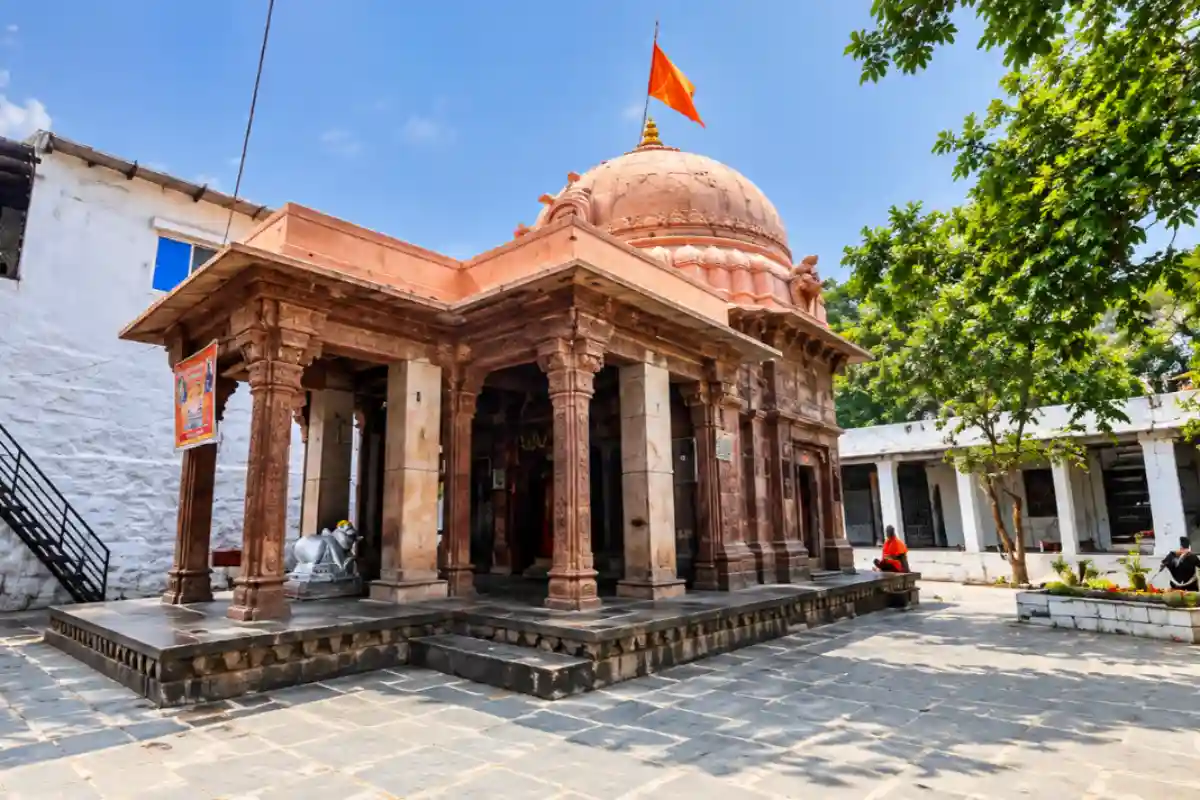
What is Agastyeshwar Mahadev in Ujjain?
Agastyeshwar Mahadev is the first of Ujjain's 84 Mahadev lingas. Its story appears in the Skanda Purana, Avantya Khanda, in the first chapter of the Chaturashiti Linga Mahatmya. Sage Agastya is said to have done penance here to be freed from brahmahatya, and Shiva gave the linga his name.
The name joins two words, Agastya and Ishwara, meaning "the lord worshipped by Agastya." You will also see it written Agasteshwar, but the name Shiva gives in the Purana is Agastyeshwar.
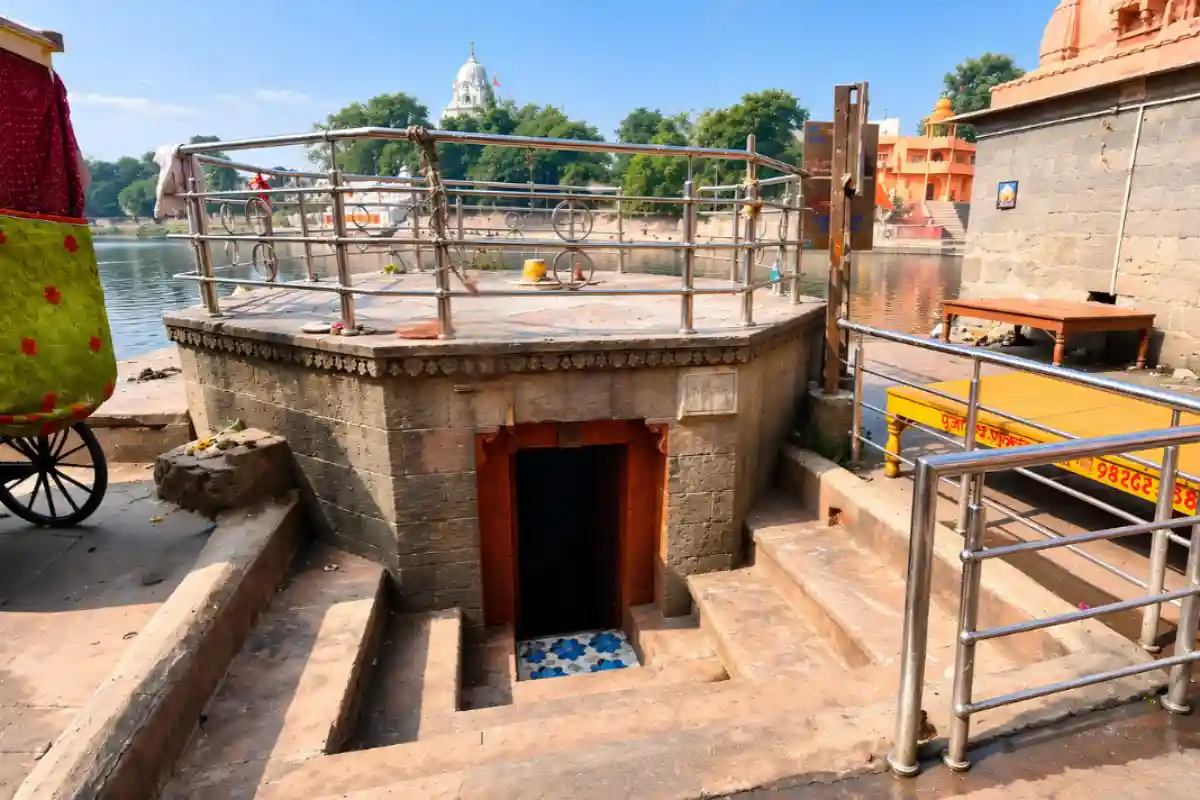
Local tradition identifies it with the shrine behind the Harsiddhi temple, inside the Santoshi Mata temple compound.
At a glance
- Agastya's sin came from killing demons, which he saw as a breach of non-violence.
- Brahma came to Agastya himself to tell him the remedy.
- After the penance, Shiva declared Agastya sinless and named the linga.
- The Purana sets three specific days for worshipping this linga.
Agastyeshwar Mahadev: quick facts
| Topic | Detail |
|---|---|
| Meaning of the name | Lord (Shiva) of Agastya |
| Deity | Shiva, in linga form |
| Source text | Skanda Purana, Avantya Khanda, Chaturashiti Linga Mahatmya, Chapter 1 |
| Position among the 84 Mahadevs | First |
| Sage in the story | Agastya (Maitravaruni) |
| Sacred zone in the text | Mahakalavana |
Many retellings assume Agastya set up the linga himself. In the Skanda Purana, Brahma directs him to a linga that already stands in Mahakalavana. Agastya worshipped it, and the linga took his name only after that worship.
What is the story of Agastyeshwar Mahadev in the Skanda Purana?
In the Skanda Purana, Shiva tells the story of Agastyeshwar Mahadev to Parvati. She asks how the first linga of Mahakalavana came to be called Agastyeshwar, and this is his answer.
The gods lose, and Agastya loses his temper
The asuras defeated the gods in battle. The gods lost their share of the sacrifices, the ancestors were left without offerings, and the gods, stripped of their splendour, wandered the earth.
On the way they met Agastya, who shone like the sun. They told him plainly that the danavas had thrown them out of heaven and begged him to protect them.
Agastya flared up like the fire that ends the world. His rays burned thousands of danavas, who fell from the sky, and the surviving daityas fled in terror to Patala, the underworld.
Regret after the victory
Agastya does not celebrate. He sinks into grief.
In the Purana he says he has committed a terrible sin by killing the danavas, because Manu declared non-violence the highest dharma. He asks himself what he should do, where he should go and how he can be purified.
Brahma, grandfather of the worlds, arrives at this point and asks why he is grieving. Agastya tells him that killing the danavas has brought brahmahatya on him and that the power of his long penance is gone.
Brahma's remedy
Brahma answers with a place. In divine Mahakalavana, visited by yakshas and gandharvas, there is an excellent linga to the north of Vatayakshini, in the southern part of Pishacha Tirtha.
Worshipping that linga, Brahma says, will wipe out every sin. Agastya goes to Mahakalavana and begins his penance.
Shiva's blessing and the naming
Shiva is pleased with the penance. He tells Agastya that through the power of this linga he is now free of sin, and the brahmahatya born of killing the danavas is destroyed.
Asked to choose a boon, Agastya wants two things: unwavering devotion at Shiva's feet, and no obstacles in his penance and religious duties.
Shiva adds that this linga, worshipped by Agastya and destroyer of the sin of brahmahatya, will be known across the three worlds as "Agastyeshwar Deva." Agastya then settles there, adorned with the five mudras.
Who is Agastya in this story?
Agastya's name goes back to the Rigveda. Hymns 1.165 to 1.191 of the first mandala are attributed to Agastya Maitravaruni, and hymn 1.179 is a dialogue between Agastya and his wife Lopamudra.
In the Mahabharata's Vana Parva (chapters 96 to 99), the same Agastya digests Vatapi, younger brother of the daitya Ilvala. Clashes with demons run through his stories, but in Ujjain's version that clash is what makes him guilty.
What does the Skanda Purana promise for worshipping Agastyeshwar Mahadev?
The phalashruti (the closing section on merit) of the Skanda Purana lists these results of seeing, remembering and worshipping Agastyeshwar Mahadev:
- A devotee who sees the linga with devotion is freed from all sins and gets what he wishes for.
- He is blessed with sons and prosperity.
- At death he travels to Shiva in a celestial chariot, and gandharvas sing his praise in Rudraloka.
- Merely remembering the linga destroys the sins of crores of births.
- The merit of seeing it is said to exceed that of a hundred Rajasuya sacrifices.
- Whoever worships it on a Monday, or on Ashtami or Chaturdashi, as far as his means allow, uplifts a hundred generations on both his mother's and father's side.
Why doesn't the Purana give a method of worship?
The chapter names Monday, Ashtami and Chaturdashi but gives no procedure. It simply says "yathashakti," as far as your means allow, so the offerings and method are left to the devotee.
Offering bel leaves in the month of Shravan comes from local Shaiva practice, common in Shiva worship generally. It is not part of this chapter.
Shiva's words on pilgrimage and charity
In the phalashruti, Shiva weighs holy baths and charity against his own grace (Skanda Purana 5.2.1.56):
किं तीर्थैर्विविधैः स्नानैः किं दानैर्विविधैः कृतैः ।
ते प्राप्स्यंति फलं सर्वे मत्प्रसादान्न संशयः ॥
Meaning: What use are many pilgrimages and baths, what use are many gifts? They will all gain the reward through my grace, without doubt.
Which popular claims about Agastyeshwar Mahadev don't match the text?
The story of Agastyeshwar Mahadev is often retold with changes. These are the claims that do not match the Skanda Purana.
| Popular claim | What the Skanda Purana says | Status |
|---|---|---|
| Agastya's anger burned the gods | The danavas burned; the gods had come to him for protection | Contradicts the text |
| Sages and other beings fled to Patala | The daityas fled to Patala | Contradicts the text |
| Agastya went to Brahma for a remedy | Brahma came to Agastya | Contradicts the text |
| Vatayakshini lies in the northern part of Mahakalavana | The linga lies north of Vatayakshini; no direction is given for Vatayakshini within the forest | Contradicts the text |
| Shiva emerged from the linga | Shiva only says he is pleased; there is no scene of him appearing | Not in the text |
| Special worship on Fridays | The worship days are Monday, Ashtami and Chaturdashi | Not in the text |
| Offering water removes mental conflict | The phalashruti lists no such result | Not in the text |
| Self-purification here is mandatory before the 84 Mahadev circuit | The Purana lists the lingas in order but lays down no such rule | Not in the text |
The Kashi Khanda of the Skanda Purana has a separate set of Agastya stories, including the Vindhya mountain growing tall and Agastya leaving Kashi. Separately, Chapter 64 of the Reva Khanda describes a different Agastyeshwar tirtha on the Narmada. Ujjain's brahmahatya story belongs to neither.
What else do people ask about Agastyeshwar Mahadev?
Why did killing demons count as brahmahatya for Agastya?
The Agastyeshwar Mahadev story does not explain this itself; it only has Agastya cite Manu's teaching on non-violence. One reading is that the Puranas treat the danavas as descendants of the sage Kashyapa, so killing them counted as brahmahatya. Indra carries a similar sin after killing Vritra.
The weight of that charge shows in the Manusmriti (11.54), which lists brahmahatya first among the great sins.
What are Vatayakshini and Pishacha Tirtha?
Vatayakshini and Pishacha Tirtha are two landmarks in Mahakalavana that Brahma uses to locate the Agastyeshwar Mahadev linga. The Purana says nothing more about them. Reading Vatayakshini as a goddess guarding a banyan tree is a later interpretation; the text uses the name only to give a direction.
Is today's temple the same spot the Purana describes?
The identity of today's Agastyeshwar Mahadev temple rests on local tradition. The Purana places the linga only in relation to Vatayakshini and Pishacha Tirtha. Treating the shrine behind Harsiddhi as the Puranic site is therefore a matter of faith and tradition.
Does seeing the linga without devotion bring any merit?
According to the last verse of the Skanda Purana's phalashruti, a person who sees Agastyeshwar Mahadev casually, without enthusiasm, still does not see hell. The Purana keeps two levels here: devoted darshan leads to Rudraloka, and chance darshan at least saves you from hell.
Why is Agastyeshwar first in Ujjain's 84 Mahadev tradition?
In the first chapter of the Chaturashiti Linga Mahatmya, Shiva counts what lies in Avanti's sacred zone, one yojana across: 84 lingas, 8 Bhairavas, 11 Rudras, 12 Adityas, 6 Vinayakas and 24 Matrikas. Agastyeshwar is the first name on that list.
The same chapter ranks Mahakalavana above the Ganga, the Yamuna and other tirthas. The Purana says this zone destroys even brahmahatya and survives the dissolution of the world. Agastya's story is the first example of that claim.
In local tradition, the 84 Mahadev circuit starts at Agastyeshwar and is completed by returning here at the end. The Purana gives no rule for the circuit; tradition took over its order of lingas.
Which linga comes after Agastyeshwar in the 84 Mahadevs?
This chapter of the Skanda Purana closes by saying that the first of the eighty-four lingas has been described. The next chapter is Guheshwar's, followed by Dhundheshwar, Damarukeshwar and Anadikalpeshwar, and the count ends at the 84th linga, Uttareshwar.
How Guheshwar got its name is told in that next chapter.
Comments
No comments yet. Be the first to share your thoughts!
Leave a Comment