Key highlights
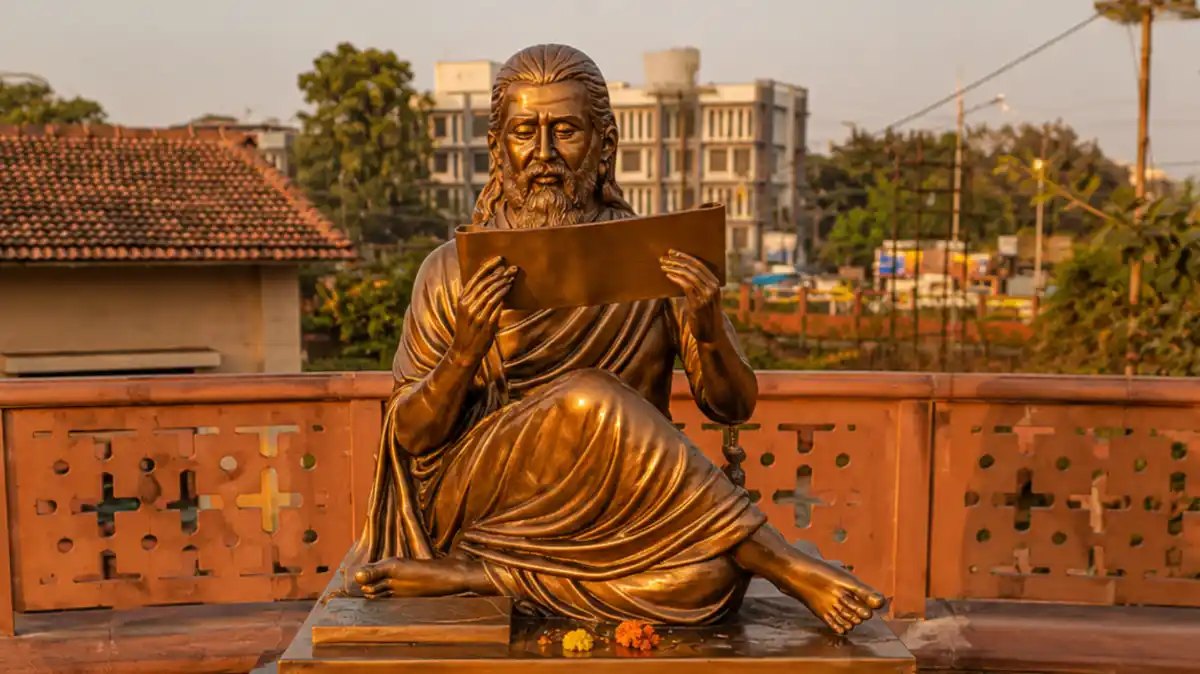
- "Vararuchi" is a shared name, at least three distinct scholars across different centuries. Treating him as one person is a medieval conflation, not ancient tradition.
- Katyayana (c. 250 BCE) wrote the Varttikas on Panini's Ashtadhyayi, about 4,000 critical notes on 1,245 of Panini's sutras. Patanjali quoted and debated them in the Mahabhashya but never called their author "Vararuchi."
- A later Vararuchi (c. 3rd-4th century CE) wrote the Prakrit Prakasha, the oldest surviving grammar of the Prakrit languages, covering four dialects across twelve chapters.
- The Navaratna verse comes from the Jyotirvidabharana (22.10), dated to the 12th century or later. D. C. Sircar called it "absolutely worthless for historical purposes."
- The Kathasaritsagara places Vararuchi at Pataliputra under King Nanda, not at Ujjain under Vikramaditya.
- Best Ujjain sites: Vikram Tila memorial (all nine Navaratnas sculpted, 2016) and Scindia Oriental Research Institute at Vikram Kirti Mandir (~18,000 manuscripts).
Who was Vararuchi? One name, several scholars
Sanskrit intellectual culture often attached prestigious names to later scholars in the same lineage. "Vararuchi" is one of the clearest examples. K. V. Abhyankar's Dictionary of Sanskrit Grammar, the standard authority, distinguishes at least three independent figures:
The Navaratna verse (Jyotirvidabharana 22.10) names nine scholars for Vikramaditya's court. V. V. Mirashi dates the text to the 12th century or later and shows it contains grammatical faults incompatible with Kalidasa's authorship; D. C. Sircar called it "absolutely worthless for historical purposes." Katyayana lived in the 3rd century BCE, Varahamihira in the 6th century CE, and the legendary Vikramaditya in the 1st century BCE, no single court could have held all nine. Vararuchi has no independent scholarly argument placing him in any Vikramaditya era. His Navaratna membership reflects cultural prestige, not documented history.
The Panini-Katyayana-Patanjali triad: what it means
To understand what Katyayana-Vararuchi actually did, you need to understand what Panini left unfinished, and what Patanjali added on top.
Panini's Ashtadhyayi, composed around the 4th century BCE, is among the most sophisticated grammatical works in any language. Its roughly 4,000 sutras describe the rules of classical Sanskrit with a precision that modern linguists still study. But Panini's sutras are compressed to the point of opacity, each one is as short as possible, and the system requires constant interpretation.
Katyayana's Varttikas are the first major layer of interpretation. A varttika is a critical supplement, it either confirms a Paninian rule, qualifies it, or proposes a correction. Katyayana wrote approximately 4,000 of them, covering about 1,245 of Panini's sutras. His tone is analytical and sometimes adversarial: he's not simply praising Panini, he's pushing back on rules he finds incomplete or ambiguous.
Patanjali's Mahabhashya, written roughly a century after Katyayana, is the third layer, and the one that preserved the first two. The Mahabhashya is a running commentary on both Panini's sutras and Katyayana's varttikas, often quoted in dialogue form. It's through this text that we know Katyayana's varttikas at all: no independent manuscript of the Varttikas survives. Patanjali repeatedly names his source as "Katyayana", not "Vararuchi." The later identification of the two names is a medieval convenience, not a contemporary fact.
This triad, Panini, Katyayana, Patanjali, is the foundation of the Sanskrit grammatical tradition. Classical Sanskrit education was built on these three texts in sequence, and the tradition of paniniya grammar that runs through Indian education to this day traces directly back to this chain.
What Vararuchi wrote: the texts that actually exist
| Text | Attributed to | What it covers | Status |
|---|---|---|---|
| Varttikas on Panini | Katyayana (c. 250 BCE) | Critical notes on ~1,245 of Panini's 4,000 sutras; ~4,000 varttikas total | Survive only through Patanjali's Mahabhashya; no independent manuscript exists |
| Prakrit Prakasha | Later Vararuchi (c. 3rd-4th c. CE) | 12 chapters on 4 Prakrit dialects; oldest surviving Prakrit grammar | Cowell's 1854 edition on Internet Archive; still foundational for Prakrit linguistics |
| Ubhayabhisarika | Vararuchi as playwright | Satirical bhana (dramatic monologue) set in Pataliputra | Preserved in the Chaturbhani; published in Clay Sanskrit Library series |
| Chandravakyas | Kerala's Vararuchi | Lunar position tables for the Kerala astronomical tradition | Still used in traditional Kerala panchang calculations |
Sources: K. V. Abhyankar, Dictionary of Sanskrit Grammar (via Wisdomlib); R. Pischel, A Grammar of the Prakrit Languages; E. B. Cowell, Prakrita-prakasa (1854, Internet Archive); D. Pingree, Census of the Exact Sciences in Sanskrit, August 2026.
The Prakrit Prakasha: why it matters
The Prakrit Prakasha deserves more than a line in a table. It's the oldest surviving systematic grammar of the Prakrit languages, the spoken vernaculars of ancient India from which modern languages like Hindi, Marathi, Bengali and Gujarati ultimately descend.
Classical Sanskrit was a prestige language, fixed by Panini's grammar and used for sacred and literary texts. Prakrit languages were what people actually spoke, and what dramatists wrote dialogue in, what inscriptions were carved in, what Buddhist and Jain canonical texts were composed in. Ashoka's edicts are in Prakrit. The Jain Agamas are in Ardhamagadhi. Classical Sanskrit plays by Kalidasa himself give their female characters and lower-status males lines in Prakrit rather than Sanskrit, the language marked social register.
The Prakrit Prakasha describes four major dialects:
Note what's absent: Apabhramsha, the transitional stage between Prakrit and the modern Indo-Aryan languages, is not covered in the Prakrit Prakasha. Some accounts list five dialects for Vararuchi's grammar, that's an error. The text covers four.
The Ubhayabhisarika: Vararuchi as playwright
The Chaturbhani is a collection of four Sanskrit one-act plays called bhanas, dramatic monologues in which a single actor plays a character who speaks to imaginary interlocutors. The genre is comic and often satirical, set in urban environments and populated by courtesans, gamblers, rogues and their middlemen.
One of the four bhanas is the Ubhayabhisarika, attributed to a Vararuchi. It's set in Pataliputra. The central character is a vita, a sophisticated man-about-town, something like a wit and social fixer, navigating an encounter between two women both trying to reach the same lover on the same night without the other knowing. The tone is light, the language elegant, the social world recognisably urban and Gupta-era.
The Clay Sanskrit Library published an English translation of the Chaturbhani. Whether this playwright Vararuchi is the same as Katyayana the grammarian or the Prakrit Prakasha author is not established, the name was common enough that coincidence of authorship is entirely possible.
What does the Kathasaritsagara say about Vararuchi?
The most vivid single account of Vararuchi appears in Somadeva's Kathasaritsagara (c. 1063-1081 CE). He's described as also called Katyayana and as a mortal incarnation of Pushpadanta, a divine attendant of Shiva cursed by Parvati. In the text, Vararuchi is a minister to King Nanda at Pataliputra, placed in Pataliputra, outside Ujjain, in a different era entirely. The setting is consistent with Katyayana's 3rd-century-BCE dating but contradicts the Navaratna legend entirely. The Kathasaritsagara is an 11th-century story collection, not a historical chronicle; its Vararuchi is a legendary figure, not a court record.
The Kerala Parayi petta panthirukulam tradition gives Vararuchi twelve children, not eighteen. Eighteen refers to dishes at a meal in the story, not children. Documented in Kottarathil Sankunni's Aithihyamala (1909-1934) and Edgar Thurston's Castes and Tribes of Southern India (1909), the tradition's moral is that worth comes from upbringing, not birth.
The Vararuchi tradition in Indian literary culture
Across these texts, Kathasaritsagara, Kerala tradition, Navaratna verse, "Vararuchi" functions less as a biography and more as a symbol. He represents the possibility of genius that crosses social boundaries: the grammarian who critiques even Panini, the king's minister who is also a wandering spirit, the Brahmin scholar whose children are raised across twelve castes and found worthy in each.
That symbolic function explains why the name got attached to figures across different centuries and regions. A scholar who produced work of Katyayana's stature, a playwright who wrote with the wit of the Ubhayabhisarika author, a Kerala astronomer who mapped the moon's path, each of them attracted the prestigious name "Vararuchi" as a badge of exceptional learning. The medieval conflation of all three into one Navaratna courtier is the culmination of that process.
Understanding this doesn't diminish the tradition. It explains why Ujjain, as the city of ideal kingship and Sanskrit scholarship, is exactly where such a figure would be imagined to have served.
Who should explore this tradition
This thread works well for
- Students of Sanskrit linguistics and grammar, the Panini-Katyayana-Patanjali triad is one of the great intellectual chains in world philology. Knowing Katyayana's role makes the Mahabhashya legible rather than mysterious.
- Readers interested in Prakrit literature, the Prakrit Prakasha is the entry point to understanding why classical Sanskrit plays give different characters different languages, and how Maharashtri poetry differs from Magadhi prose.
- Visitors who want the scholarly layer of Ujjain, the Scindia Oriental Research Institute at Vikram Kirti Mandir is one of the most significant manuscript repositories in central India. Knowing the tradition you're walking into makes the visit more than a building tour.
- Anyone drawn to the Navaratna articles on this site, Vararuchi's story of a name shared across centuries is the clearest example of how the nine-gems tradition works: cultural prestige gathering around greatness, not a staff list from one court.
Plan differently if you are
- Looking for a single verified biography, there isn't one. Three different scholars share the name, and the medieval tradition that merged them into one Navaratna courtier is not ancient. That's the honest position.
- Expecting a Vararuchi temple or monument, there's no ancient site dedicated to him. The Vikram Tila memorial (2016) shows him among the nine Navaratnas, but it's modern commemorative art, not an ancient monument.
What you can see in Ujjain connected to Vararuchi's tradition
Vararuchi has no dedicated temple or ancient monument in Ujjain. His only tie to the city is the Navaratna legend, and the Kathasaritsagara actually places him at Pataliputra, not Ujjain. But two sites give his scholarly tradition physical form:
Vikram Tila (Vikramaditya Singhasan Battisi): On an island in Rudrasagar lake behind MahakaleshwarExplore the divine Mahakaleshwar Jyotirlinga in Ujjain.. The 2016 brass memorial depicts Vikramaditya enthroned with all nine Navaratnas sculpted around him, Vararuchi included. Free entry; 15-20 minutes. Modern commemorative art, not ancient monument, but the one spot in Ujjain where the complete nine-gems tradition is physically present.
Vikram Kirti Mandir / Scindia Oriental Research Institute (SORI): Roughly 4 km from Mahakaleshwar. Holds approximately 18,000 manuscripts in Sanskrit, Prakrit, Arabic, Persian and other languages, including palm-leaf and birch-bark texts. The most significant repository of the classical literary culture that produced the Vararuchi tradition. An adjacent museum covers the city's archaeological history. Allow 1 hour; open morning to evening, closed Mondays.
Comments
No comments yet. Be the first to share your thoughts!
Leave a Comment