

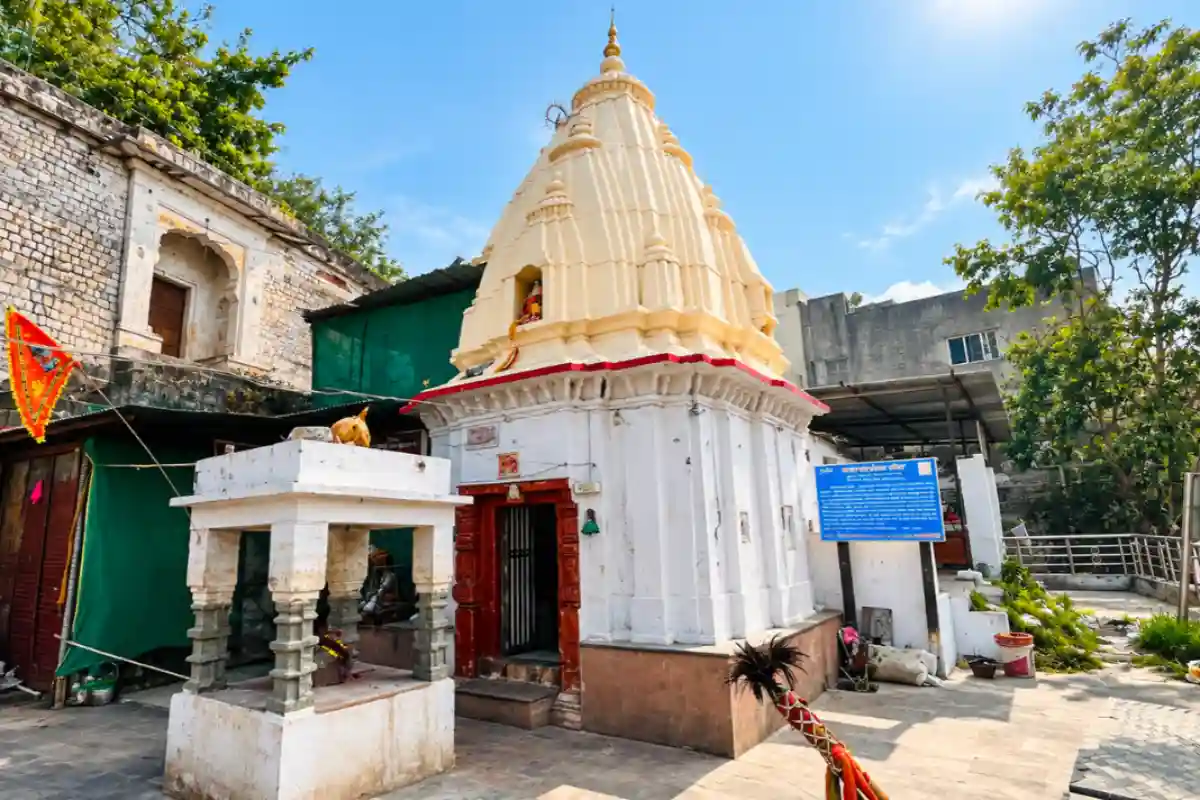
What is Dhundheshwar Mahadev in Ujjain?
Dhundheshwar Mahadev is the third of Ujjain's 84 Mahadev lingas. Its story is told in the Skanda Purana, Avantya Khanda, in the third chapter of the Chaturashiti Linga Mahatmya. The Purana says Shiva's gana Dhundha gained siddhi by worshipping this linga in Mahakalavana, and the linga was named after him at his own request.
The most accurate spelling in Roman letters is Dhundheshwar. In Hindi you will see ढुंढेश्वर, ढूंढेश्वर and ढूण्ढेश्वर, but the Sanskrit form is ढुण्ढेश्वर, with a retroflex "ḍha."
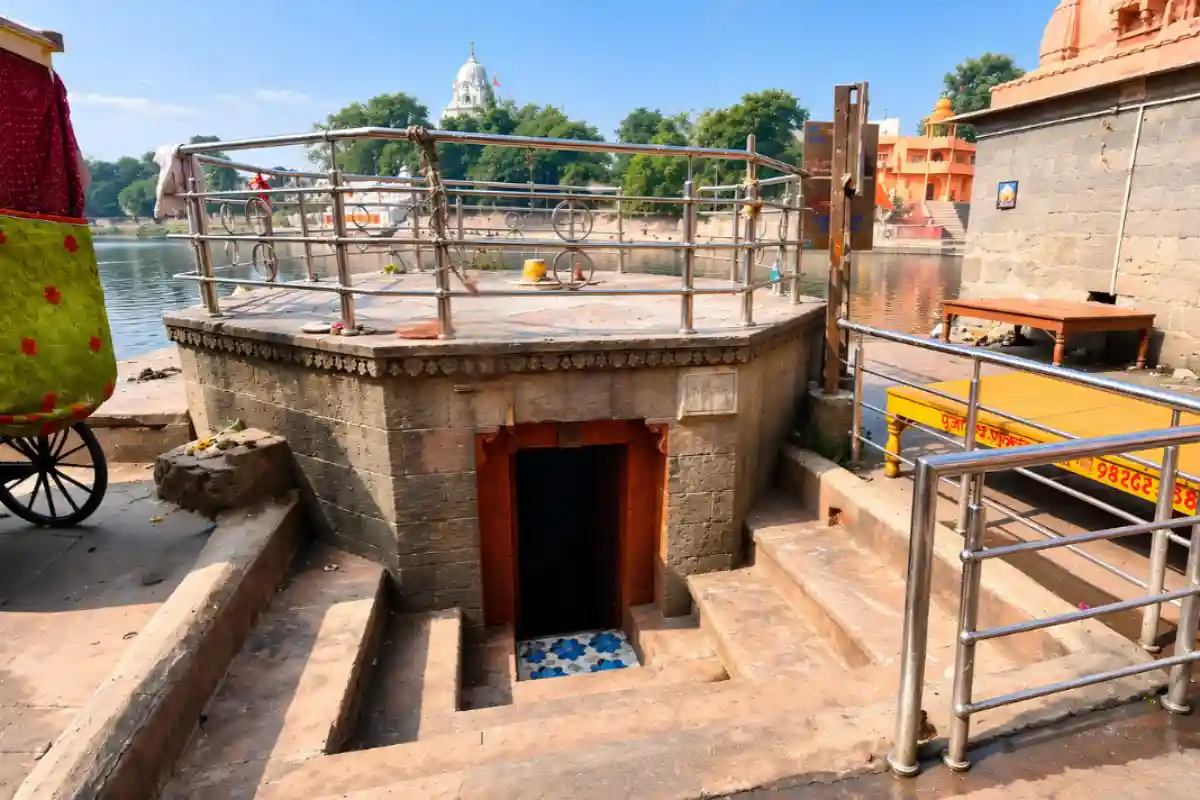
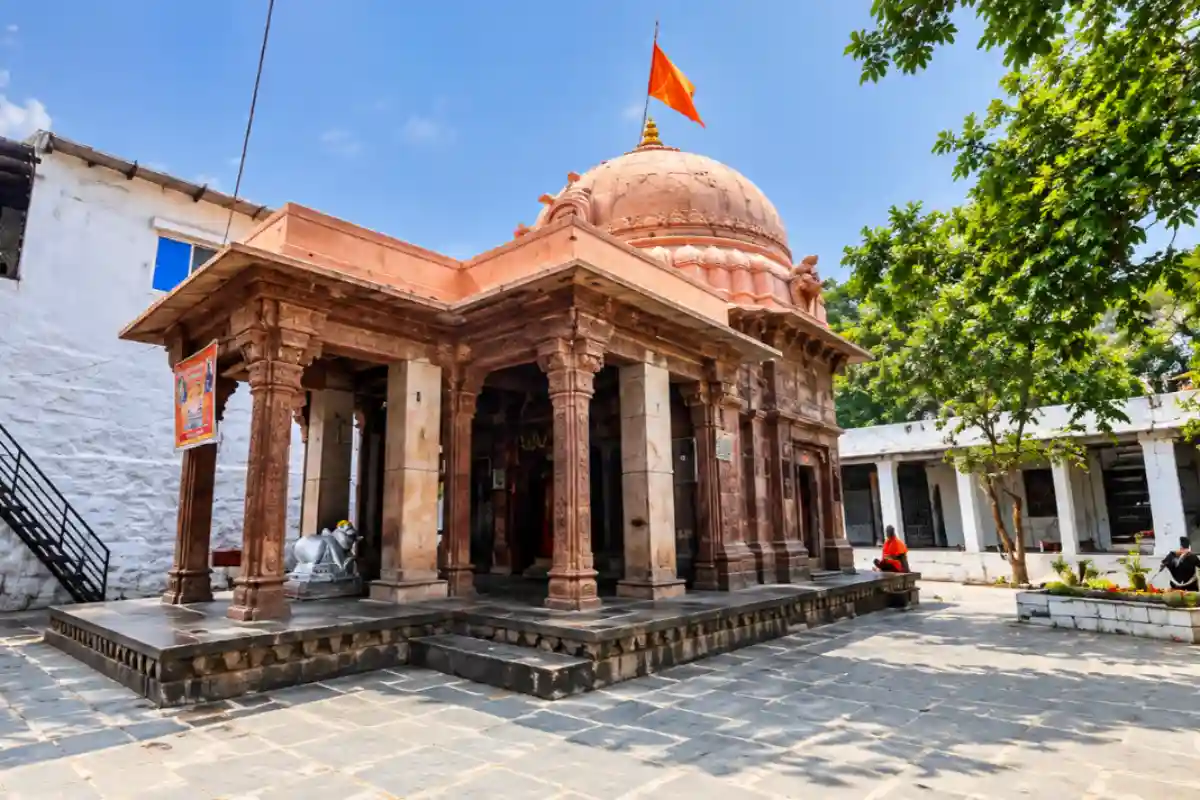
Local accounts place the shrine at Ramghat on the bank of the Shipra, opposite the Datta Akhara.
At a glance
- Dhundha was the leader of Shiva's ganas in Kailasa, but lustful and ruled by his senses.
- For throwing flowers at Rambha mid-dance, Indra cursed him to fall into the mortal world.
- After a long, fruitless pilgrimage, a voice from the sky sent him to Mahakalavana.
- The linga granted his wishes, and Dhundha returned to Shiva's world as a gana leader.
Dhundheshwar Mahadev: quick facts
| Topic | Detail |
|---|---|
| Basis of the name | Named after the gana Dhundha |
| Deity | Shiva, in linga form |
| Source text | Skanda Purana 5.2.3 (Avantya Khanda, Chaturashiti Linga Mahatmya, Chapter 3) |
| Position among the 84 Mahadevs | Third |
| Characters | Dhundha (gana leader), Rambha, Indra |
| Sacred zone in the text | Mahakalavana, near Pishacheshwar |
| Narrator | Shiva, telling the story to Parvati |
Shiva named Agastyeshwar, and the gods announced the name Guheshwar from the sky. Dhundheshwar is different. After receiving his boon, Dhundha himself says, "Let this linga be renowned after my name," and the linga answers, "Let it be so."
What is the story of Dhundheshwar Mahadev in the Skanda Purana?
In the Skanda Purana, Shiva tells the story of Dhundheshwar Mahadev to Parvati. In the opening verses he calls it the third linga, one that gives happiness and heavenly pleasures and destroys all the sins of men. Then he explains how it got its name.
The leader of the ganas
Dhundha was the leader of Shiva's attendants in Kailasa. The Purana describes him as lustful, with bad conduct and senses overwhelmed by vice.
Rambha's dance in Indra's court
One day he wandered, on a whim, into Indra's world. Rambha was dancing there, and her glances, hand gestures and dance postures, including the one called suchividdha, kept perfect time with the beat. Indra and the other gods were watching her expressions closely.
Dhundha was fascinated too. As fate would have it, desire overcame him, and he hit Rambha, who was absorbed in her performance on the stage, with a bunch of flowers.
Indra's curse
Indra saw this improper act and cursed him: you have disturbed the dance, so fall into the mortal world.
Dhundha landed in a wilderness on earth. He lost consciousness, his enthusiasm withered and his senses raged. He lamented again and again (Skanda Purana 5.2.3.9):
पतितो मानुषे लोके विसंज्ञो विह्वलेन्द्रियः ।
कादिग्भूतो हतोत्साहो विललाप पुनःपुनः ॥
Meaning: He fell into the mortal world, senseless, with agitated senses, directionless and dispirited, and wept again and again.
Regret, and a long pilgrimage
When he recovered a little, Dhundha admitted that this was the fruit of his own injustice, done in delusion. He resolved to follow the path of right conduct and gain siddhi.
He did penance on Mahendra, Shrishaila, Malaya, Vindhya and Pariyatra. Then he went to the banks of the Ganga, Yamuna, Chandrabhaga, Vitasta, Narmada, Godavari, Bhimarathi, Kaushiki and Sharada. Siddhi did not come.
Despair on the banks of the Charmanvati
At last he reached the Charmanvati (today's Chambal), bathed there, and gave up all rites. Pilgrimage is futile, he said, penance is useless, and after all my wandering my wish is still unfulfilled.
The voice from the sky
At that moment a bodiless voice comforted him: go to Mahakalavana. Mahakala always grants siddhi, and he is greater than Prayaga and the other tirthas of the earth (Skanda Purana 5.2.3.17):
प्रयागाद्यानि तीर्थानि पृथिव्यां यानि संति वै ।
सदा सिद्धिकरं तेषां महाकालं विशिष्यते ॥
The voice went on: there is a highly meritorious linga there that fulfils every wish, so hurry to worship it near Pishacheshwar. By its favour you will return to Shankara's world, open to the radiant and always closed to sinners.
A voice from inside the linga
Dhundha went gladly to Mahakalavana, saw that linga, and worshipped the Lord of the gods with great devotion. Then a voice came from the centre of the linga: I am pleased, dear one. What do you want?
Dhundha's two requests
Dhundha first asked for himself: may my devotion to your lotus feet stay unshaken. His second request was for everyone: may all who visit this linga be freed of their sins at once.
The linga replied that those who worship it with deep faith will always be free of sin, will see their wishes fulfilled, will become excellent ganas, and will be honoured in every world.
The naming, and Dhundha's restoration
With the boon granted, Dhundha made one more request: let this linga be renowned across the universe by my name. The pleased linga said, "Let it be so," and from that day the deity was known as Dhundheshwar (Skanda Purana 5.2.3.29):
एवमस्त्विति लिंगेन प्रोक्तं तुष्टेन पार्वति ।
तदाप्रभृति विख्यातो देवो ढुंढेश्वरः परः ॥
Meaning: "Let it be so," said the pleased linga. O Parvati, from then on this supreme deity became famous as Dhundheshwar.
Shiva ends the story by saying that, through the greatness of the linga, Dhundha was made leader of the ganas again and went to Shiva's world, where he shone among the other gana leaders.
What does the Skanda Purana promise for seeing Dhundheshwar Mahadev?
The phalashruti (the closing section on merit) of the Dhundheshwar chapter lists these results:
- Merely seeing the linga brings siddhi, always.
- Devotees who worship Mahadev Dhundheshwar lose all sins, from birth onwards, at once.
- A man who visits it with devotion is the most meritorious in the world and dear to Shiva.
- The merit of seeing it is said to exceed that of a hundred Rajasuya sacrifices.
- Sins of mind, body or speech, secret or open, deliberate or accidental, vanish quickly by visiting it.
- One who hears or recites this story is honoured in Shiva's world.
This chapter names no lunar day, month or weekday. The Monday, Ashtami and Chaturdashi rule appears in the Agastyeshwar and Guheshwar chapters, not here.
What are the temple and its local beliefs like?
Local accounts say the shrine's entrance faces north and carries an image of Ganesha above it. The sanctum holds a serpent-wrapped linga about a foot tall with a brass jaladhari. Images of Ganesha and Parvati stand there too, and Nandi is installed facing the linga.
According to the temple priest's tradition, darshan and worship free a person from sins and bring back lost reputation. There is also a belief that worship done with a wish for a lost object helps recover it.
In the temple's tradition, a devotee who bathes in the Shipra through the whole month of Kartik but skips Dhundheshwar's darshan does not get the full merit of the Kartik bath. Lighting lamps here on Kartik Purnima is considered especially meaningful.
Some explain the name by linking "dhundh" with "dhundhna," to search, and so with finding lost things. That is a popular interpretation. In the Purana the name comes from the gana Dhundha.
Which popular claims about Dhundheshwar Mahadev don't match the Purana?
Several claims have attached themselves to the Dhundheshwar story that the Skanda Purana text does not support. These are the main ones.
| Popular claim | What the Skanda Purana says | Status |
|---|---|---|
| Dhundha taunted or scolded Rambha | He threw a bunch of flowers at her; no taunt is mentioned | Differs from the text |
| Shiva appeared in person and granted the boon | The voice came from the centre of the linga | Differs from the text |
| The name comes from "searching" (dhundhna) | The name comes from the gana Dhundha, at his own request | Popular interpretation |
| Special merit on Mondays, Pradosh or Mahashivratri | The chapter names no lunar day or weekday | Not in the text |
| The Ashtami and Chaturdashi rule applies here too | That rule is in the Agastyeshwar and Guheshwar chapters | Not in the text |
| The Kartik bath is incomplete without darshan here | The chapter does not mention Kartik | Local tradition |
| Seeing these three lingas removes planet and star defects | The chapter mentions no planets or stars | Local tradition |
| Darshan leads straight to Shivaloka | Worshippers will become excellent ganas, and one who hears the story is honoured in Shiva's world; there is no direct promise of Shivaloka for darshan | Partly supported |
| The name is "Dhundheshwar" with a plain "dha" (धुंधेश्वर) | The Sanskrit form is ढुण्ढेश्वर, with a retroflex "ḍha" | Spelling error |
| The nearby linga called "Pishachmukteshwar" is the Purana's name | The Purana calls that linga Pishacheshwar | Name difference |
| The temple is hundreds or thousands of years old | The text gives no date for any temple building | Unproven |
On the Charmanvati, Dhundha says tirthas are futile. The Purana shows this as a moment of despair, and the very next lines send him to Mahakalavana, with a voice declaring Mahakala greater than Prayaga and the other tirthas. The story wants to say that Mahakalavana ranks above the rest.
What else do people ask about Dhundheshwar Mahadev?
Where did Dhundha fall after the curse?
In the Dhundheshwar Mahadev story, Indra's curse drops Dhundha into the mortal world, in a wilderness. The Purana names no city. From there he wandered over mountains and riverbanks until he finally reached the Charmanvati.
How are Dhundheshwar and Pishacheshwar related?
Dhundheshwar and Pishacheshwar are two neighbouring lingas in Mahakalavana. The voice from the sky tells Dhundha to worship the linga near Pishacheshwar. The chapter on Pishacheshwar (68th of the 84) places it south of Dhundheshwar, and Guheshwar is placed north of the same Pishacheshwar.
Local accounts call this neighbouring linga Pishachmukteshwar. The Purana's name is Pishacheshwar.
Is there a special day to visit Dhundheshwar Mahadev?
The Skanda Purana's Dhundheshwar chapter names no special lunar day or weekday. The merit is tied to darshan and worship themselves. The temple's local tradition stresses the month of Kartik and Kartik Purnima, which is tradition, not a rule laid down in the Purana.
What are the darshan timings at Dhundheshwar Mahadev?
No confirmed official darshan timing is available for Dhundheshwar Mahadev. Timings at small shrines change with the priest's convenience and the season, so ask a local priest near Ramghat before you go.
Where does Dhundheshwar stand in Ujjain's 84 Mahadev tradition?
In the order of the Chaturashiti Linga Mahatmya, Agastyeshwar is first, Guheshwar second and Dhundheshwar third. Damarukeshwar is fourth and Anadikalpeshwar fifth. The tirtha index in Chapter 70 of the Avantikshetra Mahatmya gives the same order.
In local tradition the 84 Mahadev circuit is done in Shravan, and Dhundheshwar is the third stop on it. For the full list, see the complete guide to Ujjain's 84 Mahadev temples.
Which linga comes after Dhundheshwar in the 84 Mahadevs?
The Dhundheshwar chapter ends by saying that the power that destroys sins has been told. The next chapter is Damarukeshwar's, the fourth linga.
How Damarukeshwar got its name is told in that next chapter.
Comments
No comments yet. Be the first to share your thoughts!
Leave a Comment