Key highlights
- Dhanvantari is worshipped as the divine source and patron of Ayurveda and is listed as an avatar of Lord Vishnu in the Bhagavata Purana's 22-avatar enumeration, though not in the standard ten-avatar Dashavatara.
- He emerged from the Samudra ManthanThe epic mythological churning of the ocean that led to Kumbh Mela. (the churning of the cosmic ocean) carrying the kalash of amrit. The tradition that drops of that nectar fell at four sites, including Ujjain, is the most widely told origin story of the Kumbh, though scholars note this specific story is not found in the Puranas themselves.
- Dhanvantari appears in the traditional Navaratna (nine gems) list associated with King Vikramaditya's court at Ujjain. That list comes from the Jyotirvidabharana, a text scholars regard as a later composition, not a verified court register.
- The traditional religious observance of Dhanvantari Jayanti falls on Dhanteras, two days before Diwali. Since 2025, the Government of India also observes National Ayurveda Day on a fixed date of 23 September every year.
- AYUSH health camps operated at Maha Kumbh 2025 in Prayagraj, treating over 9 lakh pilgrims. MP Chief Minister Dr. Mohan Yadav has called for an Ayurveda festival during Simhastha 2028.
- Simhastha 2028 runs from 27 March to 27 May 2028, with Amrit Snan on 9 April, 23 April and 8 May. Dates are subject to final government notification.
Who is Dhanvantari?
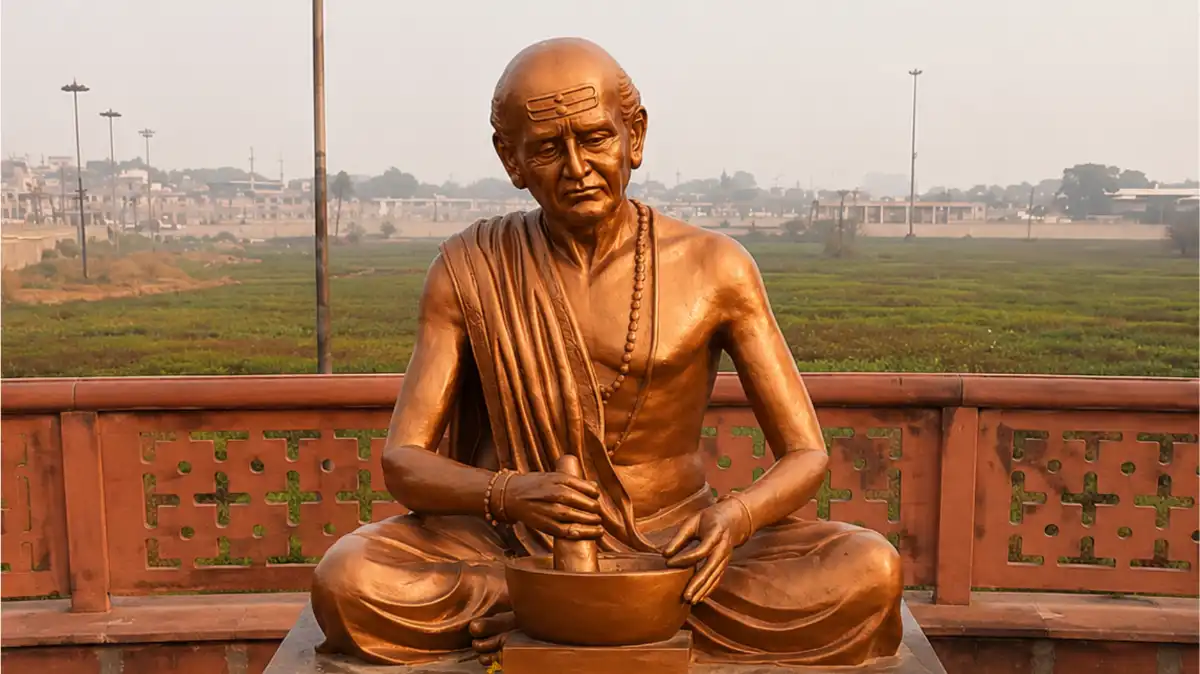
Dhanvantari is the physician of the gods in Hindu tradition. Encyclopaedia Britannica describes him as a figure who, according to legend, rose out of the churned ocean bearing a cup filled with the elixir of immortality. The Bhagavata Purana gives a physical description: a strong, dark-complexioned youth carrying a jug of nectar. Ayurveda, India's classical system of medicine, is attributed to him as its divine originator.
Two clarifications that most articles skip. First, Dhanvantari is counted among the avatars of Vishnu in the Bhagavata Purana's expanded list (Canto 1, Chapter 3), which names 22 avatars with Dhanvantari as the twelfth. He is not, however, part of the standard Dashavatara (ten avatars: Matsya, Kurma, Varaha, Narasimha, Vamana, Parashurama, Rama, Krishna/Balarama, Buddha, Kalki). The Bhagavata itself adds that the avatars are innumerable, like rivulets flowing from an inexhaustible lake.
Second, Dhanvantari is the divine patron and originator of Ayurveda, but the actual codification of the medical system into surviving texts was the work of human sage-physicians. The Charaka Samhita, the foundational treatise on internal medicine, is attributed to Charaka. The Sushruta Samhita, the foundational treatise on surgery, is attributed to Sushruta. Both texts trace their knowledge back to Dhanvantari as the ultimate divine source, but the writing, classification and compilation was done by human hands. Saying Dhanvantari "codified" Ayurveda, as many articles do, collapses a chain of transmission into one figure.
Britannica also notes that the name Dhanvantari "has also been applied to other semilegendary and historical physicians and to a legendary king." This matters because tradition distinguishes at least two Dhanvantaris: the churning deity, and Divodasa Dhanvantari, a semi-legendary King of Kashi (Varanasi) who the Sushruta Samhita names as the teacher who transmitted surgical knowledge to Sushruta and his fellow pupils. The Vishnu Purana links the two by making the churning deity the great-grandfather of Divodasa.
When you see Dhanvantari at a shrine or in a painting, you are looking at the churning deity: four-armed, carrying the amrit kalash. When Ayurvedic practitioners invoke Dhanvantari as the founder of their science, they are often referring to the Kashi lineage, the teacher of Sushruta. Both are called Dhanvantari, both are venerated, and the tradition treats them as connected. But they are not interchangeable, and knowing the difference helps you read the iconography and the temple plaques accurately.
The Samudra Manthan and the origin of Simhastha
The Samudra Manthan, or churning of the cosmic ocean, appears in the Bhagavata Purana (Book 8, Chapters 8 and 9), the Vishnu Purana, the Mahabharata and the Skanda Purana. The narrative is familiar: gods and demons churned the ocean of milk in search of amrit, the nectar of immortality. Various treasures emerged during the churning. Near the end, Dhanvantari rose from the waters carrying the pot of amrit.
The asuras snatched the pot. Vishnu then took the form of Mohini, an enchantress, to recover and distribute the nectar to the devas. Both parts of the story are Puranic. Some versions emphasise Dhanvantari carrying the pot; others emphasise Mohini distributing it. Both are traditional and neither contradicts the other: they are sequential episodes in the same narrative.
What happened next is the story every Kumbh pilgrim has heard in some form. During the struggle over the pot, drops of amrit are said to have fallen at four earthly locations: Prayagraj, Haridwar, Nashik and Ujjain. Each city now hosts the Kumbh or Simhastha at astronomically prescribed intervals. This is the most widely told origin story of the mela.
One thing worth stating plainly, since most pilgrim guides don't: historians note that this specific "four drops" story is not found in the Puranas themselves. The Puranas contain the Samudra Manthan narrative, but none of them mentions amrit spilling at four places, and none names the Kumbh Mela. Scholars including Kama Maclean and R.B. Bhattacharya have documented that the four-site branding consolidated in the colonial period. The festival's actual timing is fixed by an astronomical alignment: Jupiter (Brihaspati) entering Leo (Simha Rashi), which is literally why it's called "Simhastha." The astronomical basis is the operational determinant; the amrit-drops story is the devotional explanation layered on top of it.
Saying this doesn't diminish the pilgrimage. Millions of people bathe at these four sites because the tradition says the water carries sacred power. The tradition is real, practised, and deeply felt. What the history tells you is that the astronomical alignment came first and the origin story followed it. Both are worth knowing.
Dhanvantari and Ujjain: the Navaratna connection
Dhanvantari appears in the traditional Navaratna (nine gems) list associated with King Vikramaditya's court, whose capital tradition places at Ujjain. The list names Kalidasa, Varahamihira, Dhanvantari, Amarasimha, Vararuchi, Kshapanaka, Shanku, Vetala Bhatta and Ghatakarpara.
The only source for this list is a verse in the Jyotirvidabharana (22.10), traditionally attributed to Kalidasa. As covered in this site's article on Raja Vikramaditya and Ujjain, V.V. Mirashi dated that text to the 12th century and demonstrated Kalidasa could not have written it. D.C. Sircar's verdict on the Navaratna tradition was that it's absolutely worthless for historical purposes. No earlier text mentions such a group, and the nine could not have been contemporaries.
The Dhanvantari in this list is the mythological divine physician, not a documented court physician who treated patients in a historical Ujjain. Present the connection as what it is: a cultural tradition tying the city's identity to its most revered names, not a court roster. At Vikram Teela in Ujjain, behind MahakaleshwarExplore the divine Mahakaleshwar Jyotirlinga in Ujjain. Temple, statues of Vikramaditya and the Navaratnas (including Dhanvantari) stand as a physical reminder of this tradition. They were installed for Simhastha 2016.
Dhanvantari Jayanti and National Ayurveda Day: two calendars, one figure
Pilgrims are sometimes confused about which date applies when they hear "Ayurveda Day." The answer is that there are now two separate observances, tied to different calendars, both honouring Dhanvantari.
| Observance | Calendar basis | When it falls | What it is |
|---|---|---|---|
| Dhanvantari Jayanti (religious) | Hindu lunar: Trayodashi of Krishna Paksha, Kartik month | Dhanteras, two days before Diwali. The date shifts every year. | Traditional worship of Lord Dhanvantari for health and wellbeing. This is the older observance. |
| National Ayurveda Day (government) | Fixed Gregorian date, set by Ministry of AYUSH | 23 September every year, starting from 2025 | Government-organised promotion of Ayurveda through health camps, seminars, awards and exhibitions. |
Sources: Press Information Bureau (PIB), Government of India, confirming the Gazette Notification of 23 March 2025 fixing the date to 23 September; and the Ministry of AYUSH's Ayurveda Day portal. The first National Ayurveda Day was observed on 28 October 2016 (Dhanteras). From 2016 to 2024, it was observed on Dhanteras. From 2025 onward, it falls on 23 September.
The Ministry's stated reason for the change: Dhanteras drifts widely across the Gregorian calendar (between roughly 15 October and 12 November), which created logistical and global-participation challenges. The fixed 23 September date aligns with the autumnal equinox, symbolising balance, a concept central to Ayurveda. The 10th National Ayurveda Day (23 September 2025) was celebrated at the All India Institute of Ayurveda in Goa under the theme "Ayurveda for People and Planet."
For Simhastha 2028Explore the world's largest spiritual gathering in Ujjain. pilgrims: Dhanvantari Jayanti (Dhanteras) falls outside the 27 March to 27 May 2028 mela window, since Dhanteras is in October or November. National Ayurveda Day (23 September) is likewise outside the window. Neither observance overlaps with Simhastha 2028 dates. You can still honour Dhanvantari during the mela through ghat bathing, temple worship and the Ayurveda camps that appear during major religious gatherings.
Ayurveda at the mela: documented practice, not speculation
AYUSH health camps at Kumbh and Simhastha melas are a documented feature, not a guess about what might happen. At Maha Kumbh 2025 in Prayagraj, the Ministry of AYUSH deployed about 20 OPDs, over 90 doctors and 150 healthcare workers. Per the PIB's year-end review for 2025, over 9 lakh pilgrims benefited from AYUSH services through OPDs, mobile health units, wellness halls and yoga sessions. The All India Institute of Ayurveda distributed 10,000 Ayush Raksha kits and organised a week-long health camp for 15,000 pilgrims.
For Simhastha 2028 specifically: MP Chief Minister Dr. Mohan Yadav has publicly called for an Ayurveda festival during the mela and announced plans for an All-India Ayurveda Institute in Ujjain, with support for permanent Ayurvedic institutions. Specific camp layouts and schedules for 2028 are still being finalised.
Ayurveda's global recognition: context for foreign visitors
Foreign pilgrims and tourists visiting Simhastha sometimes ask whether Ayurveda has any standing outside Indian devotional tradition. The short answer: yes, and at the institutional level.
The WHO Global Centre for Traditional Medicine (GCTM) in Jamnagar, Gujarat, is the World Health Organization's first and only global outpost dedicated to traditional medicine. Its foundation stone was laid on 19 April 2022 by Prime Minister Modi with WHO Director-General Dr. Tedros Ghebreyesus. India committed US$85 million to the centre in July 2024. The first WHO Traditional Medicine Global Summit was held in August 2023, producing the Gujarat Declaration.
Separately, the Kumbh Mela was inscribed on UNESCO's Representative List of Intangible Cultural Heritage of Humanity in 2017. So the festival you are attending is itself a formally recognised element of world heritage, and the medical tradition its mythology credits to Dhanvantari has a dedicated WHO research centre.
How Simhastha 2028 connects to the Dhanvantari story
Simhastha 2028 is scheduled from 27 March to 27 May 2028, a window of about 62 days. The three Amrit Snan (royal bath) days are expected to be 9 April, 23 April and 8 May 2028. These dates are officially announced but subject to final government notification, so confirm before booking non-refundable travel.
The name Simhastha itself explains the connection. It means "Jupiter in Leo" (Simha Rashi). The festival happens when this planetary alignment occurs, roughly every twelve years. The devotional layer says the water of the Shipra carries sacred power during this window because of the amrit that once fell there. The astronomical layer says the alignment of Jupiter (Brihaspati, the guru of the gods) in Leo creates an exceptionally auspicious period for ritual bathing. Both layers point to the same practical conclusion: the dates matter, and Dhanvantari, who carried the amrit out of the ocean, is the mythological reason the dates matter.
Situation
You have a full day in Ujjain on a Parva Snan date or a non-snan day, and you want to trace the Dhanvantari thread through the city. Budget roughly ₹200 to ₹400 for local auto movement across the day.
Early morning, 4 AM to 8 AM. Bhasma Aarti at Mahakaleshwar if you hold a confirmed booking, or standard early darshan. This is Ujjain's presiding deity and the traditional first stop before any other ritual observance.
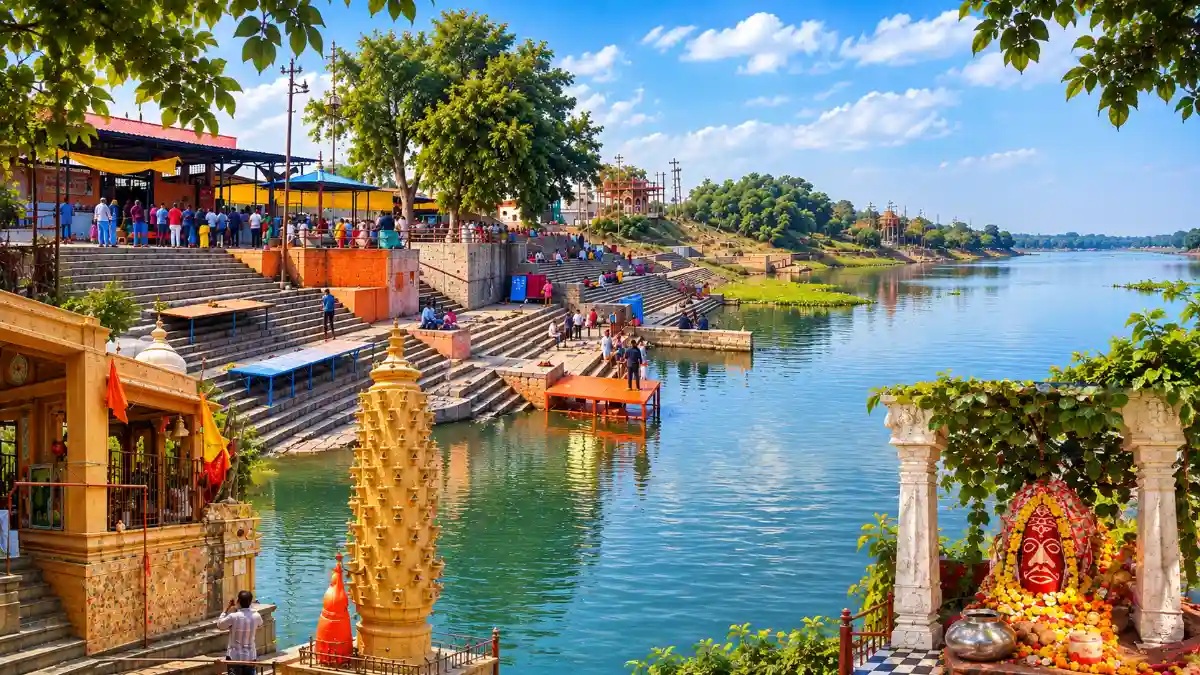
Mid-morning, 9 AM to 11 AM. Ritual bath at Ram Ghat or another Shipra ghat. This connects directly to the Samudra Manthan story: the water you are bathing in is the water the tradition says received the amrit.
Late morning, 11 AM to 12 PM. Walk to Vikram Teela behind Mahakaleshwar, where the Navaratna statues include Dhanvantari. This is not a temple; it's an open-air installation. Allow 15 to 20 minutes.
Afternoon, 1 PM to 3 PM. If an AYUSH health camp is operating near the fairground during the mela window, visit it. Pulse diagnosis and herbal consultation take about 15 to 30 minutes.
Key lesson: The Dhanvantari thread in Ujjain is dispersed, not concentrated in one temple. You trace it through the ghat water (amrit), the Navaratna statues (court tradition), and the health camps (living Ayurveda practice). No single stop delivers the whole picture; the connection emerges across the day.
Who should follow this thread, and who should plan differently
This angle works well for
- Pilgrims interested in why the water is considered sacred: Dhanvantari's story is the direct mythological answer.
- Foreign visitors looking for a non-devotional entry point: the WHO recognition, the medical tradition, and the astronomy give intellectual hooks that don't require prior faith commitment.
- Health-conscious travellers: the AYUSH camps and the Ayurvedic philosophy of prevention over cure are practically useful, and the mela is physically demanding enough that basic health awareness helps.
- Families with school-age children: the Samudra Manthan story is vivid, visual, and known from school textbooks; the Navaratna statues at Vikram Teela make it physical.
Plan differently if you are
- Looking for a dedicated Dhanvantari temple in Ujjain: there's no major standalone Dhanvantari temple here. The connection is through the ghat water, the Navaratna statues and the broader mythology, not a specific shrine.
- On a single-day visit during Amrit Snan: your time is better spent at the ghats and Mahakaleshwar. The Dhanvantari thread is a second-day enrichment, not a replacement for the core Simhastha experience.
- Expecting to time your visit with Dhanvantari Jayanti (Dhanteras): Dhanteras falls in October or November, outside the March-to-May Simhastha 2028 window. National Ayurveda Day (23 September) is likewise outside it.
What you should know about Ayurvedic caution at the mela
- Should I try herbal remedies from roadside vendors? Exercise caution. Stick to recognised government or institutional camps rather than unlicensed stalls. The Ayurvedic principle itself is balance, not experimentation with unknown substances during a physically demanding pilgrimage.
- Is the Shipra water safe to bathe in? Ritual bathing at the ghats during Simhastha is a religious practice with deep traditional significance. For drinking water, use your own sealed bottle or packaged water. The mela administration provides water distribution points; check the logistics guide closer to the dates.
- What should I carry for health? A reusable water bottle, basic first-aid supplies (antiseptic, bandages, any personal medication), sunscreen and a hat for the March-to-May heat, and comfortable footwear that you can remove easily at temple and ghat entry points.
- Where can I get medical help during the mela? Government medical camps (both AYUSH and allopathic) operate during major melas. At Maha Kumbh 2025, over 7 lakh pilgrims were treated. Expect a similar setup for Simhastha 2028, with details published closer to the event.
Comments
No comments yet. Be the first to share your thoughts!
Leave a Comment