

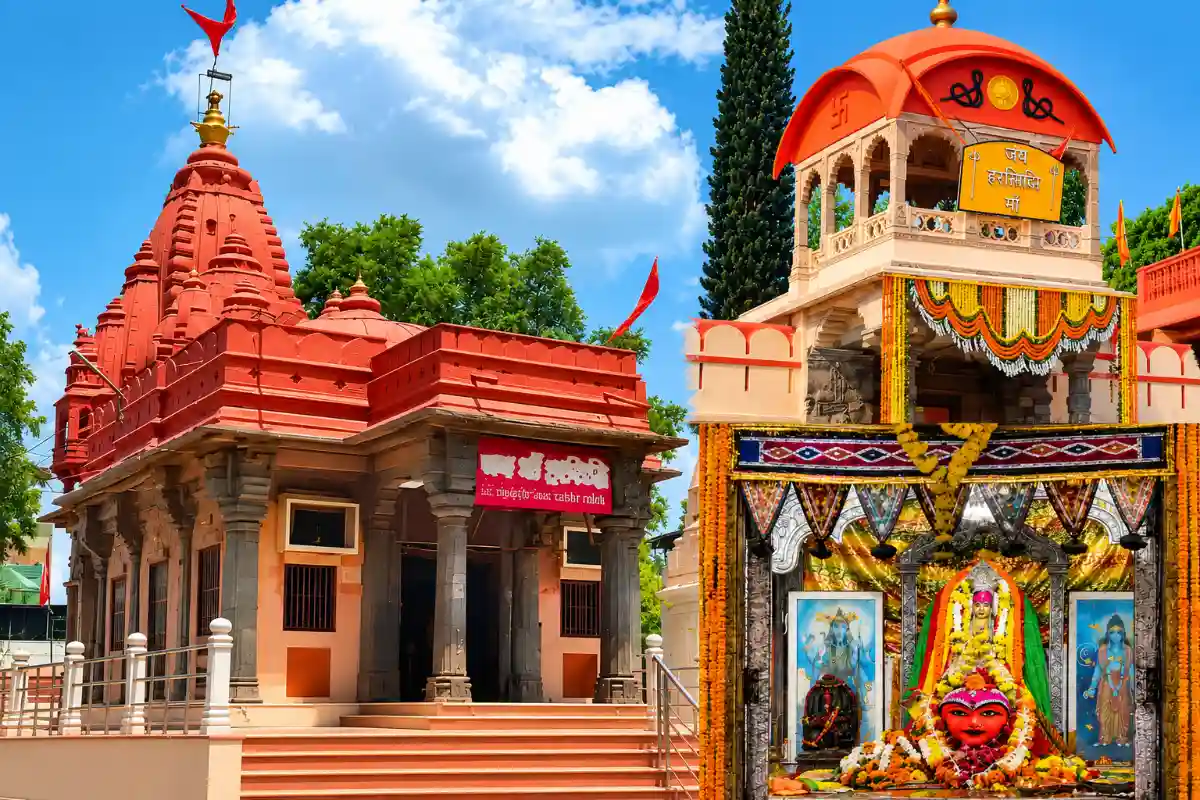
Which Shakti Peetha is Harsiddhi Temple?
The total number of Shakti Peethas depends on which scripture you follow. The Shiva Charitra and Devi Bhagavata count 51; the Tantrachudamani and Markandeya Purana count 52. Ujjain's Harsiddhi Peetha appears in both traditions and is generally listed as the 13th Shakti Peetha, though that number is not fixed across all texts.
Verse 16 of the Peetha Nirnaya Tantra names this peetha clearly:
Peetha Nirnaya Tantra, Verse 16
"Ujjayinyam kurparanca mangalya Kapilambara / Bhairavah siddhidah sakshat devi Mangalachandika"
Meaning: At Ujjayini my auspicious elbow (kurpara) fell. Kapilambara is the Bhairava who visibly grants siddhi, and the Devi is Mangal Chandika.
Two body parts of Sati fell in Ujjain, which is why the city has 2 Shakti Peethas. The elbow fell at Harsiddhi, and the upper lip fell at Bhairavparvat, where Gadkalika (Avanti Peetha) stands. This is why Ujjain is called the city of both Mahakal and Mahakali.
Where does the name Harsiddhi come from?
The Skanda Purana's Avanti Mahatmya tells of two demons, Chand and Prachand, who reached Kailash and defeated Nandi. Shiva then invoked Chandi. The goddess destroyed both demons. Shiva declared: "Harsiddhi to loke namna khyatim gamishyati" - she who grants perfection in every task will be known as Harsiddhi.
Because she also slew Chand and Mund, the goddess is connected to Chamunda. In the Tantric tradition, Mangal Chandika and Harsiddhi are different names for the same goddess.
History of Harsiddhi Temple - before and after the Marathas
The site is ancient. According to INTACH (Indian National Trust for Art and Cultural Heritage), the original temple dates to the Paramara period, 10th to 14th century. The Paramara kings regarded Harsiddhi as their kuldevi (family deity). The connection to Raja Vikramaditya exists in local belief and devotional literature, but no dated inscription has been found to confirm it.
The current structure belongs to the era of Ranoji Rao Shinde (Scindia). After winning Malwa in 1726 and making Ujjain his capital in 1731, he rebuilt MahakaleshwarExplore the divine Mahakaleshwar Jyotirlinga in Ujjain., Harsiddhi, Ram Ghat, Mangalnath, and several other temples. The 2 lamp pillars also date to this Maratha period.
Many tourism websites state the temple was built by the Marathas in 1447. This is impossible: the Marathas did not reach Ujjain until 1726. According to the INTACH board, "1447" refers to an inscription on an ancient stepwell (baoli) on the temple's south-east side - not to the temple's construction.
| Period | Event |
|---|---|
| Mythological | Sati's elbow falls here; Shakti Peetha established |
| 10th -14th century [verify] | Original temple, Paramara period |
| 1447 (inscription) | Stepwell inscription - not the temple |
| After 1731 | Ranoji Shinde rebuilds temple; 2 lamp pillars added |
| Present | Daily worship; Navratri deepamala |
Raja Vikramaditya and Harsiddhi Mata
Harsiddhi Mata is regarded as Raja Vikramaditya's ishta devi (personal deity). Devotional tradition holds that Vikramaditya offered his severed head to the goddess 11 times and was restored to life each time. On the 12th offering, he was not. This story comes from devotional literature and oral tradition; no dated archaeological evidence supports it.
The Paramara kings also regarded Harsiddhi as their kuldevi. This is why the temple carries not just religious but also historical and political weight in Ujjain.
Architecture and temple complex
The temple faces east, with the main entrance on the eastern side. There are 4 entrances, one in each direction. Above the garbhagriha is a Nagara-style vimana topped with an amalaka and kalasha. The mandapa vimanas are pyramidal — a marker of Maratha architecture.
Inside the garbhagriha, Mata Harsiddhi (Mahakali) is flanked by Mahalakshmi and Mahasaraswati. The Annapurna idol is painted in deep vermilion. Near the sanctum stands a stone engraved with the Sri Yantra, representing the 9 forms of Durga. The mandapa ceiling is painted with images of all 51 Shakti Peethas and their yantras.
Other shrines in the complex:
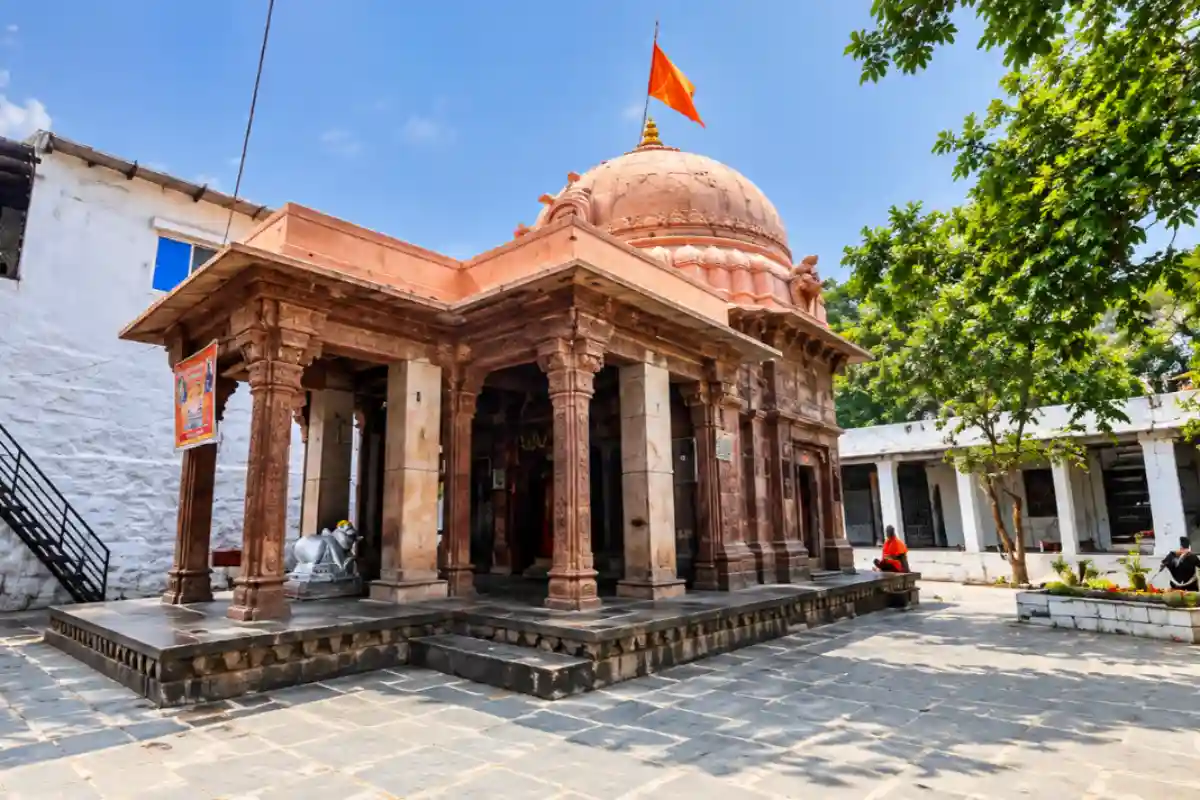
- Chintaharan Ganesh Temple
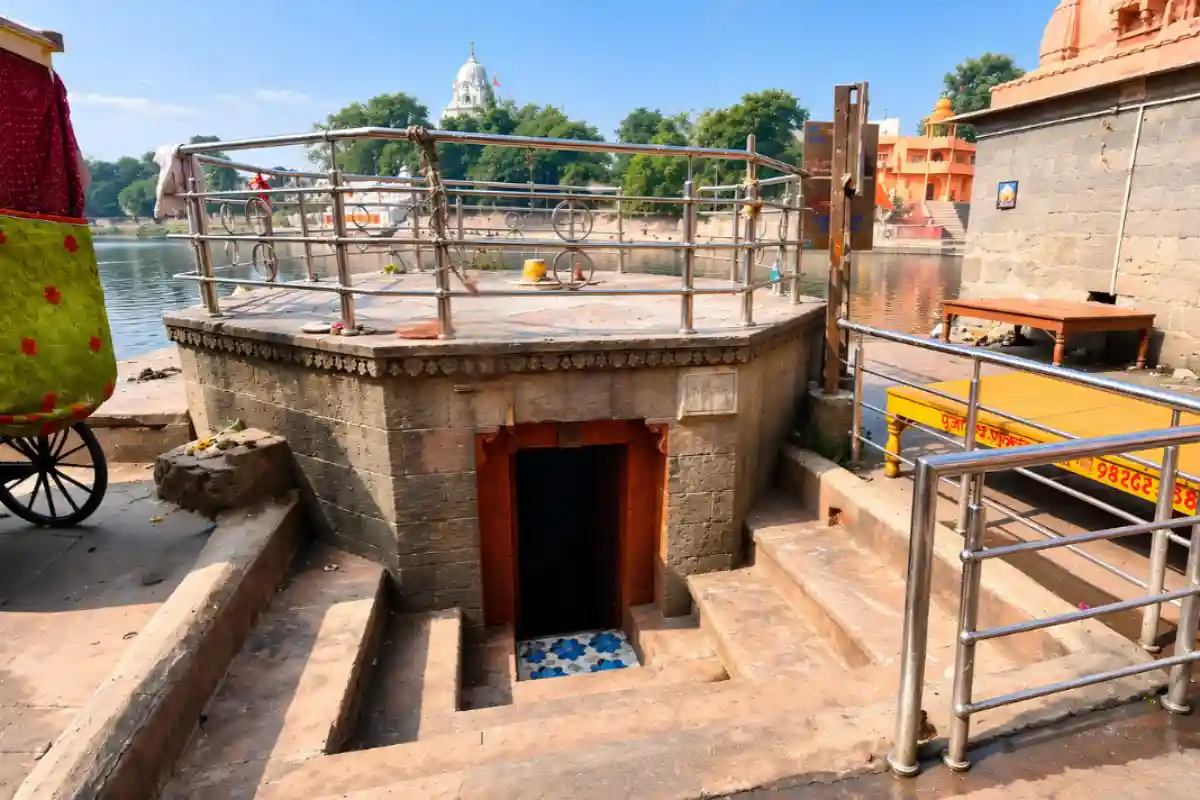
- Adi Shakti Mahamaya Temple (underground, reached by stairs)
- Karkoteshwar Mahadev (underground; known for Kala-sarpa dosha relief)
- Varasiddhi Mata Temple
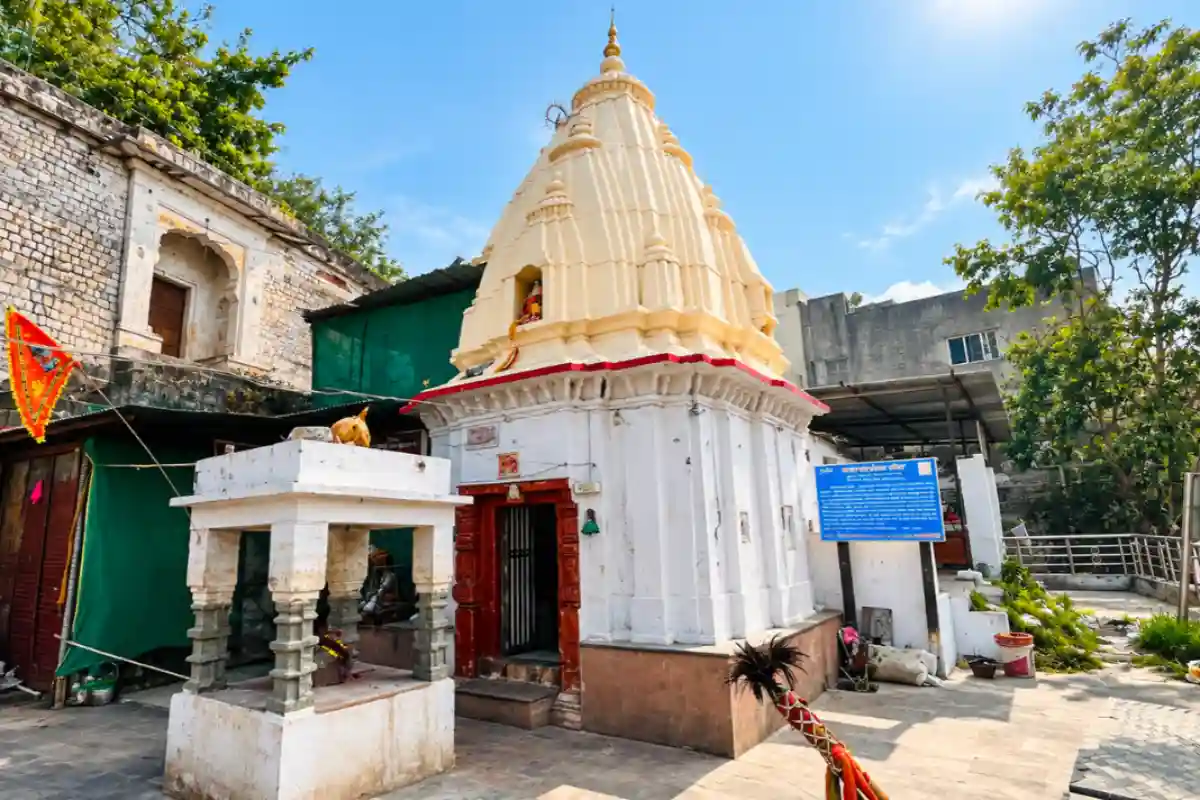
- Ancient stepwell with the 1447 inscription (south-east)
- Shoe stand and small shops outside the complex
The lamp pillars - 51 feet tall, over a thousand lamps
Two lamp pillars stand in front of the temple, each approximately 51 feet tall. Together they hold over a thousand lamps [verify: confirm exact count with temple trust]. When they are all lit at once, the entire complex lights up.
The pillars are not lit only during Navratri. They are lit every evening during the aarti. During Navratri, all 9 nights see full illumination - and that is the biggest draw.
On Ashtami and Navami, queues grow very long by evening. Full illumination of the lamp pillars happens around 7-7:30 PM. If you want both darshan and the deepamala, arrive by 6:30 - 6:45 PM. Between 5 and 7 AM, the crowd is thin and you can get close for darshan.
Navratri and other festivals
Navratri is the temple's biggest event. Two main Navratris are observed each year: Chaitra Navratri (March–April) and Sharad Navratri (September–October). The Gupt Navratri in Ashadha (June–July) is also observed here.
Diwali, Maha Shivaratri, and Holi also see special celebrations. Simhastha Kumbh Mela comes to Ujjain every 12 years; the next is in 2028. During Simhastha, Shakta sadhus and saints give Harsiddhi Temple particular importance.
Darshan - practical information
| Detail | Information |
|---|---|
| Location | Near Ram GhatRam Ghat, the most prominent bathing ghat in Ujjain., 600 metres west of Mahakaleshwar |
| Darshan timings | 5:00 AM to 7:00 PM daily |
| Morning aarti | 7:00–8:00 AM |
| Evening aarti | 6:00–7:00 PM (with lamp pillar lighting) |
| Entry fee | Free |
| Lamp pillar height | Approximately 51 feet each |
| Lamps | 1,000+ total [verify with temple trust] |
| Photography | Allowed in outer courtyard; prohibited inside the sanctum |
| Dress code | Modest clothing; footwear to be removed |
| Nearby sites | Mahakaleshwar (600 m), Ram Ghat (walking distance), Gadkalika Temple |
How to reach Harsiddhi Temple
The temple is in Ujjain's old city, about 1.6–2 km from Ujjain Junction. From Mahakaleshwar it is 600 metres - a short walk.
Start with the Bhasma Aarti at Mahakaleshwar at 5 AM. Then go to Harsiddhi between 7 and 8 AM when the crowd is light. In the afternoon, visit Gadkalika Temple about 5 km away. Come back to Harsiddhi in the evening for the lamp pillar lighting.
Ujjain's 2 Shakti Peethas: Harsiddhi vs Gadkalika
| Detail | Harsiddhi Temple | Gadkalika Temple (Avanti Peetha) |
|---|---|---|
| Part of Sati | Elbow (kurpara) | Upper lip (oshtha) |
| Goddess name | Mangal Chandika | Avanti / Gadkalika |
| Bhairava | Kapilambara | Lambakarna |
| Location | Near Ram Ghat, city centre | Bhairavparvat, about 5 km from city |
| Maratha connection | Rebuilt by Ranoji Shinde | Associated with Kalidasa as his ishta devi |
Who should visit and when
This temple is a must for
- 51 Shakti Peetha pilgrims - this is the 13th peetha; it cannot be skipped.
- Navratri visitors - full illumination of the lamp pillars on all 9 nights.
- First-time visitors to Ujjain - the most important stop after Mahakaleshwar.
- Tantric and Shakta practitioners - Sri Yantra and Mangal Chandika worship are central here.
Plan timing carefully if you
- Prefer a quiet darshan - Navratri evenings on Ashtami and Navami are very crowded. Come before 7 AM.
- Are travelling with young children - reaching the sanctum at peak times is difficult. Monday mornings are relatively calm.
Comments
No comments yet. Be the first to share your thoughts!
Leave a Comment