

Ancient to modern history
The akhara institution predates the ABAP by more than a millennium. The word "akhara" originally meant a wrestling ring in Sanskrit a training ground for physical and martial combat. Over centuries it came to mean an organised sect of sadhus who defended dharma through both spiritual discipline and, historically, armed force.
The earliest recorded founding of any akhara was Avahan Akhara in 547 CE. By the 8th century, Adi Shankaracharya formalised the Dashanami order and established the institutional framework from which the 7 Shaiva akharas emerged. Whether Shankaracharya personally founded each akhara or simply catalysed an organic progression of ascetic organisation remains a point of scholarly debate.
During the medieval period, akharas were not purely contemplative. They functioned as armed forces, trading guilds along pilgrimage routes, and repositories of military knowledge. In 1565, the philosopher Madhusudana Sarasvati further mobilised akharas as a defensive force against invasions threatening Hindu pilgrimage sites.
Inter-akhara violence at Kumbh gatherings was a documented feature of early modern India. At the 1760 Haridwar Kumbh, large-scale clashes between Shaiva and Vaishnava groups were recorded – though the death toll of 18,000 cited by British officer Francis Raper (1808) is likely inflated. The 1796 Haridwar Kumbh clash between Nirmalas and Shaivites killed around 500 people.
British colonial administrators resolved the procession-order problem pragmatically: they codified a fixed bathing sequence based on each akhara's relative strength in the late 19th century. This ended most armed confrontations and set the structural precedent for the ABAP's own sequencing authority after 1954.
In 2024-25, ABAP president Mahant Ravindra Puri formally replaced the Persianate term "Shahi Snan" (royal bath) with "Amrit Snan" (nectar bath), and "peshwai" with "Chhavni Pravesh," arguing these older terms carried Mughal-era connotations incompatible with pre-colonial Sanatan tradition. Madhya Pradesh Chief Minister Mohan Yadav adopted "Rajsi" for the Mahakal procession as an early local implementation. For Simhastha 2028, pilgrims and media will encounter "Amrit Snan" as the official term on all government communications.
Founding and tradition
The ABAP was formally constituted in 1954 in Allahabad. Its immediate trigger was the Kumbh stampede of 3 February 1954 the first Kumbh after Indian Independence in which somewhere between 316 and 800 pilgrims were killed on Mauni Amavasya. Government failures in crowd control, a shrinking riverbank caused by the Ganga changing course, and the volatile procession dynamics of Naga SadhusLearn about the mysterious Naga Sadhus of Kumbh Mela. all contributed to the disaster.
The driving force behind forming the new apex body was Anantpuri Maharaj, then secretary of Shri Panchayati Mahanirvani Akhara. The structure he proposed was simple: 2 representatives from each of the 13 participating akharas, plus a president and general secretary, giving the ABAP a council of 28 voting members.
One secondary source states the organisation began in 1914 as "Akhil Bharatiya Sadhu Samaj" and was later renamed ABAP. This claim conflicts with the 1954 founding date confirmed by Wikipedia, ETV Bharat, and academic sources, and has not been independently corroborated. Confirm founding history against official ABAP records at akhadaparishad.org before citing.
Founder and lineage
The ABAP has no single founder in the way an individual akhara does. It was constituted collectively by the sitting heads of the 13 akharas in 1954, with Anantpuri Maharaj of Mahanirvani Akhara as its principal architect.
Its deeper lineage traces to Adi Shankaracharya's 8th-century Dashanami Sampradaya and the 4 cardinal mathas he established at Badrinath, Puri, Dwarka, and Rameshwaram. All 7 Shaiva akharas under ABAP derive their sannyasa initiation traditions from this Shankaracharya framework.
Guru-shishya (teacher-disciple) tradition
The ABAP itself does not manage guru-shishya initiation that's the internal function of each member akhara. Within the Shaiva akharas, a new sadhu receives diksha through a formal ceremony involving symbolic death of the worldly self, the taking of a new name, and attachment to an existing lineage chain. The Vaishnava akharas follow similar but doctrinally distinct processes.
The ABAP's own leadership succession follows electoral convention, not guru-shishya lineage. Its presidents are elected by the 28-member council. The current president, Mahant Ravindra Puri of Niranjani Akhara, was elected in October 2021 following the death of his predecessor, Mahant Narendra Giri.
Religious and spiritual significance
The ABAP's authority is fundamentally religious, not governmental. Its core significance lies in certifying who is a legitimate sadhu and which organisations are authentic akharas. It maintains this authority through a registration system and, periodically, through public blacklists of self-styled godmen it deems fraudulent.
In September 2017, it released a list of 14 "fake babas" including Gurmeet Ram Rahim Singh, Radhe Maa, and Asaram Bapu and demanded legislation against unauthorised cult leaders. A 29-member ABAP delegation met UP Chief Minister Yogi Adityanath to press the demand directly.
For pilgrims, the ABAP's imprimatur determines which processions are legitimate Amrit Snan processions. An akhara camp operating outside ABAP recognition can't claim official Kumbh status or government-allocated land. This makes ABAP membership the single most important institutional credential for any monastic order wishing to participate in Simhastha.
Dashanami sect affiliation
The ABAP is not a Dashanami sect – it's an umbrella body across multiple traditions. But 7 of its 13 member akharas are Shaiva and operate within the Dashanami Sampradaya established by Adi Shankaracharya: Juna, Niranjani, Mahanirvani, Atal, Avahan, Anand, and Agni (Panchagni) Akharas.
The 3 Vaishnava akharas (Nirmohi, Digambar, Nirvani) follow Ramanandi and related Bhakti traditions. The 3 Udasin-Nirmal akharas trace their lineage to Sri Chand (elder son of Guru Nanak) and, in the case of Nirmal Akhara, to the Sikh Nirmala Sampradaya founded in 1856 in Punjab.
Ishta-devata (presiding deity)
The ABAP as an institution doesn't have a single presiding deity it encompasses traditions devoted to Shiva, Vishnu, Dattatreya, Ganesha, Kartikeya, Surya, and Gayatri, among others. Each constituent akhara maintains its own Ishta-devata:
- Juna Akhara: Lord Dattatreya
- Niranjani Akhara: Lord Kartikeya
- Mahanirvani Akhara: Rishi Kapila
- Atal Akhara: Lord Ganesha
- Panchagni Akhara: Mata Gayatri
- Anand Akhara: Dev Bhuvan Bhaskar Suryanarayana
Naga Sadhu tradition
Naga Sadhus are the most visible members of the Shaiva akharas. They're initiated through a rigorous multi-year process and live as renunciants who, in their most traditional form, don't wear clothes in public. The British administration attempted to ban public nudity in 1840, but ultimately backed down conceding to popular religious sentiment rather than enforcing the ordinance against Naga Sadhus.
At Kumbh gatherings, Naga Sadhus lead the Amrit Snan procession of each Shaiva akhara. Their presence at the Shipra River on Amrit Snan days at Simhastha is the defining spectacle for millions of pilgrims. The ABAP governs the order in which each akhara's Naga contingent enters the river, based on conventions codified across successive Kumbh cycles.
The Vaishnava akharas don't maintain the Naga tradition. The Udasin and Nirmal akharas don't practise it either.
Organisational structure
The ABAP council has 28 voting members: 2 from each of the 13 akharas, plus the president and general secretary as additional members.
The president chairs meetings, represents ABAP in dealings with central and state governments, and issues public statements on behalf of all akharas. The general secretary manages day-to-day coordination. Sub-committees handle specific functions including Kumbh logistics, sadhu authentication, and inter-akhara disputes.
Each constituent akhara can itself be divided into 8 davas (divisions) and 82 marhis (centres), each marhi led by a Mahant. This decentralised architecture means the ABAP governs a network spanning thousands of maths, ashrams, and educational institutions across India.
The ABAP's headquarters is currently listed as Ayodhya, Uttar Pradesh, though its operational activity is concentrated in Prayagraj, where its founding Kumbh-coordination work continues to be conducted.
After the expiry of the transitional committee formed following Mahant Narendra Giri's death, a new executive committee was constituted at a meeting held at Shri Shambhu Panchayati Atal Akhara. 8 of the 13 akharas participated, forming the committee on a majority basis. This new committee's term is 5 years. All 8 akharas had signed a prior declaration in December, committing to form the next executive committee together. The new committee has confirmed ABAP's full and united participation in upcoming Kumbh Melas including Simhastha 2028, Ujjain, and the Ardh Kumbh in Haridwar.
The new executive committee was formed with participation of 8 out of 13 akharas. The remaining 5 akharas' position vis-à-vis this committee was not specified in the source transcript. Confirm the current full membership standing via akhadaparishad.org before citing ABAP as a unified body for Simhastha 2028 coverage.
Role in Kumbh Mela (historical)
Before 1954, no apex body governed inter-akhara relations at Kumbh gatherings. Disputes over bathing order were sometimes violent. The British codified a procession sequence based on akhara strength in the late 19th century, but enforcement remained inconsistent in independent India.
After 1954, the ABAP assumed authority over two key functions: determining which akhara bathes in which order on Amrit Snan days, and allocating camp zones within the Kumbh mela grounds to each akhara. Disputes that would previously have been settled by physical confrontation are now resolved through ABAP deliberation.
The ABAP's involvement in political life has been periodic rather than systematic. It supported the Ram Janmabhoomi movement and welcomed the 2010 Allahabad High Court verdict that awarded one-third of the Ayodhya site to Nirmohi Akhara. It has also publicly criticised the Vishva Hindu Parishad for overreach and refused to follow the VHP's political agenda on multiple occasions.
Role in Simhastha 2028 specifically
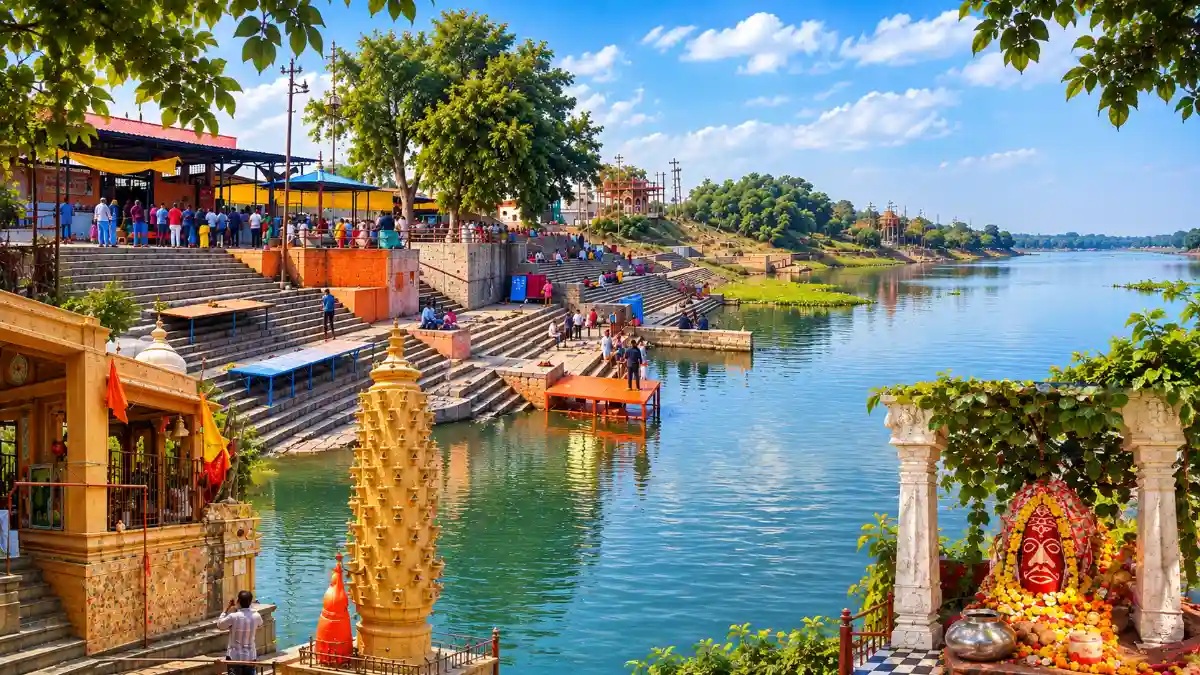
For Simhastha 2028 in Ujjain, the ABAP's formal role is consultative, not administrative. The Government of Madhya Pradesh, through the Simhastha Mela Authority, holds administrative and legal authority over the event. The ABAP and individual akhara heads are consulted on ritual schedules, Amrit Snan procession timings, and camp allocation along the Shipra River – but they don't control law enforcement, funding, or infrastructure.
Following the Maha Kumbh 2025 at Prayagraj, the ABAP shifted preparation focus toward the Ardh Kumbh in Haridwar (2027) and Simhastha in Ujjain (2028). The Udasin Nirmal Parishad, formed in May 2025 by 3 Udasin-Nirmal akharas, explicitly named Simhastha 2028 as a key event in its own coordination calendar.
At Simhastha 2028, all 13 akharas will establish Chhavni Pravesh camp zones in Ujjain. On the 3 Amrit Snan dates 9 April, 23 April, and 8 May 2028 they'll process in a prescribed sequence to the Shipra ghats, primarily Ram Ghat, for the ceremonial royal bath.
Amrit Snan dates are confirmed as 9 April, 23 April, and 8 May 2028 per the official Simhastha Mela Authority announcement. Confirm the final akhara procession sequence directly with the ABAP or the MP government's Simhastha portal before planning travel around these dates.
Shahi Snan order and sequence
The ABAP determines which akhara bathes first on each Amrit Snan date. The general sequencing convention established during the British colonial period and refined by the ABAP since 1954 places Shaiva akharas before Vaishnava akharas, and both before the Udasin-Nirmal akharas. Within Shaiva akharas, bathing order is based on the relative size and strength of each akhara's membership.
The exact per-event sequence for each Amrit Snan day at Simhastha 2028 is determined closer to the event through ABAP-MP government coordination meetings. The specific akhara procession sequence for Simhastha 2028 had not been officially published as of this article's research date (August 2026). Confirm the final order from the official Simhastha Mela Authority or akhadaparishad.org before the event.
Connection and relationship with Ujjain
Ujjain is one of the 4 Kumbh Mela cities – Prayagraj, Haridwar, and Nashik – As the Simhastha host city, it has a direct and recurring relationship with ABAP through every 12-year cycle. The ABAP coordinates with the MP government ahead of each Simhastha to establish akhara camp zones, Amrit Snan dates, and procession routes to the Shipra River.
Ujjain's identity as the seat of MahakaleshwarExplore the divine Mahakaleshwar Jyotirlinga in Ujjain. Jyotirlinga one of the 12 Jyotirlingas gives it particular weight in Shaiva akhara traditions. The Shaiva akharas under ABAP, especially Juna, Niranjani, and Mahanirvani, hold Ujjain in high religious regard as the city of Mahakal.
Ashrams in Ujjain (with addresses where verifiable)
The 13 akharas under ABAP each establish temporary camp zones in Ujjain during every Simhastha. Permanent Ujjain ashrams maintained by the ABAP as an institution as distinct from the individual akharas have not been independently verified across multiple sources. Specific permanent akhara ashrams in Ujjain are documented in the individual akhara profiles on this site.
Major ashrams and maths elsewhere in India
The ABAP doesn't own or operate maths directly; its constituent akharas do. Among the most prominent institutions under ABAP's umbrella: Niranjani Akhara operates MM Jain PG College, Sadhu Sanskrit Mahavidyalaya in Haridwar, Ramanand Institute of Management Pharma and Technology, the Manasa Devi Mandir Trust, and Shravan Nath Math in Haridwar, all currently under the personal supervision of ABAP president Mahant Ravindra Puri.
The ABAP's operational base remains concentrated around Prayagraj and Haridwar – the 2 Kumbh cities where it most frequently convenes for planning meetings, elections, and coordination sessions.
Prominent Mahants and Mahamandaleshwars
The current executive committee, formed by 8 of the 13 akharas at a meeting held at Shri Shambhu Panchayati Atal Akhara, is structured as follows. The committee's term is 5 years.
Current ABAP executive committee
- President: Shri Mahant Ravindra Puri Ji Maharaj Shri Panchayati Akhara Mahanirvani
- Vice President: Shri Mahant Durgadas Ji Maharaj Shri Panchayati Akhara Bada Udasin
- General Secretary: Shri Mahant Rajendra Das Ji Maharaj (Nirmohi Akhara)
- Secretary: Shri Mahant Pujya Vaishnodas Ji Maharaj (Digambar Akhara)
- Treasurer: Shri Mahant Jasinder Singh Ji Maharaj Nirmal Akhara
Patrons
- Shri Mahant Bhagat Ram Ji Maharaj Naya Udasin Akhara
- Shri Mahant Muralidas Ji Maharaj (Nirvani Ani Akhara)
- Shri Mahant Gyandev Singh Ji Maharaj Nirmal Panchayati Akhara
Other office bearers
- National Spokesperson & Media In-charge: Mahamandaleshwar Shankar Das Ji (Karauli Sarkar)
- National Spokesperson: Mahant Sanjay Das Ji (Hanumangarh)
- Accounts: Satyamveer Giri Ji Maharaj, Secretary, Shri Shambhu Panchayati Atal Akhara
- Shri Mahant Ravindra Puri Ji Maharaj (president, Shri Panchayati Akhara Mahanirvani): Re-elected as ABAP president in the new 5-year committee formed with 8-akhara majority. Earlier elected in October 2021 following Mahant Narendra Giri's death. Joined Niranjani Akhara in Delhi in 1980; elevated to Thanapati in 1994, Upmahant in 2001, Shrimahant in 2003. Oversees multiple educational institutions including Manasa Devi Mandir Trust and Shravan Nath Math, Haridwar.
- Mahant Narendra Giri (president 2014-2021): Head of Prayagraj's Baghambari Gaddi Mutt and secretary of Shri Panchayati Akhara Niranjani. Served 2 consecutive terms as ABAP president. Died 20 September 2021 in Prayagraj.
- Anantpuri Maharaj (founding architect, 1954): Secretary of Shri Panchayati Mahanirvani Akhara. Credited as the leader who pushed the formation of ABAP after the 1954 Allahabad stampede.
Architecture of key ashrams or temples
The ABAP as an institution doesn't own or maintain a distinct architectural monument. Its council meetings are typically held within the premises of member akhara maths – most often in Prayagraj and Haridwar. Architectural descriptions of specific akhara buildings belong to individual akhara profiles rather than to ABAP as an umbrella body.
Religious rituals and practices
The ABAP's institutional rituals centre on Kumbh participation. Each Kumbh cycle triggers a standardised sequence: akharas conduct their Chhavni Pravesh (camp entry procession), install a dharma-dhvaja flag at their camp, perform internal rituals including dhuni (sacred fire), initiate new members during the Kumbh period, and finally process to the river on Amrit Snan days in the sequence determined by ABAP.
In 2024, ABAP formalized new guidelines to authenticate sadhus and restrict access to Kumbh grounds by persons presenting themselves as sadhus without akhara affiliation. This ritual-policing function preventing impostors from joining the Amrit Snan procession is now built into ABAP's pre-Kumbh coordination with state governments.
Rare and lesser-known facts
- The 13 is not permanent: A 14th akhara (Kinnar Akhara, composed of transgender saints) joined the 2019 Ardh Kumbh under Juna Akhara's umbrella and has announced plans for Simhastha 2028 participation, but has not yet received full ABAP recognition.
- Sadhus once traded goods along pilgrimage routes: Pre-modern akharas were not purely ascetic institutions. They transported gold, silk, and spices between pilgrimage centres, making them commercially significant actors. The competitive bathing order at Kumbh had real economic stakes the winning akhara gained prestige that directly affected its trading power.
- The 1796 Haridwar clash had 500 deaths: The violence between Nirmala and Shaiva akharas in 1796 resulted in approximately 500 deaths – the backdrop against which British administrators later codified the procession sequence that ABAP now governs.
- The Vaishnava akharas threatened to split in 2024: In November 2024, leaders of the 3 Vaishnava akharas announced formation of a rival "Akhil Bhartiya Vaishnava Akhara Parishad," citing marginalisation within ABAP by Shaiva-dominated decision-making. The split didn't fully materialise for Maha Kumbh 2025, but remains a live tension heading into Simhastha 2028.
- ABAP formally doesn't participate in electoral politics: Despite maintaining close relations with ruling governments and having its leaders meet CMs and the PM regularly, ABAP has kept a formally non-electoral position. It has also publicly criticised the VHP on multiple occasions for mixing political with religious agendas.
Timeline of key events
| Year | Event | Source |
|---|---|---|
| 547 CE | Founding of Avahan Akhara; earliest recorded akhara establishment | Himalayan Academy Publications, 2007; traditional institutional records |
| 8th century | Adi Shankaracharya establishes Dashanami Sampradaya; 7 Shaiva akharas attributed to this period (exact founding dates debated among scholars) | Himalayan Academy Publications, 2007; traditional accounts and scholarly research |
| 1565 | Madhusudana Sarasvati mobilises akharas as armed defensive force against invasions | Himalayan Academy Publications, 2007; historical accounts and traditional records |
| 1760 | Large-scale Haridwar Kumbh clashes between Shaiva and Vaishnava groups; death toll contested per Francis Raper account, 1808 | Mohta, Nikita. Indian Express, Jan 2025; contemporary and later historical accounts |
| 1796 | Haridwar Kumbh clash between Nirmalas and Shaivites; approx. 500 deaths | Mohta, Nikita. Indian Express, Jan 2025; historical accounts |
| Late 19th century | British administration codifies fixed Kumbh bathing sequence based on akhara strength | Colonial-era administrative records; Mohta, Nikita. Indian Express, Jan 2025 |
| 3 Feb 1954 | Allahabad Kumbh stampede on Mauni Amavasya; 316-800 deaths; triggers ABAP formation | Kama Maclean, Pilgrimage and Power, UNSW; contemporary press reports |
| 1954 | ABAP formally constituted; Anantpuri Maharaj of Mahanirvani Akhara credited as driving force | ETV Bharat, 25 Feb 2021; institutional records |
| 1974, 1984, 1998, 2010 | Documented internal splits within ABAP, each subsequently resolved | Mahant Hari Giri statement, Hindustan Times, Oct 2021 |
| Sep 2010 | ABAP welcomes Allahabad High Court verdict awarding one-third of Ayodhya site to Nirmohi Akhara | Hindustan Times, 30 Sep 2010 |
| 2014-2021 | Mahant Narendra Giri serves two consecutive terms as ABAP president | Biographical and institutional records; The Print, Sep 2021 |
| Sep 2017 | ABAP releases list of 14 "fake babas"; delegation meets UP CM Yogi Adityanath demanding legislation | Hindustan Times, Sep-Oct 2017; Firstpost, Sep 2017 |
| Jan 2019 | Kinnar Akhara (transgender saints) participates in Ardh Kumbh under Juna Akhara umbrella; full ABAP recognition still pending | BBC News, 7 Jan 2019 |
| 20 Sep 2021 | Mahant Narendra Giri found dead in Prayagraj; ABAP presidency vacant | The Print, 22 Sep 2021; biographical records |
| Oct 2021 | ABAP splits into 2 factions; Mahant Ravindra Puri elected president with support of 7 akharas at Prayagraj meeting | India TV News, 25 Oct 2021; Hindustan Times, 26 Oct 2021 |
| 2024-25 | ABAP renames "Shahi Snan" to "Amrit Snan" and "peshwai" to "Chhavni Pravesh"; implemented at Maha Kumbh 2025, Prayagraj | India TV News, 16 Jan 2025; PTI |
| Nov 2024 | 3 Vaishnava akharas announce formation of rival "Akhil Bhartiya Vaishnava Akhara Parishad"; unresolved heading into Simhastha 2028 | Recent organisational records; date to be confirmed from official sources |
| 27 May 2025 | Udasin Nirmal Parishad formed by 3 Udasin-Nirmal akharas; Simhastha 2028 named as key planning event | Recent organisational records; date to be confirmed from official sources |
| Post-2025 (exact date unconfirmed) | New 5-year ABAP executive committee formed at Shri Shambhu Panchayati Atal Akhara by 8 of 13 akharas on majority basis; Mahant Ravindra Puri re-elected president; committee commits to united Kumbh participation including Simhastha 2028 | Transcript provided by site owner; exact date to be confirmed from official ABAP records |
| 27 Mar to 27 May 2028 | Simhastha Kumbh Mela 2028, Ujjain; ABAP to coordinate all 13 akharas' Amrit Snan participation on 3 dates | Official Simhastha Mela Authority announcement, MP government |
Comments
No comments yet. Be the first to share your thoughts!
Leave a Comment