Ancient to modern history
The Vaishnava Akhara tradition didn't emerge from a single founding moment. It grew from a centuries-long contest for sacred geography , specifically Ayodhya.
Until the 17th century, Ayodhya was under the influence of Shaiva Dashnami Sanyasis. The Ramanandi saints had devotional roots going back to Swami Ramananda's lifetime (circa 1300–1475 CE), but they were not militarily organized.
The turning point came in the early 18th century when Dasnami Sanyasis seized Ayodhya during Ram's birthday celebrations, driving the Ramanandis out. The Vaishnava communities called a historic assembly near Galata, Jaipur. Under Swami Balanand, they reorganized into armed monastic orders , akharas , modeled on Shaiva Naga structures.
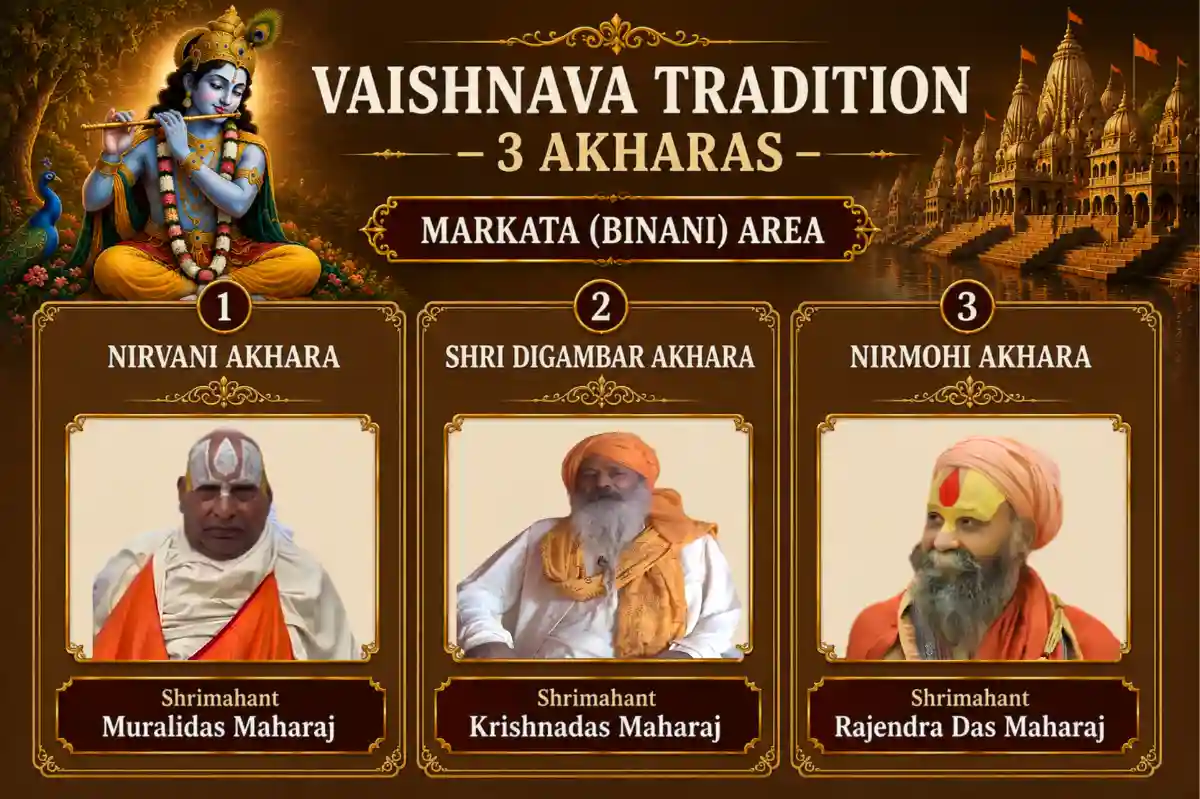
Three akharas took shape: Digambar as Raja (king), Nirmohi as Mantri (commander), and Nirvani as Sena (army).
By the close of the 18th century, the Ramanandis had displaced Dashnami Sanyasis from Ayodhya. Nirvani Akhara built Hanumangarhi into a temple-fortress with land and funds granted by the Nawabs of Awadh , a political alliance rarely mentioned in devotional accounts.
All 3 Vaishnava Akharas have participated in Kumbh Melas at all 4 sites: Prayagraj, Haridwar, Nashik, and Ujjain, since their formal organization. The Akhil Bharatiya Akhara Parishad (ABAP) officially recognizes all three.
Founding and tradition
All 3 Vaishnava Akharas share a common foundation in the Ramanandi Sampradaya but each has a distinct institutional origin, role, and home base.
Key highlights
- Shri Panch Nirmohi Ani Akhara: Headquartered at Dhir Samir Mandir, Bansivat, Vrindavan, Mathura (UP). Formed through the merger of 18 Vaishnava groups. Presiding deity: Lord Hanuman. Role: Mantri (commander). Symbol: 52-foot white flag.
- Shri Nirvani Ani Akhara: Principal seat at Hanuman Garhi, Ayodhya (UP). Guardian of the Hanumangarhi temple-fortress. Presiding deity: Lord Hanuman. Role: Sena (army). Initiates are tattooed with a bow-and-arrow mark burned on the arm.
- Shri Digambar Ani Akhara: Originally from Ayodhya; headquarters now at Kathiya Khak Chowk Mandir, Sabarkantha, Gujarat. Over 2 lakh saints, 450+ temples and monasteries. Role: Raja (king). Symbol: 5-color flag bearing Lord Hanuman's image.
The exact founding year of all 3 Vaishnava Akharas is disputed. Dates range from 1475 CE to the early 18th century depending on the source. Cross-verify against Akhil Bharatiya Akhara Parishad official records before publishing any specific founding date.
Founder and lineage
All 3 Vaishnava Akharas trace their spiritual lineage to Jagadguru Swami Ramananda, the 14th–15th century Vaishnava saint from Prayagraj who founded the Ramanandi Sampradaya. Ramananda studied under Raghavananda and drew from the Vishishtadvaita philosophy of Ramanuja , but developed a distinct path emphasizing direct devotion to Lord Ram, open to all castes.
Ramananda's disciples included Kabir, Ravidas, and Pipa. The institutional akharas bearing his name were organized centuries after his death, primarily in the early 18th century under Swami Balanand at the Galata conference near Jaipur.
Nirmohi Akhara credits Govindadas as the figure who first established Ramanandi akhara presence in Ayodhya, around 1720 CE.
One source (LinkedIn article by Dr. Ravindra Pastor) places an earlier 1475 CE Vrindavan assembly as the founding moment of the 3 Ramanandi akharas. Mainstream academic sources (Jain, Pinch, Britannica) place institutional organization in the early 18th century. Do not conflate these two claims without further verification against primary documents.
Guru-shishya (teacher-disciple) tradition
The guru-shishya lineage in all 3 Vaishnava Akharas runs through the Ramanandi chain from Ramananda himself. Each Akhara maintains a continuous succession of mahants and Mahamandaleshwars who transmit initiation, Guru-mantra, and monastic discipline.
Initiation is called Diksha. Novices receive the Panch Samskar (5 rituals of formal entry into Vaishnavism) and take vows of celibacy, renunciation, and obedience to the guru. A distinctive mark of the Bairagi tradition is a bow-and-arrow tattoo burned onto the initiate's arm with a heated metal rod, created for identification during the 18th-century sectarian conflicts.
The Shree Panch (a 5-member governing council representing Brahma, Vishnu, Shiva, Shakti, and Ganesha) manages each Akhara's administrative body. It is elected every 4 years at Kumbh Mela. Only Mahamandaleshwars are authorized to transmit the Guru-mantra to initiates.
Religious and spiritual significance
The Vaishnava Akharas practice Bhakti Yoga (the path of devotion) as the primary spiritual discipline. Core practices include daily chanting of Ram's name, communal kirtan, and study of the Ramcharitmanas (Tulsidas, 16th century), Bhagavad Gita, Bhaktamal (Nabhadas, 1660 CE), and Valmiki Ramayana.
Unlike the Shaiva Naga tradition, which emphasizes ash-smeared austerity , the Vaishnava Bairagi tradition centers on emotional surrender to Ram and Hanuman. Sadhus dress in saffron, carry a kamandal (water vessel), and wear a Tulsi bead necklace. Physical discipline remains part of the monastic regimen, but the outer aesthetic is one of devotion rather than severity.
The Ramanandis also celebrate Shivratri despite being Vaishnavas (a detail that points to the theological inclusivity Ramananda advocated throughout his life.
Dashanami sect affiliation
The 3 Vaishnava Akharas are not Dashanami. The Dashanami system (10 monastic orders created by Adi Shankaracharya in the 8th century) belongs to the Shaiva tradition. The Vaishnava Akharas follow an entirely separate lineage: the Ramanandi Sampradaya rooted in Vishishtadvaita philosophy, transmitted through Ramananda.
This distinction matters for Simhastha 2028 pilgrims. The 7 Shaiva Akharas trace legitimacy to Shankaracharya. The 3 Vaishnava Akharas trace theirs to Ramananda , a separate initiation system, separate philosophy, and sacred geography centered on Ayodhya rather than the Shaiva circuit.
Ishta-devata (presiding deity)
- Nirmohi Ani Akhara: Lord Hanuman: The Akhara worships Hanuman as its central deity, with devotion also to Lord Ram. Hanuman's qualities , celibacy, service, fearlessness , mirror the Bairagi monastic ideal precisely.
- Nirvani Ani Akhara: Lord Hanuman: Nirvani's institutional control of Hanumangarhi in Ayodhya makes its Hanuman devotion both spiritual and territorial. The temple-fortress is among the most visited pilgrimage sites in Ayodhya today.
- Digambar Ani Akhara: Lord Vishnu / Lord Ram: The Akhara is dedicated broadly to Vaishnavism , worship of Vishnu and his Ram avatar. Its 5-color flag bears the image of Hanuman.
Naga Sadhu tradition
The Vaishnava Akharas have a warrior-monk tradition, but it differs from the Shaiva Naga model in form and mythology. Shaiva Nagas are naked, ash-smeared, and carry tridents. Bairagi warrior monks wear white unstitched clothes, a Tulsi bead necklace, the Urdhvapundra tilak, and carry a kamandal. Their initiation mark is a bow-and-arrow tattoo burned onto the arm.
Digambar Ani Akhara is a partial exception. Its name , "digambar" means sky-clad, or naked, and its association with ascetics who renounce clothing has been noted in some secondary sources.
"Naga Sadhu" in popular usage refers specifically to Shaiva Nagas. Vaishnava Bairagi warrior-monks are sometimes called Naga Bairagis, but their dress and initiation code differ sharply. Verify with the Akhara directly before describing them as "Naga SadhusLearn about the mysterious Naga Sadhus of Kumbh Mela." in publication.
Organizational structure
Each Vaishnava Akhara is governed by a 5-member Shree Panch council elected every 4 years at Kumbh Mela, representing the 5 divine principles (Brahma, Vishnu, Shiva, Shakti, Ganesha). The Acharya Mahamandaleshwar sits at the apex of spiritual authority. Below come Mahamandaleshwars, Mandaleshwars, and Shri Mahants. Every marhi (sub-unit) is led by a Mahant who conducts daily ritual activity.
Digambar Ani Akhara elects its Shrimahant every 12 years specifically during the Maha Kumbh , a democratic election cycle, unusual within the monastic world.
Confirmed headquarters addresses: Nirmohi Ani: Dhir Samir Mandir, Bansivat, Vrindavan, Mathura, UP. Nirvani Ani: Hanuman Garhi, Ayodhya, UP. Digambar Ani: Kathiya Khak Chowk Mandir, Sabarkantha, Gujarat (originally established in Ayodhya).
ISKCON (the Hare Krishna movement) is formally affiliated with the Vaishnava Akhara cluster recognized by the Akhil Bharatiya Akhara Parishad , a fact that surprises many observers of the tradition.
Role in Kumbh Mela (historical)
The Vaishnava Akharas have participated in all 4 Kumbh Mela sites since their formal 18th-century organization. Their participation has not always been peaceful: a Maratha Peshwa copper plate inscription records that 12,000 ascetics: Shaivites and Vaishnavites , died in a clash at the 1789 Nashik Kumbh Mela over bathing-sequence rights.
The British colonial administration, alarmed by these battles, curtailed the warrior-trader role of the akharas in the 19th century. The codified bathing sequence that pilgrims see today at Simhastha, which Akhara bathes first, which follows , emerged directly from this history of contest and colonial regulation.
The 1921 Ujjain Kumbh saw a specific theological debate between Ramanuja and Ramanandi traditions, declared in favor of the Ramanandi position , a reference point the Akhara tradition still recalls.
Role in Simhastha 2028 specifically
At Simhastha 2028, all 3 Vaishnava Akharas will participate in the Shahi Snan on April 9, April 23, and May 8, 2028, on the banks of the Shipra River in Ujjain. Designated camp zones at the Simhastha Mela grounds will be allocated by the MP government and Ujjain district administration, following the same framework used in 2016.
The overall event window is March 27 to May 27, 2028. Parva Snan dates: March 27, April 4, April 14, April 19, May 1, May 5, and May 15 , are additional auspicious bathing days beyond the 3 Shahi Snan dates.
A minority of older sources give the Simhastha 2028 window as April 9 to May 9, 2028. The current planning consensus is March 27 to May 27, 2028. Confirm against the official Madhya Pradesh government Simhastha 2028 portal (simhasthujjain.in) before publishing.
Bairagi Vaishnava Akhara camps have historically allowed pilgrims to attend kirtan and seek blessings during regular camp hours at Simhastha , unlike some Shaiva camps with restricted periods. On Shahi Snan days, arrive before sunrise: the Vaishnava procession begins after the Shaiva Akharas finish their bath, typically late morning. Camp locations are announced on simhasthujjain.in closer to the event start date.
Shahi Snan order and sequence
The bathing sequence at Simhastha Kumbh Mela is centuries-old. Shaiva Akharas, led by Juna Akhara , bathe first. Vaishnava Akharas follow. Udasin and Nirmal Akharas come last.
Within the 3 Vaishnava Akharas, the internal bathing sequence at Ujjain Simhastha 2028 has not been officially published as of the research date for this article. One source covering the Nashik Kumbh (nashikkumbhmela.org, May 2026) notes that "Nirvani Ani or Digambar usually lead the Vaishnava procession" , but Nashik and Ujjain protocols may differ.
The precise internal bathing sequence of the 3 Vaishnava Akharas for Simhastha 2028 Ujjain has not been officially announced. Confirm with the Akhil Bharatiya Akhara Parishad or the MP government Simhastha portal before publishing a sequence.
What is confirmed: all 3 Vaishnava Akharas enter the Shipra in Peshwai (ceremonial procession) form on each Shahi Snan date , decorated elephants, horses, chariots, traditional music, and flags.
Connection and relationship with Ujjain
Ujjain is one of 4 Kumbh Mela sites and has hosted the Vaishnava Akharas every 12 years since their formal organization. The city's sacred geography is primarily Shaiva , the MahakaleshwarExplore the divine Mahakaleshwar Jyotirlinga in Ujjain. Jyotirlinga makes Ujjain one of Shiva's 12 principal abodes. For the Vaishnava Akharas, Ujjain's Simhastha is a pilgrimage duty rather than home territory, but the Shipra River's astrological sanctity during the Simhastha alignment transcends sectarian boundaries.
The 1921 Ujjain Kumbh holds a specific place in Ramanandi institutional memory: a theological debate between the Ramanuja and Ramanandi traditions was held at this site, with Bhagvaddas of the Ramanandi tradition declared the winner.
Ashrams in Ujjain (with addresses where verifiable)
Information not verified across independent sources , the official Simhastha 2028 camp allocations for all 3 Vaishnava Akharas in Ujjain had not been formally published as of the research date. In Simhastha 2016, each Akhara was allotted a designated camp zone at the Simhastha Mela grounds near the Shipra ghats, governed by the Ujjain district administration.
Pilgrims should check simhasthujjain.in or the official MP Simhastha 2028 portal once 2028 allocations are announced.
Major ashrams and maths elsewhere in India
- Nirmohi Ani Akhara: Principal math at Dhir Samir Mandir, Bansivat, Vrindavan, Mathura (UP). Major presence at Haridwar. Manages numerous Ram temples primarily in UP and Uttarakhand.
- Nirvani Ani Akhara: Principal seat at Hanumangarhi, Ayodhya (UP) , a fortified temple-monastery built with Nawab of Awadh patronage in the 18th century. Registered address: Hanuman Gaadi, Ayodhya, UP.
- Digambar Ani Akhara: Headquarters at Kathiya Khak Chowk Mandir, Sabarkantha, Gujarat. Also maintains offices in Haridwar. Over 450 monasteries and temples across India.
Prominent Mahants and Mahamandaleshwars
Current leadership of the 3 Vaishnava Akharas, sourced from credible news reports and official Akhara sources:
- Nirmohi Ani Akhara: Shree Panch: Two names noted in Akhara Parishad records from 2019: Mahant Rajendra Das and Mahant Ramji Das.
- Nirvani Ani Akhara: Shree Panch: Two members noted in Akhara Parishad records from 2019: Mahant Dharamdasji and Mahant Mohandas ji.
- Digambar Ani Akhara: Shrimahant: Shri Krishnadas Maharaj was identified as Akhara head in December 2024. Tour My India (Dec 2020) also named Mahant Krishna Das and Mahant Ram Kishor Das as administrative heads.
Mahant tenures change. Names above are from 2019–2024 reports. Verify current leadership directly with each Akhara or the Akhil Bharatiya Akhara Parishad before publishing.
Architecture of key ashrams or temples
Information not verified across independent sources , detailed architectural descriptions of all 3 Vaishnava Akhara temples could not be confirmed from 2+ named sources for this profile.
Hanumangarhi in Ayodhya (Nirvani Akhara's principal seat) is a well-documented fortified temple on a raised hillock, approached by 76 steps, with a central Hanuman shrine and outer bastions dating to its 18th-century military origins.
Religious rituals and practices
Daily life in all 3 Vaishnava Akharas follows a rhythm of pre-dawn bathing, Ram-nam sankirtan (chanting), scripture study, havan (fire ritual), and bhajan. Evening closes with Aarti.
At Kumbh Mela, the Vaishnava Akharas organize kirtans, pravachans (spiritual discourses), and public satsangs at their camp pandals. Pilgrims may attend without formal invitation.
The Peshwai procession , the ceremonial entry of each Akhara into the Mela grounds , is a major public event. Akharas arrive on elephants, horses, and decorated chariots. The Vaishnava Peshwai features saffron-clad Bairagi saints carrying the Urdhvapundra tilak and Tulsi bead necklaces, distinct from the ash-smeared Shaiva Naga Sadhus.
Rare and lesser-known facts
- The Nawab connection: Nirvani Ani Akhara's Hanumangarhi was built with land and funds granted by Shia Muslim Nawabs of Awadh , from Safdarjung through Asaf-ud-Daullah. Without those grants, the temple-fortress wouldn't exist in its current form.
- The 1789 Kumbh massacre: A Maratha Peshwa copper plate records ~12,000 ascetics killed in a clash between Shaivites and Vaishnavites at the 1789 Nashik Kumbh Mela over bathing-sequence precedence. This event directly shaped British colonial policy on Kumbh Mela management.
- ISKCON's formal Akhara link: The International Society for Krishna Consciousness (ISKCON) , known globally through the Hare Krishna movement , is formally affiliated with the Vaishnava Akhara cluster recognized by the Akhil Bharatiya Akhara Parishad.
- The bow-and-arrow tattoo: Bairagi initiates are tattooed with a bow-and-arrow shape using a heated metal piece on the arm. This was created specifically for identification during 18th-century sectarian conflicts , so warrior monks of different Ramanandi akharas could recognize each other in battle.
- The Galata conference: The militarization of Vaishnava monastic orders was a deliberate, planned response , decided at a single assembly near Jaipur. Swami Balanand chaired the event and assigned the 3-akhara structure that still governs the Vaishnava Kumbh participation today.
Timeline of key events
| Period / Year | Event | Source |
|---|---|---|
| 14th–15th century CE | Jagadguru Swami Ramananda active in Varanasi; founds Ramanandi Sampradaya tradition of devotion to Lord Ram; initiates Kabir, Ravidas, Pipa among others | Britannica: Ramananda; William Pinch, Peasants and Monks in British India, University of California Press, 1996 |
| Early 17th century | Dasnami Sanyasis seize Ayodhya during Ram's birthday; Ramanandis driven out; prompts Vaishnava military reorganization | William Pinch, Peasants and Monks in British India, University of California Press, 1996; The Print, Feb 2025 |
| Early 18th century (c. 1720) | Galata conference near Jaipur under Swami Balanand; 3 Ramanandi akharas formally organized: Digambar (Raja), Nirmohi (Mantri), Nirvani (Sena) | Meenakshi Jain, Rama and Ayodhya, Aryan Books International, 2013; Swarajya Mag, Dec 2023 |
| c. 1720–1734 | Nirmohi Akhara (under Govindadas) establishes first Ramanandi foothold in Ayodhya; Nirvani Akhara follows soon after | Meenakshi Jain, Rama and Ayodhya, Aryan Books International, 2013; Outlook India, Feb 2024 |
| 1739–1793 | Nawabs of Awadh (Safdarjung through Asaf-ud-Daullah) grant land and funds to Nirvani Akhara; Hanumangarhi temple-fortress constructed | Krishna Jha and Dhirendra K. Jha, Ayodhya: The Dark Night, HarperCollins India, 2012 |
| 1789 | Clash between Shaivite Sanyasis and Vaishnava Bairagis at Nashik Kumbh Mela over bathing precedence; Maratha Peshwa copper plate records approximately 12,000 ascetics killed | Tribune India, Shahira Naim, Branding Spirituality |
| 1885 onwards | Nirmohi Akhara begins legal proceedings asserting shebait (custodial) rights over Ram Janmabhoomi site in Ayodhya | Outlook India, Feb 2024; Meenakshi Jain, Rama and Ayodhya, Aryan Books International, 2013 |
| 1921 | Theological debate at Ujjain Kumbh between Ramanuja and Ramanandi traditions; Bhagvaddas of Ramanandi tradition declared the winner | Needs verification, official records not confirmed |
| 2010 / 2019 | Allahabad High Court (2010) awards Nirmohi Akhara one-third share of Ram Janmabhoomi site; Supreme Court (2019) reverses this in final ruling | Outlook India, Feb 2024 |
| 2016 | All 3 Vaishnava Akharas participate in Simhastha Kumbh Mela, Ujjain; Amrit Snan on April 10, April 22, and May 21, 2016 | MP Government Simhastha 2016 official records |
| April 9, April 23, May 8, 2028 | First, Second, and Third Amrit Snan, Simhastha 2028; all 3 Vaishnava Akharas participate on Shipra River, Ujjain | MP Government official Simhastha 2028 date announcement |
Sources: Meenakshi Jain, Rama and Ayodhya (Aryan Books, 2013); William Pinch, Peasants and Monks in British India (UC Press, 1996); Krishna Jha and Dhirendra K. Jha, Ayodhya: The Dark Night (HarperCollins, 2012); The Print, Feb 2025; Swarajya Mag, Dec 2023; Outlook India, Feb 2024; Tribune India, Shahira Naim feature; MP Government official Simhastha 2028 date announcement. Confirm against official records before publishing.
Comments
No comments yet. Be the first to share your thoughts!
Leave a Comment