

Key highlights
- Vetala Bhatta is named in the Navaratna verse of the Jyotirvidabharana (22.10) and is described in Sanskrit dictionaries as the author of the Niti-Pradipa, a sixteen-verse work in the niti (ethics/statecraft) genre. This is his one verifiable attributed text.
- His name breaks into "Vetala" (a vampire-like spirit in Hindu mythology that inhabits corpses) and "Bhatta" (a title for a learned scholar or Brahmin pandit). Monier-Williams flags "Vetalabhatta" as both a name and a possible title/epithet, his actual birth name is not preserved.
- The Niti-Pradipa was printed in John Haeberlin's Kavya-Sangraha (Calcutta, 1847) and is confirmed by Monier-Williams, Böhtlingk-Roth's Sanskrit dictionary, and Aufrecht's Catalogus Catalogorum. It runs to sixteen verses.
- Some sources also attribute a "Mantrashastra" to him and describe him as a "court magician" versed in tantric knowledge. These attributions appear in popular and exam-prep sources, not in the principal Sanskrit literary catalogues.
- The Vetala Panchavimshati, the famous 25-tales story cycle of Vikram and the Vetala, is a separate literary work whose original author is unknown. Its connection to Vetala Bhatta the courtier is a popular conflation driven by the shared word "Vetala." No named scholar has established it in peer-reviewed publication.
- The Navaratna tradition rests on the Jyotirvidabharana, dated to the 12th century or later by V.V. Mirashi and called "absolutely worthless for historical purposes" by D.C. Sircar. The nine gems lived in different centuries and could not have shared one court.
- Sir Richard Burton's Vikram and the Vampire (1870) exists and is on Project Gutenberg, but it's a free retelling of eleven tales, not a scholarly translation of the full twenty-five.
What "Vetala Bhatta" actually means
The name splits cleanly into two Sanskrit elements with distinct meanings. "Bhatta" (Sanskrit भट्ट, IAST bhaṭṭa) is an honorific for a learned scholar or Brahmin pandit, comparable to shastri or pandita, and historically attached to the names of learned men across the subcontinent. "Vetala" (वेताल, vetāla) denotes a class of supernatural being in Hindu mythology: spirits that inhabit and animate corpses in cremation grounds, associated with Shiva and with magical power, and best known in English as "vampire" (though the fit is loose, a vetala is more specifically a possessing spirit of the dead).
The compound "Vetalabhatta" thus reads literally as something like "scholar of the vetala" or "learned one of spirits." Monier-Williams' Sanskrit-English Dictionary flags the name as both a personal name and a possible title or epithet, which means his actual birth name may simply not have survived. His fellow Navaratna Ghatakarpara was explicitly a nickname from a poetic wager, so epithet-names were not unusual in this tradition.
The Niti-Pradipa: his one verified work
The Niti-Pradipa ("Lamp of Conduct" or "Lamp of Policy") is Vetala Bhatta's one concretely catalogued work. Three authoritative Sanskrit reference sources confirm the attribution:
The text itself was printed in John Haeberlin's Kavya-Sangraha: A Sanskrit Anthology (Calcutta: W. Thacker and Co., 1847; reprinted 1888), from page 526 onwards. Niti literature, the genre of ethical and political maxims, is one of the most practiced Sanskrit genres; it includes works as diverse as the Hitopadesa and Chanakya's Arthashastra. A sixteen-verse niti poem is a compact work by the genre's standards, presenting ethical or statecraft aphorisms in polished verse. English Wikipedia's article on Vetala Bhatta confirms: "He is known to have written the sixteen stanza 'Niti-pradeepa' (Niti-pradīpa, literally, the lamp of conduct)."
Several popular sources and exam-prep websites attribute a work called "Mantrashastra" to Vetala Bhatta and describe him as a "court magician versed in tantric rituals." English Wikipedia itself states that "some historians have also mentioned him as the magician of Chandra Gupta's court." This attribution appears in popular tradition, it's plausible that a figure with a vetala-associated name would acquire associations with supernatural practice, but the Mantrashastra is not catalogued in Aufrecht's Catalogus Catalogorum, Haeberlin's anthology, Monier-Williams, or Böhtlingk-Roth. Treat it as tradition rather than verified text until a specific manuscript or print edition is identified.
The Navaratna tradition and its historical status
Vetala Bhatta appears in the standard Navaratna list from the Jyotirvidabharana (22.10): Dhanvantari, Kshapanaka, Amarasimha, Shanku, Vetala Bhatta, Ghatakarpara, Kalidasa, Varahamihira and Vararuchi. Wikipedia's Navaratnas article describes his field as "wit and political counsel", which aligns with the niti genre of his confirmed work.
But the tradition's source is chronologically impossible as a court record. V.V. Mirashi, in Kalidasa: Date, Life and Works (1969), dated the Jyotirvidabharana to the 12th century and demonstrated it couldn't be Kalidasa's because of grammatical faults incompatible with his authorship. A.B. Keith dated it to the 16th century; H. Kern to the 18th. D.C. Sircar, in Ancient Malwa and the Vikramaditya Tradition, called the Navaratna tradition "absolutely worthless for historical purposes."
The arithmetic confirms the problem. Vararuchi is placed in the 3rd to 4th century CE; Kalidasa in the 5th; Varahamihira firmly in the 6th, while the legendary Vikramaditya who founded the Vikrama Samvat did so in 57 BCE. No single king's court could have held all nine. The list is a literary construction, prestige names gathered around an ideal of kingship, not a contemporary court record.
The Chandragupta II connection
Some sources, including Wikipedia's own Vetala Bhatta article, place him not in the mythical Vikramaditya's court but at the court of Chandragupta II (r. c. 375-415 CE) of the Gupta dynasty, who also bore the title Vikramaditya. Wikipedia states: "he is among the legendary Navaratnas of Chandragupta II's court (Vikram here is referred to Chandra Gupta II as he was titled Vikramaditya)."
This is a reasonable inference, Chandragupta II's reign was genuinely a high point of Sanskrit literary culture and patronage, but it remains an inference from the shared title, not a documented fact. No inscription, contemporaneous text, or royal grant names Vetala Bhatta at Chandragupta II's court. The identification is plausible tradition, not established history.
Three things popular sources blur, and why they're separate
The most important clarification for any reader of popular Navaratna articles is that three distinct things share the word "Vetala", and are routinely and wrongly merged:
Popular websites routinely credit the Vetala Panchavimshati, the Baital Pachisi, to Vetala Bhatta the Navaratna courtier. A targeted search could not find any named Indologist or peer-reviewed publication making this argument. The claim appears driven purely by the shared word "Vetala" in the courtier's name and the spirit's name. No Sanskrit literary catalogue (Aufrecht, Haeberlin, Böhtlingk-Roth) records the Vetala Panchavimshati as Vetala Bhatta's work, his one confirmed text is the Niti-Pradipa. Until a peer-reviewed source with a citable primary text makes this connection, treat it as popular conflation, not scholarship.
The Vetala Panchavimshati: what the story cycle actually is
Because the Vetala story cycle is so often linked to this Navaratna in popular accounts, it's worth understanding the cycle properly, including what it is and where it actually comes from.
The Vetala Panchavimshati ("Twenty-Five Tales of the Vetala") is a Sanskrit frame-story collection built around King Vikramaditya's repeated attempts to capture a vetala that hangs from a corpse in a cremation ground. Each time the king lifts the body, the vetala tells a story ending in a riddle; when the king answers the riddle, the vetala flies back to its tree. The cycle is framed as a test of the king's wisdom and justice.
Its textual lineage runs like this:
Sir Richard Burton's adaptation
Sir Richard Francis Burton published Vikram and the Vampire; or, Tales of Hindu Devilry in 1870. A memorial edition edited by Isabel Burton appeared in 1893. The text is available on Project Gutenberg (ebook 48511). Critically, it's not a scholarly translation, it's a free retelling based on Hindi/Hindustani versions of the tales, in which Burton included only eleven of the twenty-five stories and added his own elaborations. Isabel Burton's 1893 preface explains: "My husband only gives eleven of the best tales, as it was thought the translation would prove more interesting in its abbreviated form." Read it as a Victorian adventure adaptation, not as a rendering of the Sanskrit text.
What the niti genre tells us about Vetala Bhatta
The Niti-Pradipa places Vetala Bhatta within a well-established Sanskrit literary tradition. Niti literature, works of ethical maxims and statecraft wisdom, sits at the intersection of philosophy, poetry and practical governance. Classical niti works include Chanakya's Arthashastra (statecraft), the Hitopadesa (fables with ethical lessons), Bhartrhari's Nitishataka (100 verses on human conduct), and hundreds of shorter works like the Niti-Pradipa itself.
A sixteen-verse niti poem is a compact, polished work, each verse typically presenting a maxim with an illustrative image or analogy, in a metre suited for memorisation. The genre was court literature in the most direct sense: verses composed to advise kings, to circulate among educated courtiers, and to be quoted in contexts of counsel. If Vetala Bhatta was indeed a "wit and political counselor" at Vikramaditya's court (as Wikipedia describes him), the Niti-Pradipa is precisely the kind of work such a figure would produce.
This contextualises the "magician" attribution as well. In classical Sanskrit culture, the boundary between a mantravadin (one who works with sacred formulas) and a scholar-poet was porous. A figure with a vetala-associated name who was known for ethical wisdom and sharp counsel in the king's service could easily accumulate associations with supernatural knowledge, especially in a storytelling tradition that loved to frame wisdom as magical power.
What you can see in Ujjain connected to Vetala Bhatta
Vetala Bhatta has no dedicated temple, inscription, or manuscript collection in Ujjain. His connection to the city is through the Navaratna tradition, the legendary Vikramaditya's capital was Ujjain (Ujjayini), making the city the symbolic home of the entire nine-gems court.
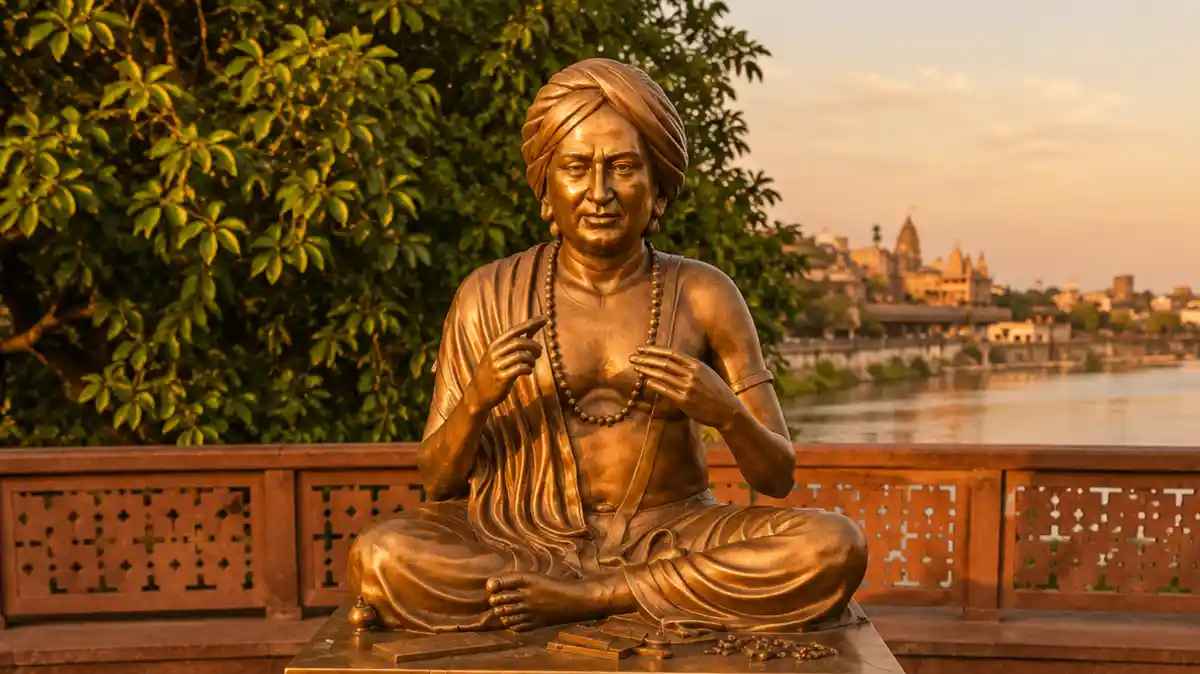
Vikram Tila (Vikramaditya Singhasan Battisi): On the island in Rudrasagar lake behind MahakaleshwarExplore the divine Mahakaleshwar Jyotirlinga in Ujjain.. The 2016 brass memorial shows Vikramaditya enthroned with all nine Navaratnas sculpted around him, Vetala Bhatta included. Free entry; 15-20 minutes. This is the one physical site in Ujjain where the courtier's name appears.
Vikram Kirti Mandir / Scindia Oriental Research Institute (SORI): About 4 km from Mahakaleshwar. Holds approximately 18,000 manuscripts in Sanskrit, Prakrit, Arabic and Persian. The SORI is the institutional home of the scholarly culture that produced and preserved the Navaratna tradition, the niti genre, and the storytelling tradition from which the Vetala tales draw. Allow 1 hour; closed Mondays.
This thread works well for
- Readers who want the Navaratna tradition explained honestly, Vetala Bhatta's case shows what a Navaratna with an actual attested text looks like: more traceable than Shanku, but still far from a verified biography.
- Readers who know the Baital Pachisi / Vikram-Vetala stories, understanding that the story cycle and the courtier share only a name, not an authorship connection, adds a genuinely interesting layer to a familiar tradition.
- Visitors interested in Ujjain's court literary culture, the niti genre that the Niti-Pradipa belongs to is one of the most important threads in Sanskrit literature. The Scindia Oriental Research Institute is the right place to explore it.
Plan differently if you are
- Looking for a dedicated Vetala Bhatta monument, there isn't one. He appears only as part of the collective nine-gems representation at Vikram Tila.
- Expecting the Baital Pachisi stories to be his work, they're not. The Vetala Panchavimshati comes from a separate, older tradition with unknown original authorship. The connection exists only in popular imagination.

Comments
No comments yet. Be the first to share your thoughts!
Leave a Comment