
Key highlights
- Amarasimha was a Sanskrit lexicographer, grammarian and poet, author of the Amarakosha. He was not a warrior. No historical or textual tradition of any kind connects him with military service, battlefield victories, or warfare. Descriptions calling him a "warrior-scholar" or "decorated fighter" have no basis in any source.
- The Amarakosha (formal title: Namalinganushasana, "instruction concerning nouns and gender") is India's oldest extant Sanskrit thesaurus. It contains roughly 1,500 to 1,608 verses in the Anushthup meter, covering approximately 10,000 words, arranged by subject rather than alphabetically.
- The work is divided into three kandas: Svargadikanda (heaven and deities), Bhuvargadikanda (earth, plants, animals, humans), and Samanyadikanda (adjectives, grammar, general words). Each kanda is subdivided into vargas (categories).
- Amarasimha was almost certainly a Buddhist, the evidence is the benedictory verse and the placement of the Buddha's names first among deities. A.B. Keith (1956) called him "certainly a Buddhist." The Tibetan Buddhist tradition (Taranatha, 1608) records him as a fully ordained monk.
- Despite its Buddhist authorship, the Amarakosha was accepted across Hindu, Jain and Buddhist scholarly traditions and attracted more than 40 commentaries over a thousand years. The earliest complete commentary is Kshirasvamin's Amarakoshodghatana (11th century).
- The Navaratna tradition that places him at Vikramaditya's court is legendary and historically unreliable, the same judgement that applies to Shanku and Vetala Bhatta. V.V. Mirashi and D.C. Sircar's assessments hold equally here.
- Scholarly consensus places Amarasimha in the 6th century CE. The 57 BCE legendary Vikramaditya is impossible: the Amarakosha reflects knowledge of Kalidasa's works, and the first reliable external mention of the text is in the 9th-century Amoghavrutti.
A necessary correction: Amarasimha was not a warrior
Some popular accounts, including at least one widely circulated article, describe Amarasimha as "Amar Singh: The Warrior-Scholar," a "decorated fighter" who secured "battlefield victories" and served as a military figure at Vikramaditya's court. This description is entirely without foundation.
Every authoritative source, the 1911 Encyclopaedia Britannica, A.B. Keith's A History of Sanskrit Literature (1956), Wikipedia, the Encyclopedia of Buddhism, Wisdomlib, describes Amarasimha as a Sanskrit grammarian, lexicographer and poet. The 1911 Britannica calls him "a Sanskrit grammarian and poet, of whose personal history hardly anything is known." No military tradition, no inscription, no Sanskrit text, no Tibetan chronicle, and no colonial-era reference connects him with warfare of any kind. The warrior narrative is a fabrication, most likely arising from the name element "-simha" (lion), a common honorific in both scholars' and kings' names, or from confusion with later historical figures named Amar Singh. If you've encountered this description elsewhere, discard it.
Who Amarasimha was: what the record shows
Amarasimha's biography is largely lost. The 1911 Britannica says plainly: "of whose personal history hardly anything is known." What's preserved is his work and a few inferences from it.
He was a Sanskrit scholar working in the lexicographical tradition, a field with a long prior history. He himself mentions 18 earlier lexicographers whose works he drew upon; all 18 of those prior lexicons are now lost, which means the Amarakosha is not just India's oldest surviving Sanskrit thesaurus but the oldest surviving work in an entire genre. That alone makes him one of the most consequential figures in the history of the Sanskrit language.
His name combines "Amara" (immortal, deathless) and "Simha" (lion), an honorific compound that Sanskrit scholars and royalty both used. It may or may not have been his birth name.
Was he Buddhist?
The scholarly consensus is yes, with an important nuance. The evidence is internal to the text rather than biographical.
The Amarakosha opens with a benedictory verse praising an unnamed "unfathomable ocean of knowledge and compassion", qualities standardly associated with the Buddha in Sanskrit Buddhist literature. Then, as Wikipedia notes, "the fifth and sixth verses give various names of Buddha and Shakyamuni (i.e. Gautama Buddha). The following verses give the different names of Brahma, Vishnu... Shiva, Indra etc." The Buddha comes first. K.G. Oka, in his 1913 critical edition, stated the work is "a production of a Buddhist." A.B. Keith, in A History of Sanskrit Literature (Oxford, 1956), called Amarasimha "certainly a Buddhist who knew the Mahayana and used Kalidasa." The Tibetan historian Taranatha, in his History of Buddhism in India (1608), records Amarasimha as a fully ordained Buddhist monk.
The nuance: the benedictory verse never names the deity, and for a thousand years, Shaiva commentators read the opening verse as praising Shiva while Vaishnava commentators read it as praising Vishnu. This deliberate ecumenism is part of why the Amarakosha was accepted across Hindu, Jain and Buddhist scholarly traditions, it serves everyone. The Buddhist authorship is a strong scholarly inference, not a documented biographical fact.
The Amarakosha: India's oldest Sanskrit thesaurus
The formal title is Namalinganushasana, "instruction concerning nouns and gender." The popular name Amarakosha derives from "Amara" (the author's name) and "kosha" (treasury, storehouse, and by extension, dictionary or thesaurus). As a kosha, it organizes words by meaning and subject rather than alphabetically, more like Roget's Thesaurus than an alphabetical dictionary, and it has in fact been credited as an early inspiration for Roget.
The word count is traditionally stated as approximately 10,000; the University of Hyderabad's computational analysis (Sivaja S. Nair and Amba Kulkarni, 2010) found the text contains 11,580 content words, of which 9,031 are unique. Both figures confirm the traditional round number. The verse count varies by edition: A.A. Ramanathan's critical Adyar Library edition (1971) states "a little less than 1,500 Anushthup verses"; other editions count 1,608. The verse form, the Anushthup meter, 32 syllables per stanza, was chosen specifically for memorization, which explains how the text spread across the subcontinent and Tibet as recitation curriculum.
The three kandas
The commentary tradition: 40 to 80+ works over a thousand years
The scale of scholarly attention the Amarakosha attracted tells you more about its importance than any superlative could. Wikipedia states "there have been more than 40 commentaries on the Amarakosha." M.M. Patkar's History of Sanskrit Lexicography counted nearly 60; recent computational scholarship counts at least 80 known commentaries, spanning the 10th to 21st centuries.
| Commentator | Century | Commentary title | Significance |
|---|---|---|---|
| Jatarupabhatta | 10th c. CE | (Fragmentary) | Possibly the earliest commentary; only partial survival |
| Kshirasvamin | 11th c. CE | Amarakoshodghatana | Earliest complete extant commentary; Oka's 1913 edition calls it "the oldest and most important commentary now extant" |
| Vandyaghatiya Sarvananda | 12th c. CE | Tikasarvasva | Important medieval commentary from Bengal |
| Rayamukuta | 14th c. CE | Padachandrika | Widely used in North India; among the most copied |
| Mallinātha | 14th c. CE | Amarapadaparijata | Same author as the great Kalidasa commentator; high literary quality |
| Bhanujidikshita | 17th c. CE | Vyakhyasudha / Ramashrami | Standard South Indian teaching text; widely used in gurukulas |
Sources: Wisdomlib (Amarakoshodghatana study); K.G. Oka, The Namalinganushasana (1913); Wikipedia (Amarakosha), August 2026. Commentary counts vary (40 / 60 / 80+) depending on whether anonymous, fragmentary and modern commentaries are included.
Why Amarasimha cannot belong to the 57 BCE Vikramaditya
The Navaratna tradition places Amarasimha at Vikramaditya's legendary court, but the same chronological impossibility that affects Shanku and Vetala Bhatta applies equally here.
Three independent lines of evidence fix Amarasimha firmly in the Common Era:
The mainstream scholarly consensus, held by Keith, Mirashi and the University of Hyderabad computational study, places Amarasimha in the 6th century CE. A minority view argues the 7th century. No credible modern scholar places him in the 1st century BCE.
The Navaratna tradition: same judgement as before
For this site's readers who have read the Shanku and Vetala Bhatta articles: the same assessment applies to Amarasimha. The Navaratna list first appears in the Jyotirvidabharana, a text falsely attributed to Kalidasa and dated by V.V. Mirashi to the 12th century or later. D.C. Sircar called the tradition "absolutely worthless for historical purposes." The nine gems demonstrably lived in different centuries and could not have shared one court. Placing Amarasimha among the Navaratnas is culturally significant, it reflects genuine recognition of his importance to Sanskrit scholarship, but it's not a historical court record.
The Chandragupta II association
Some scholars, including the 1911 Britannica, suggest the "Vikramaditya" in Amarasimha's tradition was Chandragupta II of the Gupta dynasty (r. c. 375 to 415 CE), who also bore the Vikramaditya title. This is at least chronologically more compatible: the Gupta period was a genuine high point of Sanskrit culture and royal patronage. But as with Vetala Bhatta, no inscription or contemporary text names Amarasimha at Chandragupta II's court. This is a plausible tradition, not established history.
The Amarakosha's reach: from Sanskrit gurukulas to Tibet
The Amarakosha was not just a regional text. Its reach extended across the subcontinent and beyond.
In India, it was traditionally memorized in gurukulas alongside Panini's Ashtadhyayi, functioning as one of the twin pillars of classical Sanskrit training. Online Sanskrit programs today still teach it kanda-by-kanda. The University of Hyderabad's Department of Sanskrit Studies maintains a digital "Knowledge-Net of Amarakosha" for computational linguistic research.
In Tibet, it entered the Tengyur (the canonical collection of translated Buddhist treatises) as Toh 4299. The 12th-century Pali thesaurus Abhidhanappadipika of Moggallana Thera was composed in imitation of the Amarakosha, extending its influence into the Theravada Buddhist world of Sri Lanka and Southeast Asia.
The text was also among the earliest Sanskrit works to attract Western scholarly attention. The first chapter was printed at Rome in Tamil script in 1798. H.T. Colebrooke produced the first complete English-annotated edition at Serampore in 1808, the beginning of the Western Indological tradition of lexicographical study. A French translation followed in 1839; K.G. Oka's critical Sanskrit edition with Kshirasvamin's commentary appeared in Poona in 1913 and remains a standard scholarly edition; B.L. Rice's Kannada-script edition with English and Kannada meanings came out in 1927; and A.A. Ramanathan's critical edition for the Adyar Library (1971), which first published two previously unpublished South Indian commentaries, remains the most scholarly modern edition.
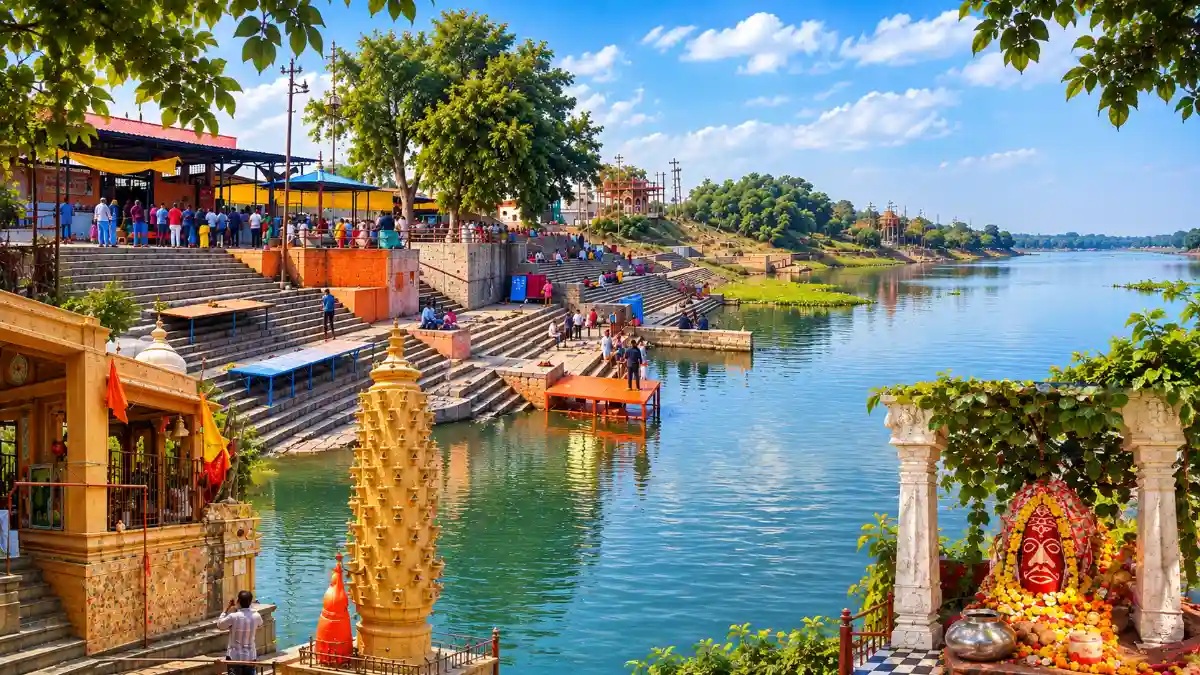
What you can see in Ujjain connected to Amarasimha
Amarasimha has no dedicated temple, inscription, or manuscript site in Ujjain. His connection to the city is through the Navaratna tradition, the legendary Vikramaditya's capital was Ujjain, making it the symbolic home of all nine gems.
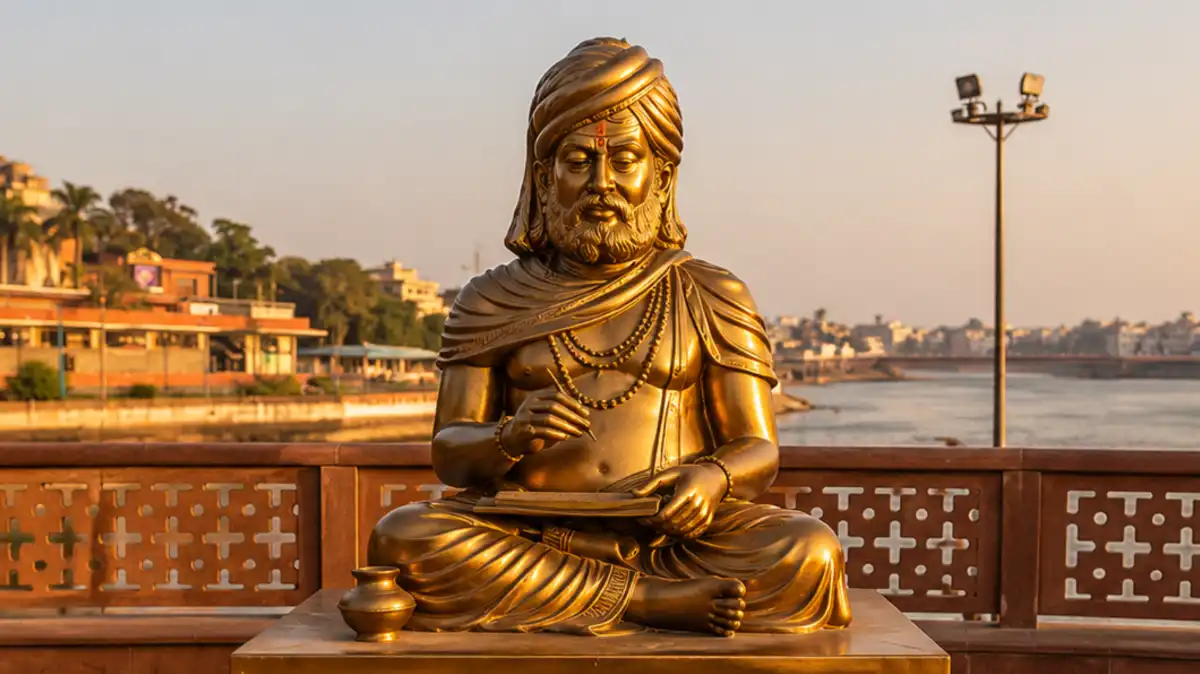
Vikram Tila (Vikramaditya Singhasan Battisi): On the island in Rudrasagar lake behind MahakaleshwarExplore the divine Mahakaleshwar Jyotirlinga in Ujjain.. The 2016 brass memorial depicts all nine Navaratnas including Amarasimha sculpted around the enthroned Vikramaditya. Free entry; 15 to 20 minutes.
Vikram Kirti Mandir / Scindia Oriental Research Institute (SORI): About 4 km from Mahakaleshwar. Holds approximately 18,000 manuscripts in Sanskrit, Prakrit, Arabic and Persian, including lexicographical and grammatical texts of the kind Amarasimha built upon. The SORI is the most direct point of contact with the living manuscript tradition that the Amarakosha both drew from and fed into. Allow 1 hour; closed Mondays.
This thread works well for
- Sanskrit students and scholars, the Amarakosha is not background knowledge; it's an active text in Sanskrit education today. Understanding its structure, commentary tradition and historical place enriches any serious engagement with classical Sanskrit.
- Readers interested in the history of language and dictionaries, the Amarakosha is the oldest surviving work in an entire genre, the ancestor of a commentary tradition spanning a thousand years, and a text that reached Tibet, Sri Lanka and Southeast Asia. That's a remarkable linguistic legacy by any standard.
- Visitors who want to engage with Ujjain's real intellectual heritage, the Scindia Oriental Research Institute's manuscript collection is the tangible form of the tradition Amarasimha both inherited and contributed to.
Plan differently if you are
- Looking for a dedicated Amarasimha monument, there isn't one. He appears only as part of the collective nine-gems representation at Vikram Tila.
- Expecting the "warrior-scholar" story, that narrative is unfounded. Amarasimha's entire fame rests on a work of scholarship, not military service. The Amarakosha is the story, and there's nothing else.
Comments
No comments yet. Be the first to share your thoughts!
Leave a Comment