
Key highlights
- Shanku (Shankuka / Śaṅkuka) is named in the Navaratna verse of the Jyotirvidabharana (22.10), but beyond that name, no primary or peer-reviewed source establishes what he did, what he wrote, or when he lived.
- The "mathematician-astronomer-architect" description found on GK websites has no scholarly basis whatsoever. No primary text, no peer-reviewed paper, no authoritative dictionary connects the Navaratna Shanku to mathematics, geometry, trigonometry, or architecture.
- Traditional sources are openly uncertain about his identity: some call him a mantravadin (expert in mantras), some a rasacharya (alchemist), some a jyotishi (astrologer). Hindi scholars state plainly: "yeh batana abhi asambhav hai", what Shanku actually was remains, at present, impossible to determine.
- A genuinely documented Shankuka exists, but he's a different, later person: a 9th-century Kashmiri poet and Natyashastra commentator who wrote the Bhuvanabhyudayam and proposed the Anumitivada theory of rasa. Scholars explicitly warn that these two are routinely confused.
- The Jyotirvidabharana itself is regarded by V.V. Mirashi and D.C. Sircar as a post-12th-century text that is "absolutely worthless for historical purposes." The nine Navaratnas lived in different centuries and could not have shared one court.
- Shanku has no connection to the Simhastha bathing-date calculations. Those rest on Jupiter's entry into Leo, an astronomical tradition linked to Varahamihira and Ujjain's meridian heritage, not to Shanku.
What the Navaratna verse actually says about Shanku
The nine gems of Vikramaditya's legendary court are named in a single verse of the Jyotirvidabharana (22.10): Dhanvantari, Kshapanaka, Amarasimha, Shanku, Vetala Bhatta, Ghatakarpara, Kalidasa, Varahamihira and Vararuchi. That's the entirety of the primary source. The verse names Shanku and nothing else, no field, no text, no accomplishment.
Wikipedia's article on the Navaratnas is unusually honest about this: "Not much is known about Shanku, Vetala Bhatta, Kshapanaka and Ghatakarpara." That's a remarkable admission for an article about a famous tradition, four of the nine named gems have essentially no documentary record behind them. Shanku is one of the four.
Descriptions calling Shanku a "master of geometry, trigonometry, astronomy, and architectural planning" appear on general-knowledge websites and exam-prep pages, none of which cite a primary source. Monier-Williams' Sanskrit dictionary, Aufrecht's Catalogus Catalogorum, S.K. De's History of Sanskrit Poetics, and Sheldon Pollock's A Rasa Reader (Columbia University Press, 2016), the authoritative references for this period, haven't attributed any mathematical or architectural work to the Navaratna Shanku. The label appears to be a modern confusion, most likely borrowed from Varahamihira, who genuinely was the astronomer-mathematician of the Navaratna list.
What traditional sources actually say about his identity
The tradition isn't silent about Shanku, it just disagrees with itself. The Hindi scholarly tradition, reflected in Webdunia's Simhastha coverage and literary portals like Sahityapedia, records three competing identifications:
The Jyotirvidabharana itself, in one verse, appears to call Shanku a kavi (poet). Some regional retellings describe him in female form, a detail that appears in scattered verses without any consistent textual source. The honest summary comes from the Hindi scholarly tradition itself: "Vasatav mein Shanku kya the, yeh batana abhi asambhav hai", what Shanku actually was remains, at present, impossible to determine.
The legendary genealogy
Some traditional accounts give Shanku a family lineage: he's described as a son of Shabarasvami (the author of the Shabara-bhashya commentary on the Mimamsa-sutras), born from one of four wives, with other wives producing Varahamihira, Bhartrhari and Amarasimha. This is explicitly a legend preserved in "scattered verses" (prakirna padya), no specific primary text names this genealogy, and Webdunia's coverage of the Simhastha Navaratna tradition notes this clearly. It's not a biographical record.
Why the Navaratna tradition itself is historically unreliable
Understanding Shanku's blank record requires understanding the source. The Jyotirvidabharana is the only text that names the nine Navaratnas together, and its reliability is severely questioned by the scholars who have examined it most carefully.
V.V. Mirashi, in his Kalidasa: Date, Life and Works (1969), dated the Jyotirvidabharana to the 12th century and showed it could not be Kalidasa's because it contains grammatical faults incompatible with his authorship. Other scholars have proposed even later dates, A.B. Keith placed it in the 16th century, H. Kern in the 18th. D.C. Sircar, in Ancient Malwa and the Vikramaditya Tradition, called the entire tradition "absolutely worthless for historical purposes."
The arithmetic of the nine names makes the problem concrete. Vararuchi is generally placed in the 3rd to 4th century CE. Kalidasa in the 5th. Varahamihira in the 6th. No single king's court could have held all nine, they span at least 300 years. The Navaratna list is a later literary construction gathering prestige names around the figure of an ideal king, not a court roster.
| Navaratna | What they're actually known for | Approximate period | Scholarly status |
|---|---|---|---|
| Kalidasa | Sanskrit poetry and drama (Meghaduta, Shakuntala) | c. 5th century CE | Well-documented, genuine works survive |
| Varahamihira | Astronomy, astrology (Pancha Siddhantika, Brihat Samhita) | c. 6th century CE | Well-documented, genuine works survive |
| Amarasimha | Sanskrit lexicography (Amarakosha) | c. 6th century CE (debated) | Work survives; dating disputed |
| Vararuchi | Grammar (Varttikas on Panini); Prakrit grammar | c. 3rd to 4th century CE | Multiple figures share the name; complex |
| Dhanvantari | Deity of Ayurveda; avatar of Vishnu | Mythological | Divine figure, not historical individual |
| Kshapanaka | Title for a Jain ascetic, not a personal name | Unknown | Name only; no biography |
| Shanku | Unknown, mantravadin, rasacharya or jyotishi per different traditions | Unknown | Name only; no verified biography or work |
| Vetala Bhatta | Unknown | Unknown | Name only |
| Ghatakarpara | A poem attributed to him survives; authorship uncertain | Unknown | Minimal |
Sources: Wikipedia (Navaratnas); D.C. Sircar, Ancient Malwa and the Vikramaditya Tradition; V.V. Mirashi, Kalidasa: Date, Life and Works (1969); Sheldon Pollock, A Rasa Reader (Columbia University Press, 2016), August 2026. The Navaratna list is a post-12th-century literary construction, not a contemporaneous court record.
The other Shankuka: the 9th-century Kashmiri aesthetician
Here is where the story becomes genuinely interesting, because a real, documented Shankuka exists. He's just not the Navaratna.
Kalhana's Rajatarangini, the 12th-century chronicle of Kashmir, records that during the reign of King Ajitapida (c. 813 to 850 CE), a poet named Shankuka composed a historical poem called Bhuvanabhyudayam, describing events of that era. The Monier-Williams Sanskrit-English Dictionary identifies Shankuka as "a poet (author of the Bhuvanabhyudaya, son of Mayura)" and Aufrecht's Catalogus Catalogorum records "Bhuvanabhyudayam... a poem by Shankuka." This is a real, dateable person with a real work, the earliest historical kavya of Kashmir.
This same Kashmiri Shankuka was also one of the earliest commentators on Bharata's Natyashastra, the foundational Sanskrit text on dramaturgy and aesthetics. His commentary hasn't survived, but Abhinavagupta cites him approximately fifteen times in the Abhinavabharati (c. 1000 CE). Sheldon Pollock, in A Rasa Reader (Columbia University Press, 2016), dates Shankuka's Natyashastra commentary to approximately 850 CE, placing it just after Bhatta Lollata's commentary (c. 825 CE) and just before Bhatta Nayaka's.
Shankuka's Anumitivada: the theory of aesthetic inference
The Kashmiri Shankuka's most significant contribution is a theory of how aesthetic emotion, rasa, works in the spectator. Because his commentary is lost, the theory is reconstructed from Abhinavagupta's quotations.
Bhatta Lollata had argued for Utpattivada: rasa is "produced" and intensified in the character, then transmitted to the spectator. Shankuka disagreed. Drawing on the Nyaya (logic) tradition, he proposed Anumitivada, the theory that rasa is a matter of inference (anumiti). Just as we infer fire from smoke, the spectator infers the emotional state of the character through the actor's imitation, mediated by vibhava (stimulants), anubhava (consequents), and vyabhicharibhava (transient emotions). Rasa is not directly felt, it's inferred.
This was itself rejected by Bhatta Nayaka (who proposed Bhuktivada, rasa as aesthetic enjoyment or savoring) and then superseded by Abhinavagupta's Abhivyaktivada (rasa as revelation or manifestation). The four-stage debate, Utpattivada (Lollata) → Anumitivada (Shankuka) → Bhuktivada (Bhatta Nayaka) → Abhivyaktivada (Abhinavagupta), is one of the central threads in the history of Indian aesthetics and is taught in university curricula from IGNOU to Columbia.
Because both figures share the name "Shankuka," popular and GK sources regularly merge them, attributing the Bhuvanabhyudayam and Anumitivada to the Navaratna Shanku. Vedveer Arya states plainly: "Some scholars have mistakenly identified the Kashmiri poet Shankuka to be one of the Navaratnas of King Vikramaditya." Kalhana places the Kashmiri Shankuka under King Ajitapida of Kashmir (c. 813 to 850 CE), roughly 800 years after the conventional dating of Vikramaditya. They are different people in different places in different centuries. The Bhuvanabhyudayam and the Anumitivada belong to the Kashmiri, not to the Navaratna.
Shanku's place in Ujjain's cultural tradition
The honest position is that the Navaratna Shanku's legacy in Ujjain is cultural and symbolic, not intellectual in any verifiable sense. His name has been part of the city's identity as a seat of learning for centuries, even if the specific learning attributed to him shifts depending on who's telling the story. As the Hindi tradition itself acknowledges, the Navaratna list reflects a cultural aspiration: Vikramaditya's court as the ideal gathering of nine disciplines, a golden age of knowledge in which every field was represented.
What gives Ujjain its genuine intellectual authority is not Shanku but the figures whose work survives and can be verified: Varahamihira's Pancha Siddhantika and Brihat Samhita, which established Ujjain's role as India's astronomical reference meridian; Kalidasa's Meghaduta, which describes the city with a specificity suggesting deep familiarity; and the long tradition of panchang (almanac) scholarship that continues to fix the Simhastha dates using Ujjain's meridian as its baseline. Shanku's name rides alongside this genuine legacy, as a symbol of completeness, not as a documented contributor.
What you can see in Ujjain connected to the Navaratna tradition
The Navaratna tradition as a whole, Shanku included, is physically present in Ujjain through two sites:
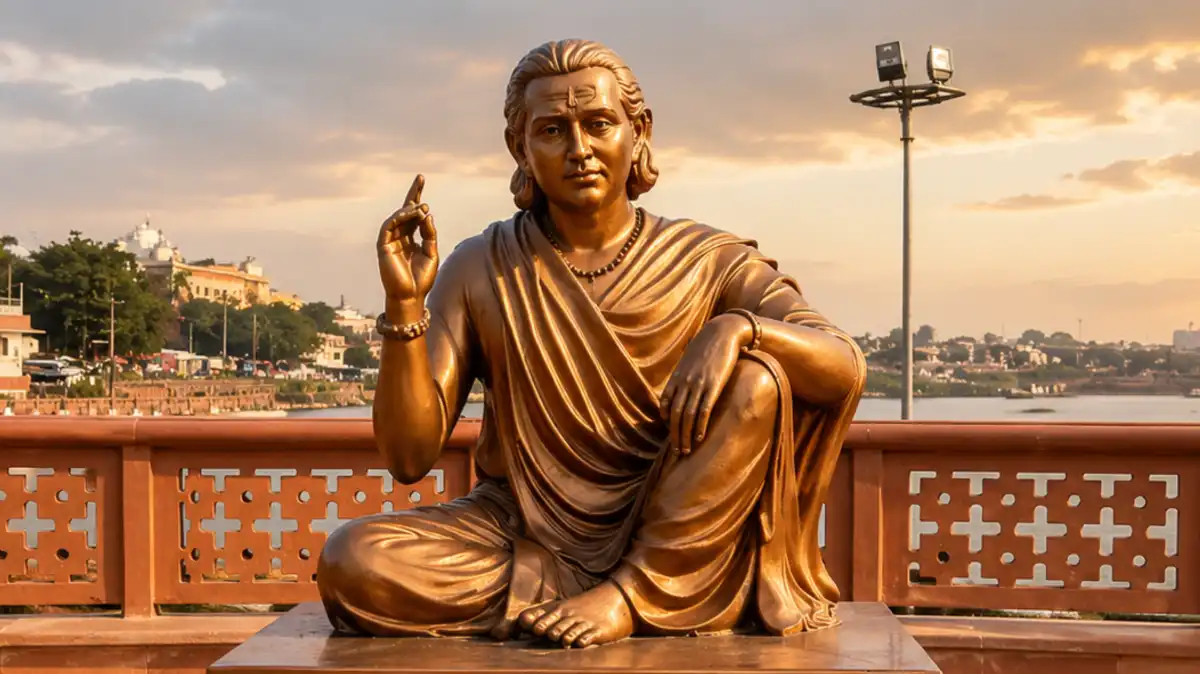
Vikram Tila (Vikramaditya Singhasan Battisi): On the island in Rudrasagar lake behind MahakaleshwarExplore the divine Mahakaleshwar Jyotirlinga in Ujjain.. The 2016 brass memorial shows Vikramaditya enthroned with all nine Navaratnas, including Shanku, sculpted around him. This is the one physical place in Ujjain where Shanku's name is literally present as part of the complete nine-gems tradition. Free entry; 15-20 minutes.
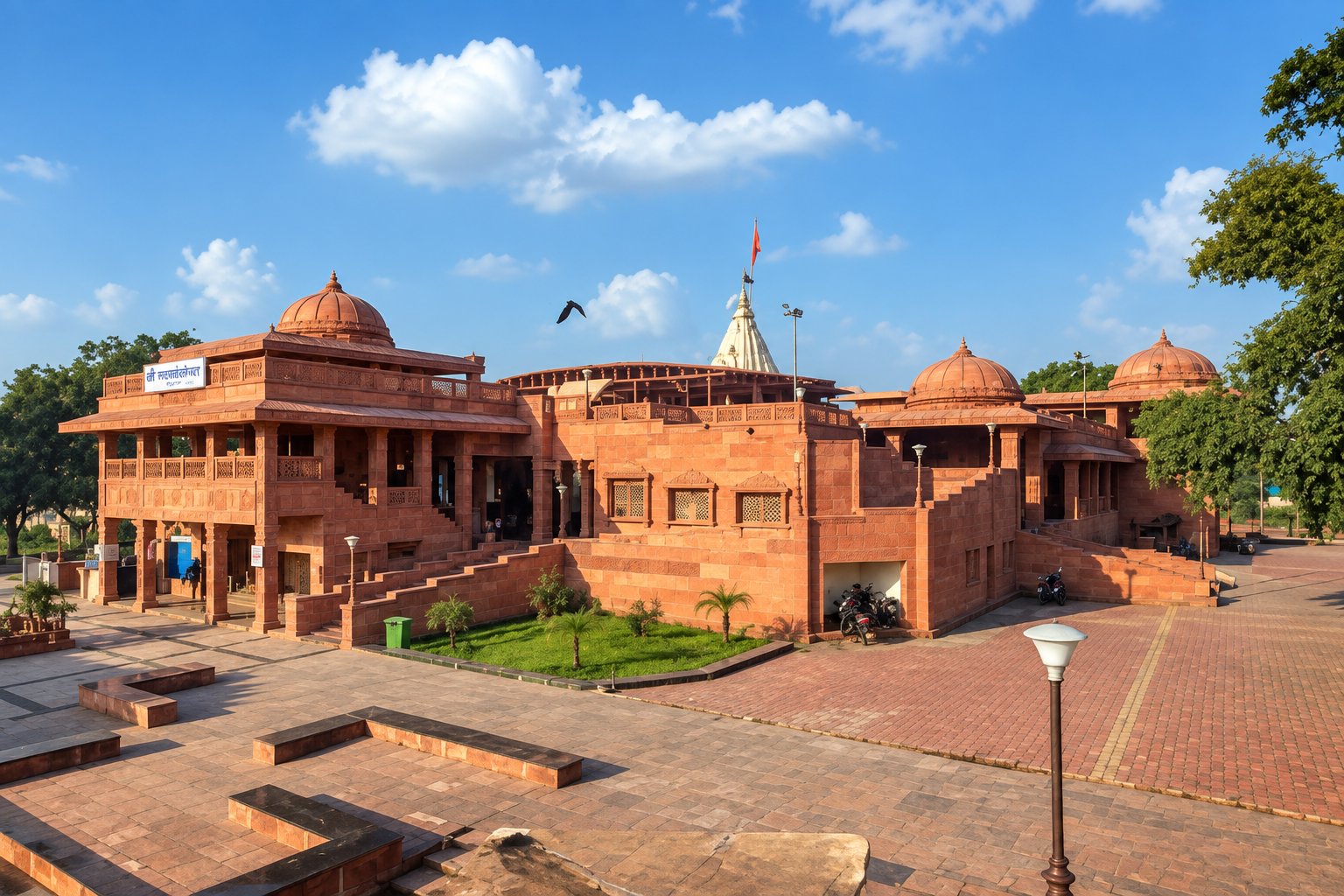
Vikram Kirti Mandir / Scindia Oriental Research Institute (SORI): About 4 km from Mahakaleshwar. Holds approximately 18,000 manuscripts in Sanskrit, Prakrit, Arabic and Persian. The SORI is the physical home of the scholarly culture that produced and preserved both the Navaratna legend and the classical Indian aesthetic tradition, including texts from the Natyashastra commentary lineage that the Kashmiri Shankuka belonged to. Allow 1 hour; closed Mondays.
This thread works well for
- Readers who want to understand the Navaratna tradition honestly, Shanku's near-blank record is the clearest illustration of how the list works: cultural prestige gathering around an ideal, not a staff roster from a real court.
- Students of Indian aesthetics, the Kashmiri Shankuka's Anumitivada is a foundational position in one of the most sophisticated debates in the history of aesthetics anywhere in the world. Knowing it transforms what "rasa" means from a vague word to a contested philosophical problem.
- Visitors who want to engage with Ujjain's real intellectual history, the Scindia Oriental Research Institute is the tangible form of that history. The Navaratna legend is the cultural frame; the manuscript collection is the substance.
Plan differently if you are
- Expecting a specific Shanku monument or site, there isn't one. Shanku appears only as part of the collective nine-gems representation at Vikram Tila. There's no temple, inscription, or manuscript in Ujjain attributed to him.
- Looking for the "mathematician-architect" story, it doesn't exist in any verifiable source. That description is a modern invention with no primary-text basis. The real intellectual legacy of mathematics and astronomy in Ujjain belongs to Varahamihira.
Comments
No comments yet. Be the first to share your thoughts!
Leave a Comment