
Key highlights
- "Kshapanaka" is a Sanskrit common noun for a Jain (or Buddhist) ascetic, a title, not a birth-name. This makes it the most unusual entry on the Navaratna list, and the only one that names a category of person rather than an individual.
- The Navaratna verse comes from the Jyotirvidabharana (22.10), dated to the 12th century or later. D. C. Sircar called it "absolutely worthless for historical purposes." Wikipedia notes: "Not much is known about Shanku, Vetalabhatta, Kshapanaka and Ghatakarpara."
- Siddhasena Divakara (c. 4th-5th century CE) is sometimes identified as the Navaratna Kshapanaka. Historians don't accept this. No medieval Jain text calls Siddhasena "Kshapanaka."
- Siddhasena's three verified works, Nyayavatara, Sanmati-tarka-prakarana and Kalyanamandir Stotra, are foundational to Jain philosophy and still recited in daily Jain worship.
- The Kalyanamandir Stotra legend gives the Avanti Parshvanath Jain temple in Ujjain its founding story and the image at its centre its claimed origin.
- Ujjain's Jain heritage is historically genuine: 32 Jain temples, the Avanti Parshvanath tirth, and documented presence from King Samprati's era (c. 3rd century BCE).
What "Kshapanaka" actually means
Start with the word itself. Kshapanaka (kṣapaṇaka) is a classical Sanskrit common noun. Monier-Williams defines it as "a religious mendicant, (especially a) Jaina mendicant who wears no garments." The root kshapana means "causing to waste away, destroying", and in Jain doctrine this connects specifically to the practice of severe austerity that destroys accumulated karma. The Jain term for this shedding of karma is nirjara, one of the central soteriological concepts in Jain philosophy.
The word appears in the Mahabharata, the Panchatantra, Dandin's Dashakumaracharita and the Kathasaritsagara, always as a generic label for a Jain (or occasionally Buddhist) renunciant, often in contexts that are satirical or ambivalent from a Brahmanical perspective. Wisdomlib's entry confirms: "In the Pancatantra and other Brahmanic Sanskrit works as well as in the Avadanakalpalata and other Buddhist Sanskrit works the Jaina ascetics are nicknamed as Kshapanaka."
So when the Navaratna verse names "Kshapanaka" as one of Vikramaditya's nine gems, it's doing something unusual: it's naming a type of person, not an individual. Either the verse is placing a Jain ascetic-figure at the ideal court as a symbol of religious pluralism, or it's borrowing a well-known generic label for a now-forgotten specific person. Either way, no documented biographical individual stands behind the name from any source earlier than the Jyotirvidabharana itself.
The Navaratna verse (Jyotirvidabharana 22.10) is a post-12th-century text that D. C. Sircar called "absolutely worthless for historical purposes." Of the nine gems it names, four have no independent documentation at all: Shanku, Vetalabhatta, Kshapanaka and Ghatakarpara. Kshapanaka is unique even within this group, the others at least have names. Kshapanaka has only a title, which means the gap between "named individual" and "complete unknown" is larger here than anywhere else on the list.
The Jain concept of kshapana: why this title matters
To understand why a kshapanaka at Vikramaditya's court is a meaningful idea, you need to understand what the title implies in Jain thought.
Jain soteriology, the Jain understanding of liberation, is built on the idea that the soul accumulates karma through action, speech and thought. Karma in the Jain system is understood literally as fine matter that sticks to the soul and weighs it down. Liberation requires destroying this accumulated karma. Nirjara, the shedding of karma, happens through two paths: passive nirjara, which happens naturally over time, and active nirjara, which is deliberately accelerated through austerity, tapas.
A kshapanaka is someone who has committed to the active path. The Digambara tradition, in which monks go without garments precisely because clothing would be a worldly attachment, is the most visible expression of this ideal. The word kshapanaka specifically evokes the Digambara monk, though Wisdomlib notes it was applied to Buddhist mendicants in some texts as well.
Placing a kshapanaka at Vikramaditya's ideal court is a statement about the king's character: this is a ruler who valued not just poets, astronomers and physicians, but also the renunciant who had left the world behind. That theological resonance explains why the tradition chose a title rather than a name, the category matters more than the individual.
Siddhasena Divakara: who he actually was
In 1909, Mahamahopadhyaya Satis Chandra Vidyabhushana proposed in his History of Indian Logic that the Navaratna Kshapanaka was Siddhasena Divakara, one of Jainism's most important philosopher-logicians. The identification has some currency in Jain tradition. Wikipedia (citing D. C. Sircar) states clearly that it "is not accepted by historians." No medieval Jain text calls Siddhasena by the title "Kshapanaka."
Setting the Kshapanaka question aside entirely, Siddhasena Divakara is a genuinely important figure in the history of Indian philosophy. The Concise Oxford Dictionary of World Religions dates him to approximately the 4th to 5th century CE and identifies him as a Jain logician. His birth name in tradition is Kumudchandra; he was a Brahmin by birth, converted to and initiated into Jain asceticism by the teacher Vriddhavadi-suri.
His three verified works
Anekantavada: the philosophy Siddhasena developed
Because the Sanmati-tarka is Siddhasena's most philosophically significant work, it's worth understanding what anekantavada actually claims.
Anekantavada, literally "the doctrine of many-sidedness", is one of Jainism's most distinctive philosophical contributions. It holds that any complex entity has multiple aspects, and that any single description of it's therefore partial. A pot is simultaneously existing (it is there) and non-existing (it doesn't exist everywhere, and it will eventually cease to exist). A pot is both one (as a whole) and many (as the sum of its parts). To say simply "the pot exists" is to suppress the truth that it simultaneously non-exists in other respects.
This leads to the syadvada method, the practice of prefacing assertions with "syat," meaning "in some respects" or "conditionally." "In some respects, the pot exists." "In some respects, the pot does not exist." "In some respects, both statements are true." "In some respects, the truth of both statements is inexpressible." The tradition elaborates this into a seven-fold formula (saptabhangi).
The doctrine was not invented by Siddhasena, it's present in Jain texts going back to Mahavira's teachings. But Siddhasena's Sanmati-tarka is among the clearest and most systematic expositions of anekantavada in the classical period, and it did so in Prakrit rather than Sanskrit, which meant it was accessible to a wider Jain readership than Sanskrit philosophical texts.
The Kalyanamandir Stotra and the Ujjain legend
The connection between Siddhasena Divakara and Ujjain comes through Merutunga's Prabandhachintamani (c. 1304 CE), a collection of medieval Jain narrative literature. The story is well known in Jain tradition:
Siddhasena was wandering incognito as a penance imposed by his teacher. He entered the Mahakala temple in Ujjain and lay with his feet pointing toward the Shivalinga, an act of apparent disrespect. The king ordered him punished, but the blows fell on the queen instead. Then Siddhasena began reciting the Kalyanamandir Stotra. At the 11th verse, the Shivalinga cracked open and an image of the 23rd Tirthankara Parshvanatha emerged. The king recognised the monk's spiritual power and became a supporter of Jainism. The image that emerged in this legend is the image now worshipped at the Avanti Parshvanath Jain temple in Ujjain.
The Prabandhachintamani is a medieval Jain literary collection, not a historical chronicle. The "king" in the story is not identified as a specific, verifiable ruler. Attempts to connect him to the Vikramaditya of the Navaratna tradition create the same chronological impossibility that affects all the nine gems, Siddhasena's c. 4th-5th century CE dating can't be reconciled with any standard dating of Vikramaditya.
What the legend establishes is the founding narrative of one of Ujjain's most important Jain pilgrimage sites. That narrative is real, living, and actively believed regardless of its historical status.
Ujjain's Jain heritage: the documented history
Even setting aside Kshapanaka and Siddhasena entirely, Ujjain's connection to Jainism is historically genuine and extends back roughly two millennia.
Ujjain (ancient Avanti) appears in Jain canonical texts as one of the cities where the Tirthankaras are said to have travelled and taught. The Maurya king Samprati, grandson of Ashoka, ruling c. 224-215 BCE, is credited in Jain tradition with an extensive temple-building programme across his empire, with Ujjain as one of his capitals. While historians treat the scale of the Samprati tradition as partly legendary, his rule from Ujjain is historically documented, and the presence of Jainism in the Malwa region from at least the 3rd century BCE is attested in the archaeological and textual record.
The city has carried both Shaiva and Jain identities simultaneously for this entire period. The 32 Jain temples in the Avanti Parshvanath complex alone represent a continuous investment in Jain pilgrimage infrastructure. That number isn't incidental, it reflects centuries of patronage by Jain merchants, rulers and religious communities who found Ujjain a hospitable city for their tradition alongside its overwhelmingly Shaiva religious identity.
| Period | Jain connection to Ujjain | Historical status |
|---|---|---|
| c. 6th century BCE | Jain canonical texts place Avanti among cities visited by Tirthankaras | Traditional; no contemporary archaeological confirmation |
| c. 3rd century BCE | King Samprati (grandson of Ashoka) credited with Jain temple building; Ujjain one of his capitals | Samprati's rule from Ujjain documented; scale of building tradition partly legendary |
| c. 4th-5th century CE | Siddhasena Divakara's tradition places his Ujjain encounter at the Mahakala temple | Prabandhachintamani (c. 1304 CE), medieval literary tradition, not contemporary chronicle |
| Medieval period onward | Avanti Parshvanath temple complex develops; 32 temples built over time | Active living tradition; temple complex is a functioning pilgrimage site |
| Present day | 32 Jain temples in the Avanti Parshvanath complex; one of Madhya Pradesh's significant Jain tirthas | Confirmed; active pilgrimage centre |
Sources: Wikipedia (Samprati, Siddhasena Divakara, Avanti); Jain Sattva (Avanti Parshvanath temple); Concise Oxford Dictionary of World Religions (Siddhasena Divakara), August 2026.
Who should explore this tradition
This thread works well for
- Readers interested in Jain philosophy, Siddhasena's Sanmati-tarka is one of the clearest classical expositions of anekantavada, and his Nyayavatara marks the beginning of formal Jain logic. Understanding his work enriches any visit to a Jain site.
- Visitors interested in Ujjain's religious pluralism, the presence of 32 Jain temples alongside the Shaiva MahakaleshwarExplore the divine Mahakaleshwar Jyotirlinga in Ujjain. complex tells you something real about how Ujjain has functioned as a multi-tradition religious city for two millennia.
- Anyone drawn to the honest version of the Navaratna tradition, Kshapanaka is the entry that makes the nature of the entire list most visible. A title rather than a name, representing an ideal rather than an individual, placed at an imaginary court to express something about what kind of king Vikramaditya was supposed to be.
Plan differently if you are
- Expecting a verified Kshapanaka biography, there isn't one. The word names a category of person, not a documented individual. That's the honest position, and it's actually more interesting than a fabricated biography would be.
- Expecting a Kshapanaka temple, there's no ancient site dedicated to him. The Vikram Tila memorial (2016) includes him among the nine Navaratnas, but it's modern commemorative art.
- Visiting the Avanti Parshvanath complex without checking access first, the site is a living Jain pilgrimage centre with its own festival calendar and its own visiting norms. Non-Jain visitors are generally welcome at the outer temples; check with the temple management on inner-sanctum access guidelines before arriving.
What you can see in Ujjain connected to Kshapanaka's tradition
Kshapanaka has no dedicated temple or ancient monument. But three sites in Ujjain give the tradition physical form:
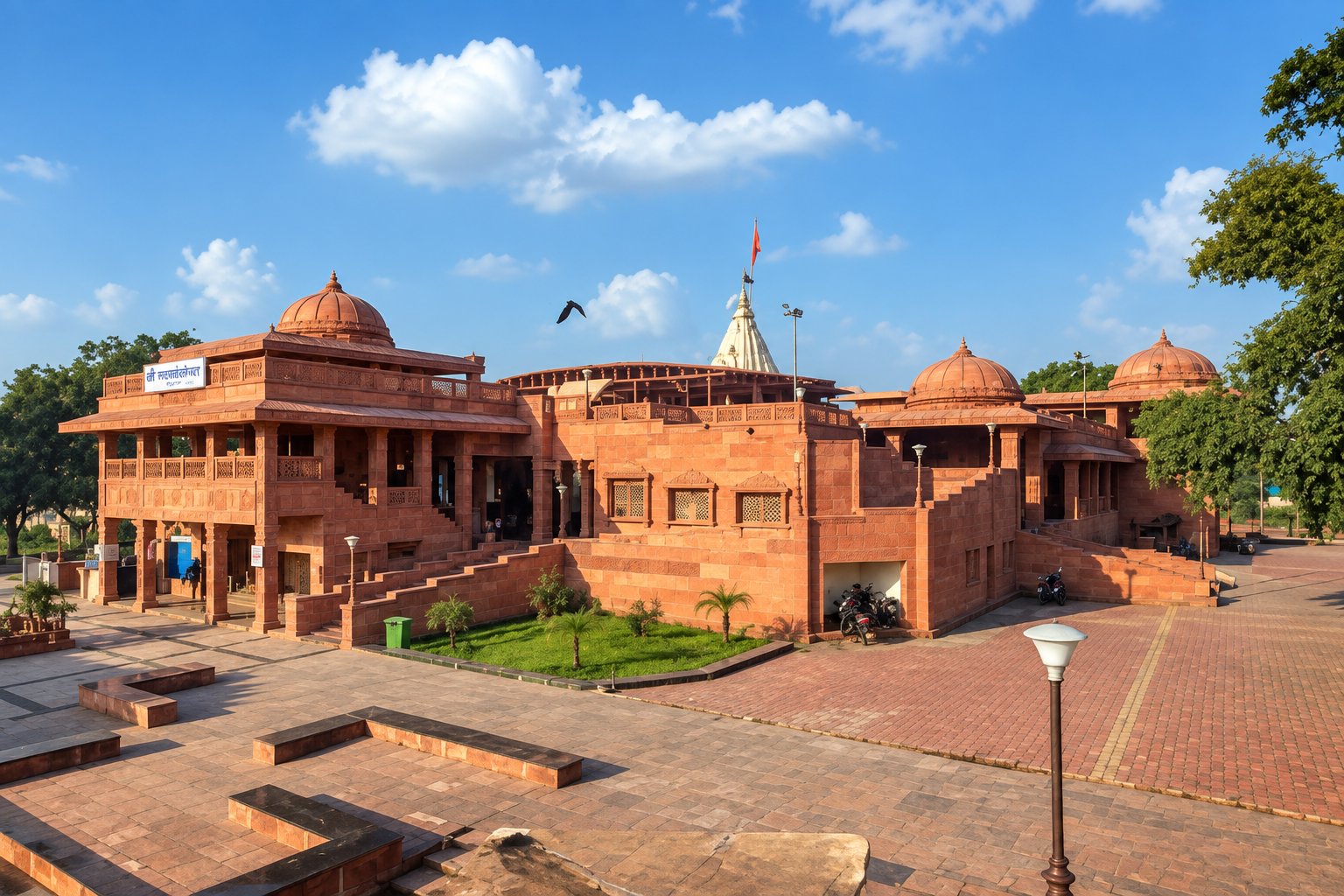
Avanti Parshvanath Jain temple complex: The most substantive site by far. The complex holds 32 Jain temples; its centre is the Avanti Parshvanath image said in tradition to have emerged from the Shivalinga during Siddhasena Divakara's recitation of the Kalyanamandir Stotra. A living pilgrimage centre, active year-round, located in the old city area accessible by auto from Mahakaleshwar. Non-Jain visitors are generally welcome at outer temples; confirm inner-sanctum access guidelines with the management before visiting.
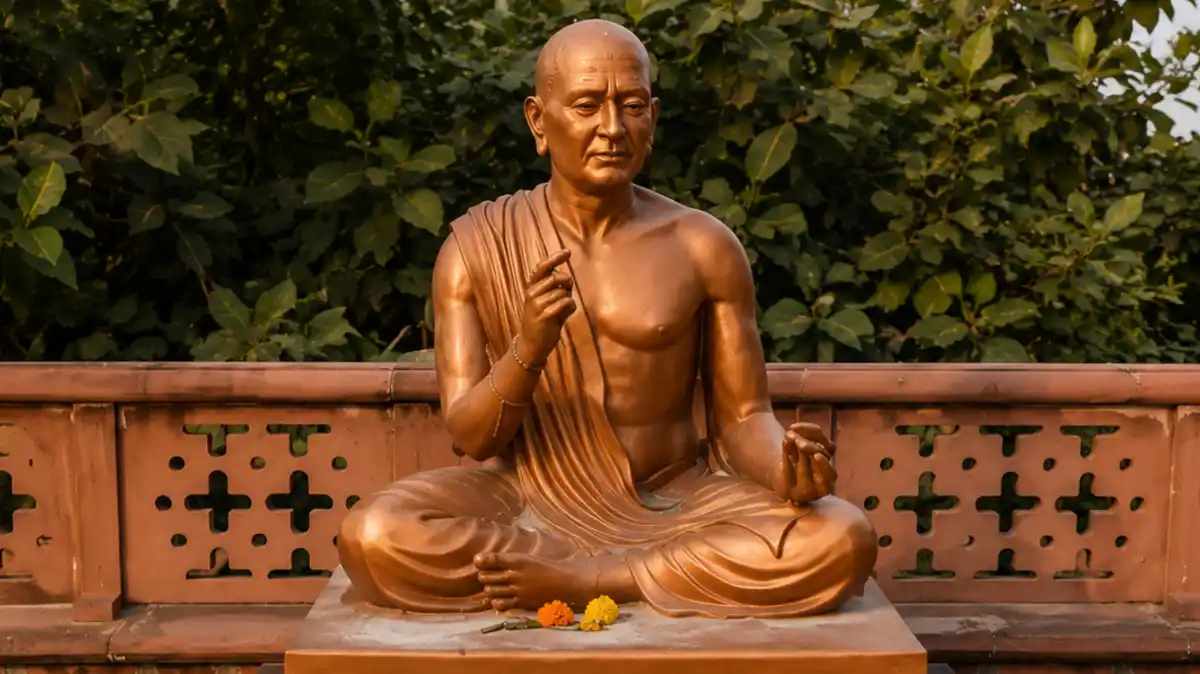
Vikram Tila (Vikramaditya Singhasan Battisi): On Rudrasagar lake island behind Mahakaleshwar. The 2016 brass memorial shows all nine Navaratnas, including a figure identified as Kshapanaka, sculpted around the king's throne. Free entry; 15-20 minutes. Modern commemorative art, not ancient monument, but the one physical spot in Ujjain where the complete Navaratna tradition is present.
Vikram Kirti Mandir / Scindia Oriental Research Institute: Roughly 4 km from Mahakaleshwar. Holds approximately 18,000 manuscripts in Sanskrit, Prakrit, Arabic and Persian, including texts from the Jain and Buddhist traditions alongside the Hindu ones. Represents the classical literary-scholarly culture of Ujjain that both the Navaratna legend and Siddhasena Divakara's tradition draw from. Adjacent museum covers the city's archaeological history. Allow 1 hour; closed Mondays.
Comments
No comments yet. Be the first to share your thoughts!
Leave a Comment