

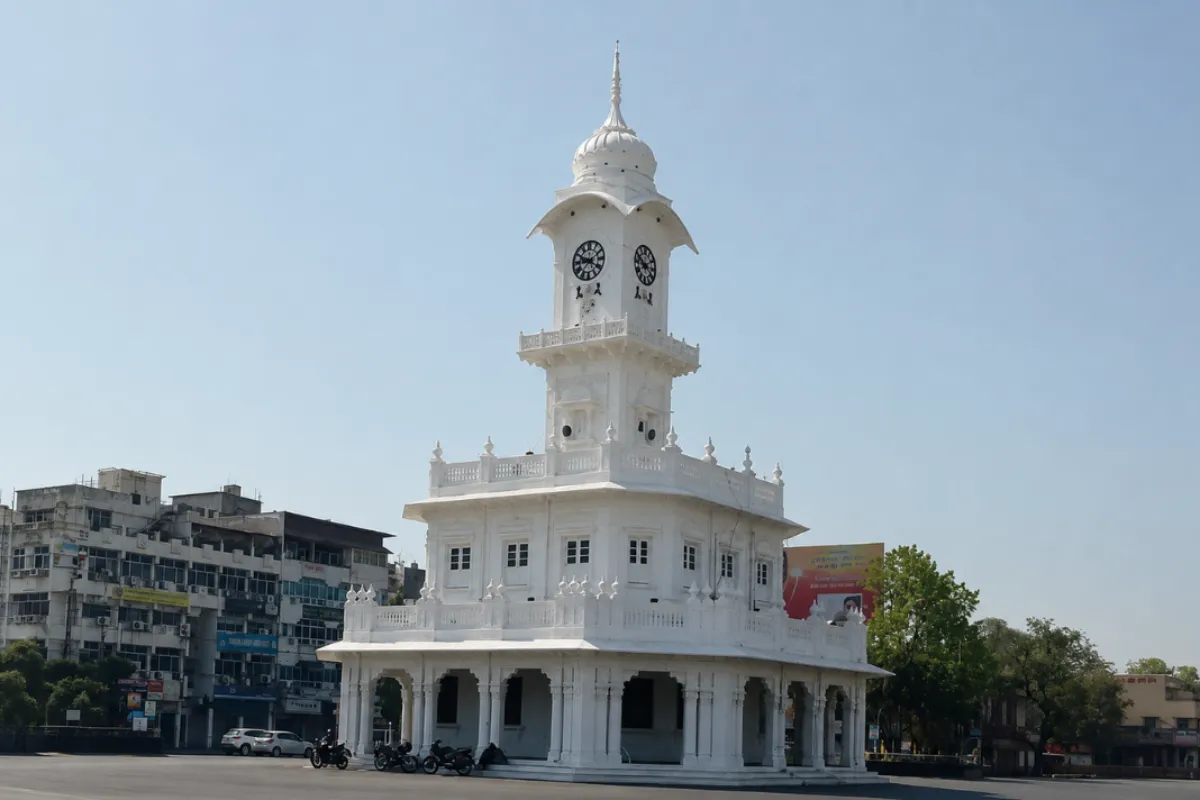
What Tower Chowk actually is
Tower Chowk is an intersection: several roads meet at a central square in Freeganj, and in the middle of that square stands the clock tower. The tower is tall, visible from a distance, and has served as a wayfinding landmark for the city since the colonial period.
The broader context matters here. Clock towers built in Indian cities during British rule were not decorative. They were civic infrastructure - placed at city centres to establish public timekeeping in commercial areas, near railway stations, and at market junctions. In the three decades from 1870 to 1900, the majority of Indian cities had clock towers as important identity markers. Their presence asserted a larger social and cultural phenomenon: reflecting the imagery of local patrons and European colonial power. Ujjain's Ghantaghar fits squarely in that tradition.
The Freeganj area it stands in is described as the most affluent and expensive area of Ujjain, known for its education hub, coaching institutes, and proximity to Ujjain Junction railway station. That positioning was deliberate: colonial urban planners consistently placed civic infrastructure like clock towers at the intersection of commerce and transit. Tower Chowk is a textbook example.
Quick facts
- Location: Tower Chowk, Freeganj, Madhav Nagar, Ujjain, Madhya Pradesh 456010
- Distance from Ujjain Junction railway station: approximately 240 metres (walkable)
- Local name: Ghantaghar (clock house)
- Type: Colonial-era clock tower at a central commercial intersection
- Area character: Commercial hub, street food zone, night market
- Best time to visit: Evenings, when the market fully opens and the tower is lit
- Entry: Open public space, no entry fee
Freeganj: the neighbourhood the tower shaped
Freeganj is Ujjain's commercial centre in a way the older city areas - clustered around Mahakaleshwar and the ghats - are not. It has the railway station, the coaching institutes, the hotels, the banks, and the busiest market streets. Tower Chowk sits at its heart.
The name "Freeganj" itself has colonial roots: "ganj" is the Hindi-Urdu word for a marketplace or grain market, and the "Free" prefix typically indicated a market free from certain duties or tolls during British administration. The combination of a toll-free market, proximity to the railway terminus, and a central clock tower made this area the commercial engine of British-era Ujjain.
That commercial character has held. Today Freeganj is known for its educational institutions - IIT-JEE and medical coaching centres are concentrated here - alongside hotels, shops, and the round-the-clock activity that comes from being 240 metres from a major railway junction.
The clock tower in Indian urban history
To understand Tower Chowk's historical weight, it helps to understand what clock towers meant in colonial Indian cities. They were not just timekeeping devices. Ghantaghar has been considered a marked distinction of British architecture, indicating a symbolic centrality of imperial administration and reflecting the cultural, religious and political acumen of the imperial mind in the town planning of an administrative centre. This symbolic erection was used as a means of expressing wealth, power, manifestation of authority, and influence of empire.
But over time, Indian cities absorbed these structures and made them their own. The tower became a meeting point, a navigation marker, a backdrop for street markets. The architecture of these clock towers was an eclectic mix of local architectural styles and the style brought in by colonial planners - as seen in the public buildings undertaken by them. In Ujjain's case, the Ghantaghar became so embedded in local life that it gave its name to the entire intersection. "Meet me at Ghantaghar" is still how directions are given.
[Note: The precise construction year of Ujjain's Ghantaghar has not been independently verified from primary or government sources. Most Indian clock towers of this type were built between 1880 and 1920. The construction date will be updated here when a verified source is available.]
What the area looks like today
Tower Chowk functions on two shifts. The day shift is commercial: clothing shops, hardware stores, medical shops, small eateries, banks, and offices all open onto the roads that converge here. The foot traffic is constant - students heading to coaching classes, commuters walking from the railway station, pilgrims passing through en route to Mahakaleshwar.
The evening shift is when Tower Chowk earns its reputation. Tower Chowk is a bustling commercial hub where tradition meets commerce, known for its vibrant street food stalls, local crafts, and affordable clothing - an excellent place to experience the pulse of daily life in Ujjain. After dark, Tower Chowk transforms into a vibrant night market where stalls and shops stay open late, offering everything from traditional handicrafts to street food - a lively spot to witness the local hustle and bustle after dark.
The tower itself is lit in the evenings. Photographs taken here at night - the lit tower, the crowds below, the movement of traffic and vendors - are a staple of Ujjain travel documentation on social media. Visitors note good panoramic views and an even better view at night, with a lively atmosphere.
Street food at Tower Chowk: what to eat
This is one of the more concrete things that can be said about Tower Chowk without overstating it: the street food here is genuinely worth the visit, independent of any heritage interest in the tower itself.
Poha-jalebi at Tower Chowk is one of the must-try combinations in Ujjain - a classic Malwa breakfast pairing that the city does well. The combination of flattened rice cooked with mustard, curry leaves, and green chillies alongside fresh hot jalebis is Ujjain's standard morning offering, and Tower Chowk's vendors do a reliable version of it.
Tower Chowk offers an array of street food including chaats like pani puri and dahi puri, each dish packed with bold flavours. Beyond those, the stalls rotate through bhel puri, samosa, dabeli, and various fried snacks depending on the vendor and the season.
A practical note: the best time for breakfast food is 7 to 9 AM, when poha-jalebi vendors are at their freshest. Evening chaat stalls are busiest between 6 and 9 PM. The market thins out after 10 PM but does not fully close.
The clock tower is lit from dusk, the street food stalls are fully open, and the pedestrian density makes the area feel properly alive. Peak afternoon heat (April to June) makes the outdoor market uncomfortable - mornings work better in those months. October to March is the most comfortable overall, with cooler evenings and clearer skies that make the tower photographs worthwhile.
Tower Chowk as a navigation anchor for Ujjain
One practical function of Tower Chowk that rarely appears in formal travel guides: it is the city's clearest orientation point. Ujjain's old city layout near the ghats and temples is maze-like, with narrow lanes and few clear landmarks. Freeganj, with Tower Chowk at its centre, is the point from which most visitors re-orient.
From Tower Chowk, the main areas of Ujjain are roughly as follows: Mahakaleshwar Jyotirlinga is approximately 1.5 km south. Ram Ghat is about 1.7 km south-southwest. Kal BhairavThe revered Kaal Bhairav temple of Ujjain. Temple is about 2 km north-east. Chintaman Ganesh Temple is roughly 6 km west. The Vedh Shala (Jantar Mantar observatory) is about 1 km south-west.
Auto-rickshaws, e-rickshaws, and app-based cabs all operate from Tower Chowk. It is the most reliable place in the city to find transport at any hour, including late nights after the Bhasma Aarti at Mahakaleshwar ends.
Nearby areas worth exploring from Tower Chowk
Tower Chowk connects to several other commercial and cultural pockets within walking distance:
- Gopal Mandir area (10 to 15 minutes on foot south-west): The marble Gopal Mandir temple, originally built by Mahadji Scindia and reconstructed by Maharani Bayzabai Raje Scindia, anchors another busy market zone. The lanes between Tower Chowk and Gopal Mandir have textile shops, silver jewellery sellers, and pooja material vendors.
- Topkhana Market (nearby): Topkhana Market is Ujjain's famous fabric market, known for textile shops that showcase sarees, dress materials, and a wide array of tailored fabrics. Reachable on foot from Tower Chowk.
- Sarafa Bazar (evening gold and silver market): Developed during the Scindia era, Sarafa is Ujjain's jewellery market and is active in the evenings, within the broader old city.
- Ujjain Junction railway station (240 metres): The proximity means Tower Chowk is genuinely useful as a last stop for shopping, eating, or sitting before a train departure.
Comments
No comments yet. Be the first to share your thoughts!
Leave a Comment