

What is Siddhavat and why does it matter
The name breaks down simply: "siddha" means spiritual accomplishment, and "vat" is the banyan tree. Tradition holds that ancient sages performed tapasya under this banyan and attained siddhis here. The tree is not just the backdrop to the shrine. It is the shrine.
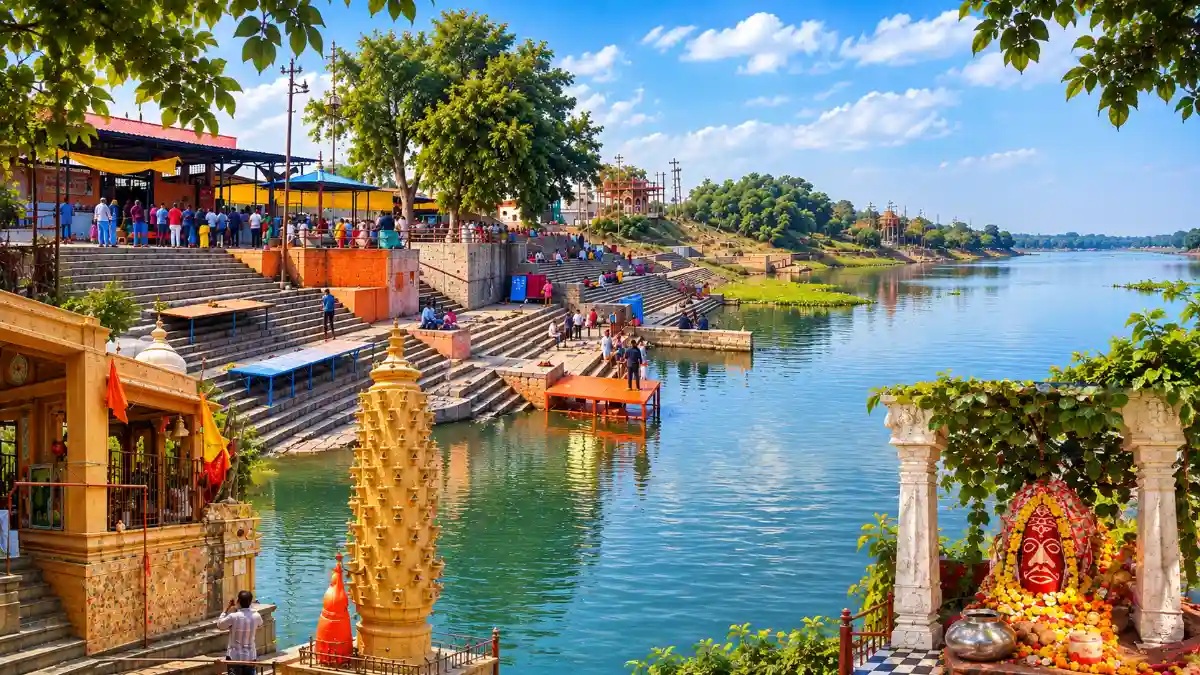
Within the complex stands a Shiva linga named Pataleshwar, a stone called the Preta-shila (associated with rites for the departed), and a Mataji shrine built around the banyan. The entire complex is built on a ghat descending to the Shipra, where pilgrims take a ritual dip before performing ancestral rites.
Siddhavat's coordinates (approximately 23°13'26"N, 75°46'37"E) place it roughly 4 km from Ujjain's city centre and about 6 km by road from the MahakaleshwarExplore the divine Mahakaleshwar Jyotirlinga in Ujjain. Temple.
Key facts at a glance
- Location: Bhairavgarh, east bank of the Shipra River, Ujjain, Madhya Pradesh
- Type of shrine: sacred banyan tree (vat) complex with ghat, Shiva linga (Pataleshwar), Preta-shila stone
- Primary purpose: pind daan, tarpan, and shraddha rites for ancestors
- Also performed: Kaal Sarp Dosh Nivaran, Pitra Dosh Shanti, Tripindi, Narayan Bali
- Best days: Pitru Paksha fortnight, Somvati Amavasya, any Amavasya
- Entry: free. Pandit fees apply for rituals; negotiate and confirm before the ritual begins.
- Timings: roughly 5:00 AM to 9:00 PM daily [verify locally before visiting]
- Distance from Mahakaleshwar: approximately 6 km (15 to 20 min by auto)
The 3 gifts of Siddhavat: progeny, prosperity, salvation
Every ritual performed here maps to one of 3 siddhis the tree is said to grant:
- Santati (progeny): couples wanting a child make an inverted swastika (ulta sathiya) and later fill the lap with a coconut. This rite is performed specifically under the banyan.
- Sampatti (prosperity): devotees tie a raksha-sutra (red thread) around the tree's trunk for material well-being and wish-fulfillment.
- Sadgati (ancestral salvation): the most common and central ritual. Pind daan, tarpan, and milk offering (doodh abhishek) are performed for the peace and moksha of departed ancestors.
The third siddhi is why most pilgrims make the journey. Siddhavat is not a general-purpose temple. Its specialty is the departed.
Mythology: Parvati, Kartikeya, and the spear in the river
The Skanda Purana's Avanti (Avantika) Khanda is the principal scriptural source for Siddhavat. It calls the site "preta-shila-tirth," a tirtha for the departed, and says Goddess Parvati herself planted the banyan here and performed penance at this spot. She is also said to have prepared kheer (rice pudding) for her son Kartikeya at this location.
The second layer of the myth concerns Kartikeya (Skanda), appointed general of the divine armies. After he slew the demon Tarakasura, Kartikeya flung his shakti (spear) into the Shipra River here, and the spear descended into Patala (the netherworld). That act gave the place its other name: Shaktibhed Tirtha.
Kalidasa's Sanskrit epic Kumarasambhava, "The Birth of the War-God," is the literary telling of exactly this story: the union of Shiva and Parvati, the birth of Kartikeya, and his campaign against Tarakasura. The myth is not obscure folklore. It has one of the most celebrated literary treatments in classical Sanskrit.
When Kartikeya's shakti entered Patala through the riverbed here, the Shiva linga in the complex was named Pataleshwar: "Lord of Patala." Most visitors focus on the banyan tree and miss the linga's specific mythological significance. Both deserve attention if you're visiting for the mythology rather than a ritual purpose.
The immortal tree: the Mughal iron-plate legend
The most repeated legend about the physical tree concerns the Mughal period. The banyan was cut down. The stump was capped with iron sheets, reportedly 7 of them, to stop regrowth. The tree broke through the iron and grew back.
This is treated across all available sources as devotional tradition rather than documented history. There is no dated record of who ordered the cutting or precisely when. But the legend does the specific work of cementing the tree's reputation as "immortal" (akshaya), which is why it's told and retold across tourism, religious, and news sources in the same terms. The tree's ability to pierce iron became proof of divine origin.
Siddhavat is a living banyan. It isn't in a museum, and it doesn't have a plaque with a founding date. The tradition explicitly treats the tree's age as unknown and that unknowability is itself considered a mark of great antiquity.
Other legends connected to the site
| Legend | What it says | Status |
|---|---|---|
| Rama's shraddha for Dasharatha | Lord Rama performed his father King Dasharatha's tarpan and pind daan at Siddhavat | Devotional tradition |
| Vikramaditya and the Vetala | King Vikramaditya performed austerities at this tree to gain mastery over the Betaal in the Vikram-Betaal folklore cycle | Devotional tradition |
| Ashoka's children | Prince Mahendra and Princess Sanghamitra worshipped here before departing to spread Buddhism to Sri Lanka | Devotional tradition |
| Nath sect | Siddhavat was historically a worship centre for the Nath (Natha) yogis | Historically attested tradition [verify] |
One of India's 4 sacred banyans
Hindu tradition groups a small number of banyan trees as supremely sacred and of unknown origin. Siddhavat of Ujjain is one of 4 (sometimes 5):
| Sacred vat (banyan) | Location | Associated deity/tradition |
|---|---|---|
| Siddhavat | Ujjain, Madhya Pradesh | Parvati, Kartikeya; pind daan for ancestors |
| Akshayavat | Prayagraj (also Gaya), Uttar Pradesh | Cosmic banyan; mentioned in the Mahabharata |
| Vanshivat (Vamshivat) | Vrindavan, Uttar Pradesh | Krishna's flute-playing beneath the banyan |
| Panchavat | Nasik, Maharashtra | Rama, Sita, and Lakshmana's forest exile |
| Gridhravat (Gyddhavat) | Soron (Shukar Kshetra), Uttar Pradesh | Cited in the Varaha Purana; the 5th sacred vat in some traditions |
Rituals at Siddhavat: what to expect and how to prepare
The rites at Siddhavat are specific. Come with a clear ritual purpose. Every ritual here has a defined purpose, and the pandas (hereditary priests) maintain family genealogical records going back around 150 years, meaning they can often trace your lineage and conduct rites for specific ancestors if you give them only your name and native village.
Pind daan and tarpan
The central ritual. You bathe first in the Shipra at the Siddhavat ghat, then proceed to the ritual space. The pandit conducts the pind daan (offering of rice balls representing the departed) and tarpan (water offering with sesame seeds) in your and your ancestors' names. The Preta-shila stone at the complex is specifically associated with these rites.
Siddhavat is considered one of the few sites in India where pind daan carries the same spiritual weight as Gaya and Prayag. That's not marketing copy. It's a position the tradition holds on the basis of the Skanda Purana's explicit designation of this site as "preta-shila-tirth."
Kaal Sarp Dosh Nivaran and Pitra Dosh Shanti
Along with Trimbakeshwar near Nasik, Siddhavat is one of the 2 most prominent centres in India for Kaal Sarp Dosh Nivaran puja. Also conducted here: Pitra Dosh Shanti, Tripindi, and Narayan Bali. These are separate rituals from the standard pind daan and require dedicated pandit time; pre-arrange your visit rather than arriving and hoping.
At Ram Ghat (6 km away), priests actively push Kaal Sarp Dosh puja on walk-in pilgrims. Trimbakeshwar near Nasik remains the primary established site for this ritual, with Siddhavat as the recognized alternative.
If Kaal Sarp puja is your purpose, come to Siddhavat directly and engage the Tirth Purohit Panda Samiti. Avoid anyone soliciting you at Ram Ghat for this specific rite.
Milk offering (doodh abhishek)
Pilgrims pour milk over the banyan tree's roots and branches specifically for ancestral peace and Pitra Dosh relief. This is separate from the pind daan itself and can be done independently.
Thread-tying and the progeny rite
For material prosperity, devotees tie a red thread (raksha-sutra or kalawa) around the banyan trunk. For a desired child, the ritual involves drawing an inverted swastika and later placing a coconut in the lap. Both rites are simple and self-directed; no extended pandit engagement is needed.
Who conducts the rituals here
Siddhavat doesn't have a single government temple trust like the Mahakaleshwar Temple Management Committee. Ritual management rests with hereditary priests organized under the Tirth Purohit Panda Samiti, whose president is Pandit Rajesh Trivedi. Per Asianet News Hindi, roughly 700 pujaris connected to around 150 families conduct tarpan and shraddha at this site.
Infrastructure renovation is being executed separately by the MP Griha Nirman evam Adhosanrachna Vikas Mandal (MP Housing and Infrastructure Development Board), Ujjain division, which received a state government sanction of Rs. 159 lakh for the Siddheshwar Mahadev Mandir (Siddhavat) renovation. This includes separate entry/exit gates, ramps, expanded pind-daan sheds, an enlarged sabha-mandap, and railings.
No source confirms that the MP Devsthan or Dharmasva department directly administers this temple. The management is hybrid: priests run the rituals, the government funds the infrastructure.
Best time to visit
| Occasion | Why significant | Crowd level |
|---|---|---|
| Pitru Paksha (16-day fortnight) | The designated period for ancestral rites across Hindu tradition; Siddhavat sees its heaviest footfall | Extremely high |
| Somvati Amavasya (Monday new moon) | Amavasya falling on a Monday, considered especially potent for tarpan; can draw massive crowds | Very high |
| Any Amavasya (new moon) | All new moon days are auspicious for ancestral rites at Siddhavat | High |
| Regular weekday morning (6:00 to 9:00 AM) | Quieter darshan, easier access to a pandit without waiting | Low to moderate |
If you're coming specifically for pind daan during Pitru Paksha, arrive by 6:00 AM. By 9:00 AM the ghats are crowded enough that finding a pandit and a clear ritual space takes time. Pre-arranging a pandit the day before is the better approach.
Practical visit information
Dress code and practical tips
- Dress code: traditional clothing for puja participation. Dhoti-kurta for men; saree or salwar-kameez for women.
- Entry: free. Puja costs range significantly by ritual type; verify before starting.
- Timings: approximately 5:00 AM to 9:00 PM daily, with morning aarti around 7:00 AM and evening aarti around 7:30 PM. Confirm locally before visiting, as times vary.
- Avoid online booking portals for Kaal Sarp or Narayan Bali: most are third-party commercial services, not representatives of the Panda Samiti. Arrange directly at the ghat.
- Monsoon: the ghat area can be wet and slippery in peak monsoon (July to August). Non-slip footwear and extra care near the river's edge.
How to reach Siddhavat
Nearby temples: combining Siddhavat with the outer circuit
Siddhavat sits in the same suburban belt as 3 other significant sites, making a half-day outer-circuit trip practical:
- Mangalnath Temple (Mangalnath Ghat): the Mars birthplace shrine, about 2 km from Siddhavat. For Mangal Dosh puja and Bhat Puja.
- Bhartrihari Caves: the meditation site of the poet-king Bhartrihari. Compact, quiet, historically interesting.
- Sandipani Ashram: the gurukul where Krishna, Balram, and Sudama studied. A separate site from Siddhavat but easily combined.
For the full Ujjain circuit, pair this outer loop (Day 2) with the central temples (Mahakaleshwar, Harsiddhi, Ram Ghat) on Day 1.
Siddhavat's position in Ujjain's sacred geography
Ujjain is one of the 7 Saptapuri cities, the Hindu cities of liberation: "Ayodhya Mathura Maya Kashi Kanchi Avantika, Puri Dvaravati chaiva saptaite mokshadayikah." Within Ujjain, Siddhavat sits within a layered network of sacred sites, each with a specific function.
Mahakaleshwar handles Shiva worship and the jyotirlinga pilgrimage. Harsiddhi is the Shakti Peetha. Mangalnath is for Mangal Dosh. Siddhavat handles the departed.
One clarification worth making: Siddhavat is not a Shakti Peetha. The 51 canonical Shakti Peethas are shrines where parts of Sati's body fell. Ujjain's Shakti Peetha associations are with Harsiddhi Temple and Bhairav Parvat.
Siddhavat's "Shakti" connection comes from Kartikeya's shakti (spear), not Sati's body. The confusion is common enough to be worth stating plainly.

Comments
No comments yet. Be the first to share your thoughts!
Leave a Comment