

Why Ujjain is the birthplace of Mars
This claim has a specific mythological basis, not just folklore. The Puranic tradition holds that Lord Shiva fought the demon Andhakasura, and a drop of sweat fell from Shiva's body at this spot on the Shipra's banks. From that point, a Shivalinga emerged, and from that Shivalinga, the planet Mangal (Mars) was born.
Mars in this tradition is called Bhauma (son of Bhumi, the Earth) and Angaraka (the burning ember). The name links back directly to the fiery nature of the planet. He is also called Kuja, meaning "born of the earth."
The best-documented Puranic sources for this legend are the Padma Purana (Srishti-Khanda, Chapter 81), where Bhauma is born as a portion of Shiva from the earth, and the Skanda Purana's Avantya-Khanda, which places the event specifically at Ujjain and names the Shivalinga established here as Mangaleshwar. The commonly repeated citation "as per the Matsya Purana" is not verifiable in any indexed version of that text: no chapter or verse exists in public scholarship. Treat it as devotional tradition rather than a textual source.
Ujjain itself carries deep astronomical significance. Ancient Hindu astronomers used Ujjain as the prime meridian, the zero longitude of classical Indian timekeeping. The city appears as "Ozene" in Ptolemy's 2nd-century CE geography. The observatory built by Maharaja Sawai Jai Singh II in the early 18th century still functions here and publishes its own panchang. This astronomical heritage is one reason Ujjain became the reference point for planetary observation in Vedic astrology, and Mangalnath, by extension, became the temple for the planet Mars.
This is repeated on hundreds of tourism sites. The Tropic of Cancer currently sits at approximately 23°26'N. Mangalnath Mandir is at approximately 23°11'N, about 28.5 km south of the Tropic. The confusion comes from Ujjain's historical role as the zero meridian (longitude) of Hindu astronomy, which has nothing to do with the Tropic's latitude. The temple's astronomical connection is real; the Tropic of Cancer claim is not.
History of the temple: ancient site, modern structure
Ujjain as a city has been continuously inhabited and sacred since at least 600 BCE. It was the capital of the Avanti Mahajanapada, one of ancient India's sixteen great realms. Ashoka served as viceroy here under his father Bindusara. The Surya Siddhanta and Pancha Siddhantika (foundational texts of Indian astronomy) of Indian astronomy. The site of Mangalnath belongs to this ancient continuum.
The building is a different matter. There is no Archaeological Survey of India (ASI) record, no dated inscription, and no documented foundation year for the temple structure. The earliest documented patronage is from the 18th century: Ranoji Scindia, founder of the Scindia dynasty, who established his capital at Ujjain in 1731, renovated several major temples in the city including Mangalnath. The present red-sandstone and marble structure is a reconstruction completed ahead of the 2016 Simhastha Kumbh Mela.
In May 2025, the Ujjain Development Authority announced a Rs. 1,100-crore project covering 11 prominent temples in Ujjain and Agar Malwa, funded partly through Madhya Pradesh's first "Temple Bonds" issue (Rs. 200 crore). Mangalnath is among the temples included. This is an announced plan: construction has not been completed as of the time of writing.
Key facts about Mangalnath Mandir
- Location: Mangalnath Ghat, Shipra River, Ujjain, Madhya Pradesh
- Coordinates: approximately 23°11'16"N, 75°46'05"E
- Deity: Shivalinga (worshipped as Mangal's birthplace, no idol of Mars
- Best day to visit: Tuesday (Mangalwar) or Angarki Chaturthi
- Signature ritual: Bhat Puja (curd-rice offered over the Shivalinga)
- Temple hours: approximately 4:00 AM to 8:00 PM
- Nearest railway station: Ujjain Junction (UJN), approximately 6 km
- Nearest airport: Devi Ahilyabai Holkar Airport, Indore, approximately 53 km
Mangalnath and Angareshwar: two temples, one tradition
Most pilgrims arrive at Mangalnath and assume it's the only significant Mars shrine in the complex. There's a second temple directly adjacent that most visitors miss: Shri Angareshwar Mahadev (also called Angarkeshwar Mahadev).
According to local priestly tradition, Angareshwar is the original birthplace of Mangal and is counted as the 43rd among Ujjain's 84 Mahadev (Chaurasi Mahadev) shrines. The Chaurasi Mahadev circuit holds that Shiva established 84 forms at the spots where drops of the demon Andhaka's blood fell; Angareshwar is one of these 84. Some priests say the Bhat Puja is only complete when performed at Angareshwar, the older site.
The reason most astrologers and travel guides direct pilgrims to Mangalnath rather than Angareshwar is practical: Angareshwar sits in a low-lying area that floods during monsoon, making Bhat Puja impossible for months at a time. A temple committee promoted Mangalnath as the accessible alternative for Mangal Dosha worship. Both temples are worth visiting if you're making the trip specifically for the ritual.
Architecture and layout
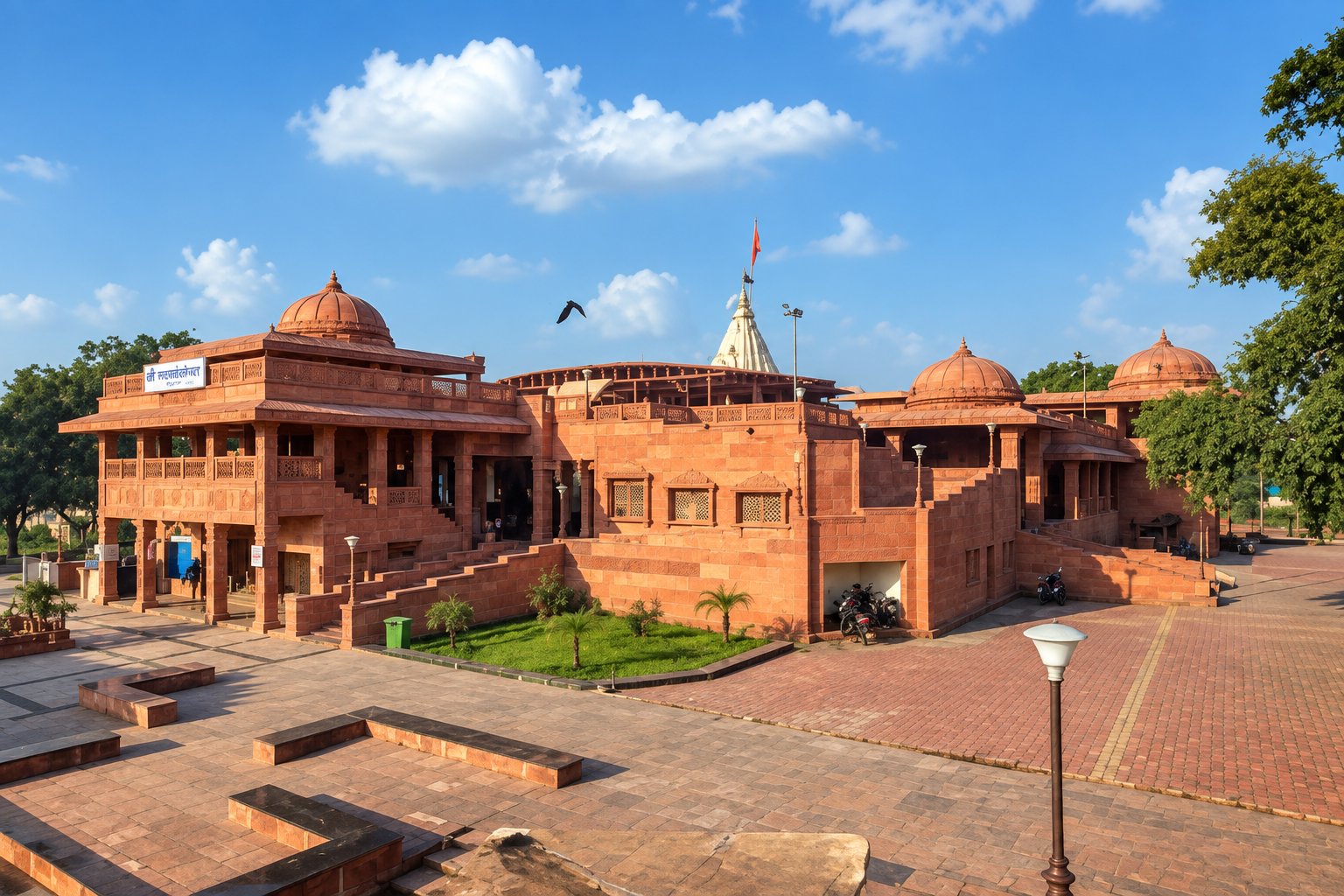
The temple is a 2-storey red sandstone structure. The main sanctum on the upper level houses the Shivalinga. Many first-time visitors are surprised to find no idol of Mars: the Shivalinga is the deity here, worshipped in the context of Mars's birth from Shiva. A lower level (basement) is used for conducting pujas. The complex includes a dedicated ghat on the Shipra where pilgrims bathe before the ritual.
The color red dominates everything: the stone, the offerings, the cloth draped over the Shivalinga, the sindoor. Red is the color of Mars, the fiery, martial planet. The temple sits on a slight elevation above the ghat, giving it a clear view of the Shipra and the riverside ghats.
During peak monsoon (roughly July and August), low-lying sections of the ghat area can flood and disrupt puja. Plan accordingly if you're visiting in this period.
Who should visit: Mangal Dosha explained
Mangal Dosha (also called Manglik Dosha, Kuja Dosha, or Bhom Dosha) is a placement in a Vedic birth chart where Mars occupies the 1st, 2nd, 4th, 7th, 8th, or 12th house from the Ascendant. In stricter interpretations, the same houses are checked from the Moon and Venus as well. The dosha is traditionally associated with delays in marriage, marital discord, health issues, accidents, and property disputes.
Severity varies by placement. Mars in the 7th or 8th house is considered the strongest (directly affecting marriage and spouse). The 4th and 12th are moderate. The 1st and 2nd are milder in most systems. Importantly, several cancellations exist: if Mars is in its own sign (Aries or Scorpio), in its exaltation sign (Capricorn), or if both partners in a marriage are Manglik, the dosha is considered nullified or reduced. A strong Jupiter aspecting Mars in the chart is another common cancellation.
Pilgrims with Ascendant or Moon in Aries (Mesha) or Scorpio (Vrischika, both Mars-ruled signs) are specifically directed to Mangalnath by astrologers. The puja is customarily performed before marriage, though many also come before major property decisions, surgeries, or periods when Mars is transiting sensitive points in their chart.
If your astrologer has confirmed that your Mangal Dosha is cancelled by one of the standard conditions above, the ritual is optional rather than obligatory.
Bhat Puja: the ritual, step by step
Bhat Puja is the signature ritual at Mangalnath. "Bhat" means cooked rice. The offering (boiled rice mixed with curd and kumkum or sindoor) is applied directly over the Shivalinga. The logic is elemental: Mars is a fiery, hot planet (Angaraka = burning ember). Cool curd-rice pacifies that heat.
| Step | What happens |
|---|---|
| 1. Sankalpa | You state your name, gotra (lineage), and purpose. If gotra is unknown, Kashyap gotra is used. |
| 2. Ganesh-Gauri Pujan | Invocation of Ganesha and Parvati before the main ritual begins. |
| 3. Navagraha Invocation | All 9 planets invoked; a Kalash (sacred vessel with water) is established. |
| 4. Panchamrit Abhishek | The Shivalinga is bathed with 5 sacred substances: milk, curd, ghee, honey, and Ganga water. |
| 5. Bhat offering | Curd-rice mixed with sindoor is offered and applied over the Shivalinga. |
| 6. Mangal Beej Mantra jaap | The seed mantra of Mars is chanted a fixed number of times. |
| 7. Aarti | Closing ritual with lamps and hymns. |
Sources: Priestly accounts and pilgrimage documentation: Mangalnath Mandir, Ujjain. Ritual sequence may vary slightly by pandit.
Duration is roughly 1 to 3 hours for the standard Bhat Puja. An extended version with a Navagraha havan runs longer. Reported costs range from Rs. 2,100 (basic) to Rs. 3,100 or Rs. 4,100 for a more complete ritual, and higher amounts if a havan is included. Confirm pricing upfront with the pandit: aggressive touting is common here, and costs are negotiable. Pre-booking a slot is advisable on Tuesdays and Angarki Chaturthi.
Bring your birth chart (kundli) if you have it. Dress code for the inner sanctum is traditional: dhoti and kurta for men, saree or salwar-kameez for women. Bathe at the Shipra ghat before the ritual: this is considered part of the practice, not optional.
One practical note: Some priests insist the Bhat Pujan is only complete at the adjacent Angareshwar temple. If you've traveled specifically for the ritual, ask whether to include both shrines. It adds perhaps 30 minutes and is considered the more thorough approach by local priests.
Best time to visit Mangalnath Mandir
| Occasion | Why significant | Crowd level |
|---|---|---|
| Tuesday (Mangalwar) | Mars's day, highest ritual significance | High |
| Angarki Chaturthi | Chaturthi falling on a Tuesday, considered especially auspicious | Very high |
| Bhaumvati Amavasya | New moon falling on a Tuesday, rare and significant | Very high |
| Shravan month | Shiva-focused month, general temple crowd peaks | High |
| Mahashivratri | Major Shiva festival; the Shivalinga draws heavy darshan | Very high |
| Early morning weekday | Quietest time; best for unhurried darshan and puja | Low to moderate |
Crowd levels are relative to this temple's typical footfall. Sources: local pilgrimage accounts and temple management practice.
Aarti timings most commonly cited: 5:00 AM (morning aarti), 11:00 AM (bhog aarti), 7:00 PM (evening aarti), 10:30 PM (shayan aarti). Special pujas and anushthans are generally conducted between 7:00 AM and 3:00 PM. Confirm exact timings locally before visiting, as they can shift by season.
Other rituals performed at the Mangalnath complex
Bhat Puja for Mangal Dosha gets most of the attention, but several other rituals are performed here or in the adjacent riverside complex:
- Kaal Sarp Dosh Puja: performed when all 7 planets fall between Rahu and Ketu in a birth chart. Note: the traditional and more widely accepted site for Kaal Sarp Dosh puja is Trimbakeshwar near Nashik, not Ujjain. Priests at Ram GhatRam Ghat, the most prominent bathing ghat in Ujjain. in Ujjain actively tout this service; approach with caution.
- Pitra Dosh Puja: for ancestral karmic debts; this is more authentically performed at Siddhavat (also in Ujjain), not Mangalnath specifically.
- Navagraha Shanti: a broader ritual pacifying all 9 planets; can be combined with Bhat Puja here.
- Kumbh Vivah / Ark Vivah: rituals for Manglik individuals before marriage. Kumbh Vivah (marriage to a pot of water) is for women; Ark Vivah (marriage to an Ark plant) is for men. Both nullify Mangal Dosha before the actual marriage ceremony.
Mars in Vedic astrology: what the planet governs
Understanding why Mangalnath draws such specific pilgrimages requires knowing what Mars represents in Vedic astrology. Mars is a natural malefic: fiery, aggressive, energetic. It governs courage, physical strength, land and property, blood and surgery, siblings (especially younger), and valor in conflict.
Mars rules two zodiac signs: Aries (Mesha) and Scorpio (Vrischika). It is exalted in Capricorn (Makar) and debilitated in Cancer (Karka). It is associated with the color red, Tuesday, the number 9, and copper among metals. In Ayurveda, it governs pitta (fire) in the body. Gemstone: red coral (moonga).
In the Navagraha tradition, each of the 9 planets has a primary temple associated with it across India. Mangalnath is the foremost Mars shrine in the north-central tradition. Tamil Nadu has Vaitheeswaran Koil as the corresponding Navagraha Mars temple in the southern tradition.
Mangalnath in Ujjain's sacred geography
Ujjain is one of the seven Saptapuri cities (the seven cities in Hindu tradition that are said to grant moksha, or liberation). The Garuda Purana verse listing them reads: "Ayodhya Mathura Maya Kashi Kanchi Avantika, Puri Dvaravati chaiva saptaite mokshadayikah." Ujjain (Avantika) is among these seven.
Within Ujjain, there are 84 Mahadev shrines (Chaurasi Mahadev), each associated with a specific story from the Skanda Purana. Completing the circuit of all 84 is said to free a devotee from 84 lakh births. Angareshwar, adjacent to Mangalnath, is the 43rd on this circuit. The Mangalnath complex thus sits within a much larger, deeply structured sacred geography: it is not simply a standalone temple but a node in a network of shrines that pilgrims have been walking for centuries.
Nearby temples: a practical two-day itinerary
Mangalnath is best visited as part of a wider Ujjain circuit. Auto-rickshaws commonly run a Kal BhairavThe revered Kaal Bhairav temple of Ujjain. + Mangalnath + Sandipani combination route. Here's how to plan it across two days:
| Day | Sites | Notes |
|---|---|---|
| Day 1 (Central) | Mahakaleshwar Jyotirlinga, Harsiddhi Temple, Ram Ghat, Bade Ganesh Temple, Gopal Mandir | Start early for Bhasma Aarti at Mahakaleshwar (pre-book); Ram Ghat is best at sunrise |
| Day 2 (Outer ring) | Kal Bhairav Temple, Mangalnath + Angareshwar, Sandipani Ashram, Ved Shala (Observatory), Gadkalika Temple | Reach Mangalnath by 7:00 AM for puja slot; Kal Bhairav has no standard prasad (liquor is offered there) is offered there |
Route sequence and timing based on typical pilgrimage practice in Ujjain. Adjust for your puja appointment.
Key nearby temples briefly
- Mahakaleshwar Jyotirlinga: one of the 12 Jyotirlingas; the Bhasma Aarti at pre-dawn is the city's most famous ritual. Approximately 6 km from Mangalnath.
- Kal Bhairav Temple: guardian deity of Ujjain; prasad here is liquor (offered in a clay cup and absorbed by the deity, visibly). Approximately 4 km.
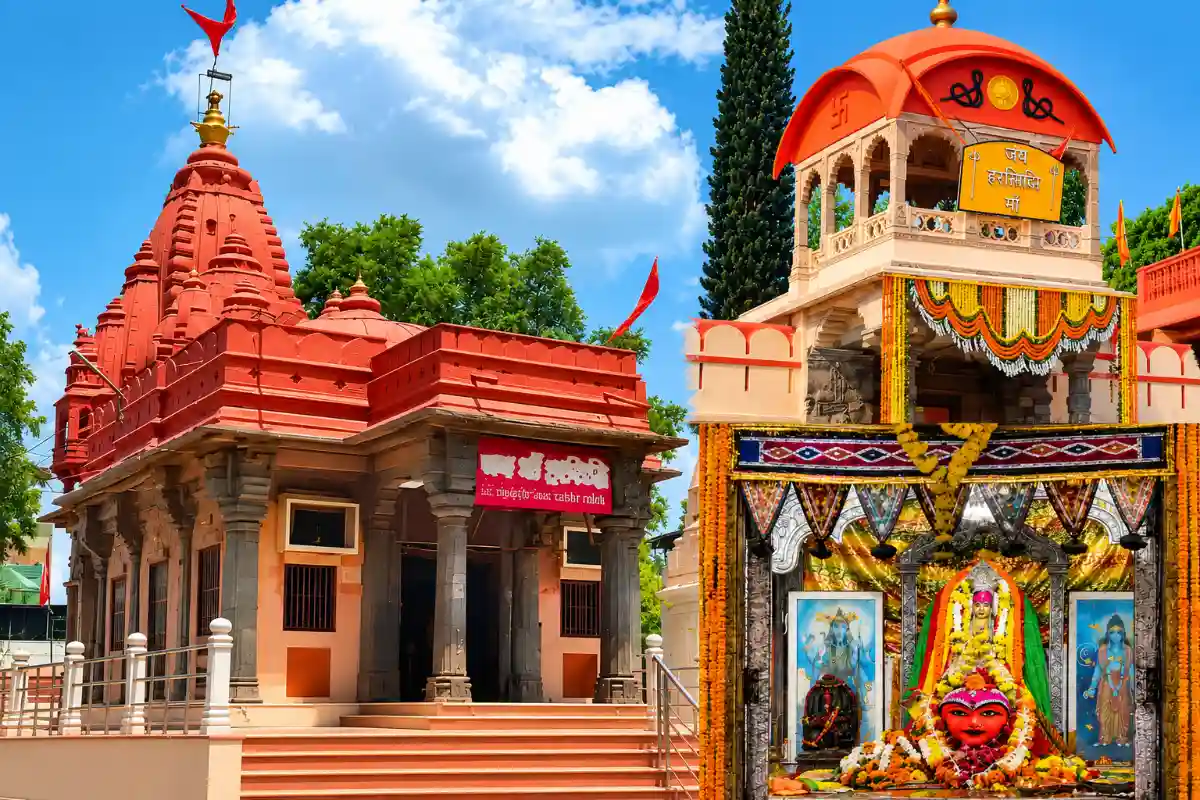
- Harsiddhi Temple: a Shakti Peetha, said to be where Parvati's elbow fell; the tall lamp-pillars lit during Navratri are a striking sight. Approximately 2.5 km from Mangalnath.
- Sandipani Ashram: the gurukul where Krishna, Balram, and Sudama studied together. A relatively quiet site, important for devotees on a Krishna pilgrimage.
- Ved Shala (Jantar Mantar): Maharaja Sawai Jai Singh II began construction around 1719; one of 5 observatories he built across India. Still operational, still publishing a panchang.
- Siddhavat: for Pitra Dosh puja and ancestral rites; the sacred banyan tree here is the authentic Ujjain site for this ritual.
How to reach Mangalnath Mandir
Practical tips before you visit
- Pre-book your puja slot. On Tuesdays and Angarki Chaturthi, walk-in slots fill quickly. Contact the temple or a reputed local priest in advance.
- Confirm prices before you start. Touting is active here. Agree on the puja fee before the pandit begins, not after.
- Bring your kundli. Your name, gotra, and birth chart details are needed for Sankalpa. If you don't know your gotra, Kashyap is used by default.
- Bathe at the Shipra ghat first. This is part of the ritual preparation, not optional.
- Avoid peak monsoon for puja. The ghat area floods in July and August. Darshan is possible but Bhat Puja may be disrupted.
- Visit Angareshwar too. It's directly adjacent. Many priests hold it to be the original Mars birthplace and the authentic site for Bhat Puja completion.
- Skip the Kaal Sarp puja touts at Ram Ghat. If Kaal Sarp Dosh puja is your purpose, Trimbakeshwar near Nashik is the recognized primary site for this ritual.
- Dress code. Traditional clothing is required for inner sanctum entry. Dhoti-kurta for men; saree or salwar-kameez for women.

Comments
No comments yet. Be the first to share your thoughts!
Leave a Comment