
Key highlights
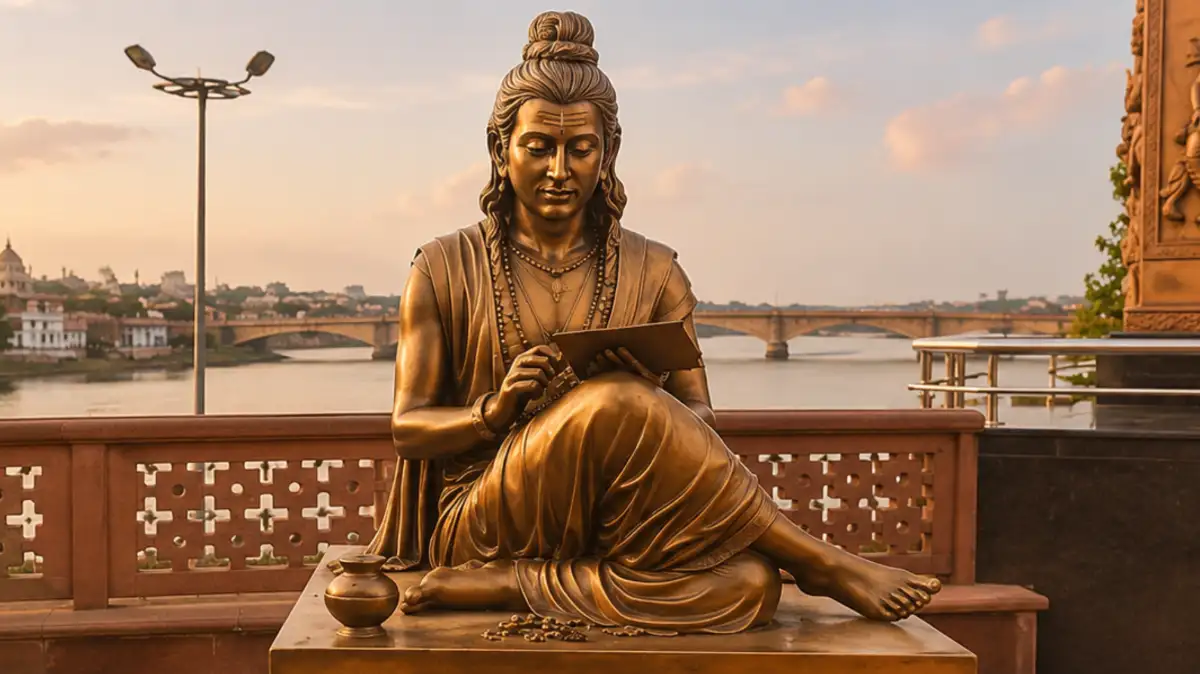
- Encyclopaedia Britannica places Kalidasa in the 5th century CE, most likely under the Gupta emperor Chandragupta II, who held the title Vikramaditya. This is the mainstream scholarly view, not a proven fact. No inscription names Kalidasa with a specific king or date.
- The Meghaduta is the strongest textual link to Ujjain: it describes the Mahakala temple's evening worship, the Shipra river and the Gandhavati stream in detail, and the poem's cloud messenger is explicitly told to detour through the city.
- Kalidasa's connection to Ujjain as a birthplace is a long tradition, not a historical finding. Encyclopaedia.com states plainly: "there's no proof that he was born there."
- The story that Kalidasa was a foolish man blessed into genius by the goddess at Gadkalika temple is a beloved local legend with no pre-12th-century textual source.
- Kalidasa is the one Navaratna with an independent, plausible connection to a Vikramaditya, specifically Chandragupta II, even though the Navaratna list itself (from the Jyotirvidabharana) is a 12th-century forgery.
- The Kalidasa Samaroh (Akhil Bharatiya Kalidas Samaroh) is held every November in Ujjain and doesn't coincide with the March-to-May Simhastha window.
When did Kalidasa live, and is it known?
Encyclopaedia Britannica says Kalidasa "flourished 5th century" and notes that many, though not all, scholars connect him to Chandragupta II, who reigned approximately 380 to 415 CE. The Britannica entry also calls this association "the most convincing but most conjectural rationale." That hedging is the key point: even the leading encyclopaedia treats the Gupta-era dating as a strong opinion, not a settled finding.
The scholarly debate spans a wide range. Traditional Indian accounts place Kalidasa at the court of the legendary Vikramaditya of 57 BCE, a connection now regarded by historians as a later legend rather than history. Some astronomical arguments pushed the dating as late as the 6th century. The Gupta-era, specifically the late 4th to early 5th century CE, is the current mainstream position, but there's no inscription, no dated colophon, no contemporary record that names Kalidasa with a specific king or year.
Two firm chronological anchors exist. First, the Mandsaur (Mandasor) sun-temple inscription of roughly 473 CE contains verses that appear to imitate the Meghaduta and Ritusamhara, meaning Kalidasa was already being echoed by that date. Second, the Aihole prashasti of 634 to 635 CE, composed by the Chalukya court poet Ravikirti for Emperor Pulakeshin II, names Kalidasa explicitly: Ravikirti hoped to win fame "equal to Kalidasa and Bharavi." So Kalidasa was a revered classic by the early 7th century, and his works were being imitated well before 473 CE. Everything else is inference.
The strongest evidence for a Gupta-era Chandragupta II connection rests on internal literary evidence: the Hunas appear in the Raghuvamsha as a still-distant people, not yet invaders, which is consistent with Gupta-era geography; Buddhist themes are entirely absent; and the Kumarasambhava glorifies Skanda (Kumara), who was the Gupta imperial deity. None of this is conclusive, but taken together it builds the credible scholarly case for a 4th to 5th century dating.
The traditional claim that Kalidasa was one of the nine gems (Navratnas) at Vikramaditya's court comes entirely from the Jyotirvidabharana, a text V.V. Mirashi dates to the 12th century and D.C. Sircar calls absolutely worthless for historical purposes. However, Kalidasa is unusual among the Navratnas in that his possible connection to a Vikramaditya is supported by independent scholarship even without the Navaratna list: Chandragupta II genuinely bore the title Vikramaditya, reigned in the right era, and is the patron most major scholars associate with him. The site's Vikramaditya article correctly calls the legendary 57 BCE Vikramaditya a tradition, not history, and the Navaratna list a forgery. Kalidasa's link to Chandragupta II is a different matter: it's a credible scholarly hypothesis standing on its own literary evidence. Present the Navaratna legend as legend, the Chandragupta II hypothesis as a serious scholarly position.
What Kalidasa actually wrote about Ujjain
The strongest and most direct link between Kalidasa and Ujjain is not a biographical claim but a textual one: the Meghaduta describes the city in more detail, and with more apparent affection, than any other ancient Sanskrit poem.
The Meghaduta and the cloud's detour through Ujjayini
The poem's premise is this: a Yaksha (a celestial attendant of Kubera, the god of wealth) has been exiled to Ramagiri in the Vindhyas as punishment for neglecting his duties. Separated from his wife in the Himalayan city of Alaka, he commissions a monsoon cloud to carry her a message. The first half of the poem, Purvamegha, is the cloud's northward route. When the Yaksha names Ujjayini on the itinerary, he insists the cloud deviate from the straight path, even though the detour will delay the message to his longing wife. The detour, and the reason for insisting on it, is Kalidasa's declaration of the city's worth.
What the poem describes in Ujjayini is specific enough to trace today. The cloud is told to pass over the Mahakala temple (clearly MahakaleshwarExplore the divine Mahakaleshwar Jyotirlinga in Ujjain.) at the hour of the evening worship, when the drums beat, the bells ring and the conch calls, and the devadasis dance in the temple's forecourt. The Shipra river appears, with its morning breeze scented by water-lilies. The Gandhavati stream is named. The women of the city appear at their lattice windows, their hair tossed by the river wind, their lamps blown sideways by the monsoon breeze. These are not generic topographic details. They are the specific sights, sounds and smells of a city the poet evidently knew from the inside.
Whether Kalidasa was born in Ujjain, spent years there or simply visited and remembered it in precise detail is unknown. Encyclopedia.com, drawing on classical scholarship, states flatly: "Although he was especially fond of the Gupta capital city, Ujjain... there's no proof that he was born there." His "hometown" is a long tradition, warmly maintained in Ujjain itself, and worth knowing as a tradition. The Meghaduta's affectionate detail is textual evidence of a different kind, and stronger for it.
Mahakaleshwar in the Meghaduta
The Meghaduta passage describing the Mahakala temple is one of the poem's most celebrated sections. The cloud is told to hover at the temple courtyard as the evening worship begins: the deep drums, the conch's cry, the devotees assembling. Kalidasa describes the dance that follows and the lamps lit in the doorways of the houses after worship, their flames bent sideways by the approaching monsoon. The Mahakaleshwar that the Meghaduta pilgrim encounters today is 12th-century Gupta-era temple architecture, then the Shunga-period shrine it rebuilt, then the 18th-century Scindia structure now standing, with Phase 1 of the Mahakal Lok corridor inaugurated in 2022. The physical buildings have changed. The evening aarti has not.
The Gadkalika legend: what tradition says and what it doesn't
The most popular story about Kalidasa and Ujjain doesn't come from any ancient text. It comes from a later medieval tradition that was probably consolidated no earlier than the 12th century, around the same period as the Navaratna forgery.
The story runs: Kalidasa was a beautiful but unintelligent man who was tricked into marriage by the scholar-princess Vidyottama as revenge against other scholars who had humiliated her. Discovering her husband was illiterate, she sent him away in shame. He came to the Gadkalika temple in Ujjain, dedicated to the goddess Kalika, and in despair placed his tongue on the goddess's sword. The goddess blessed him, and he rose from the temple an accomplished poet. His first poem was the opening verse of the Kumarasambhava.
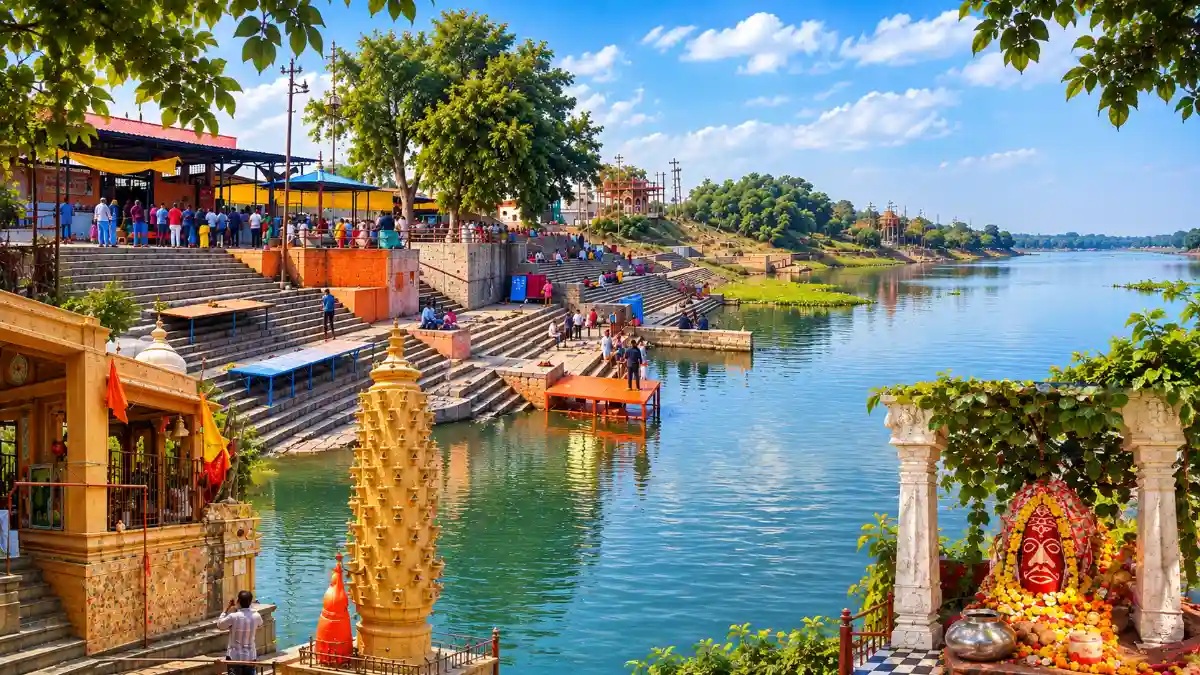
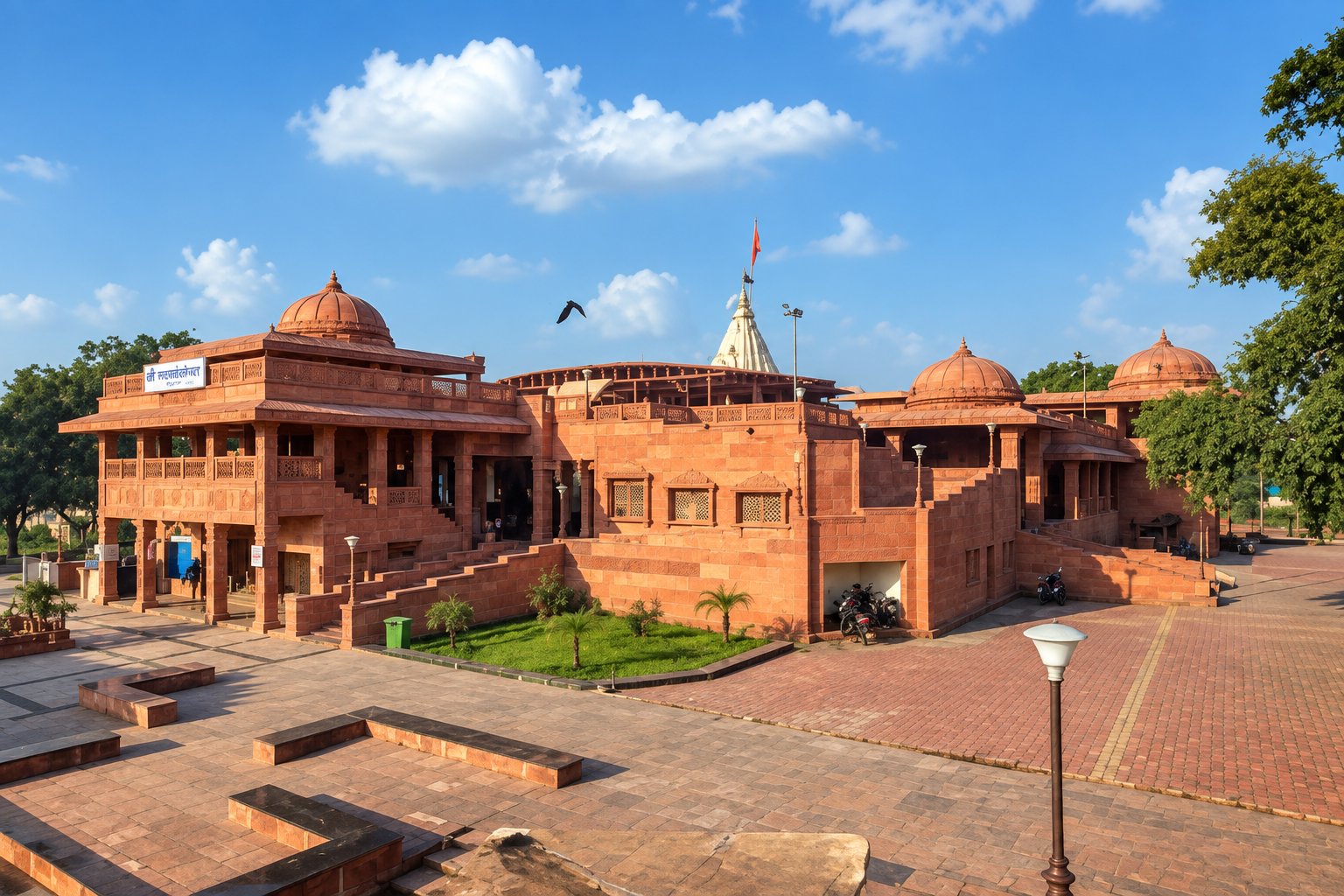
Gadkalika temple is a real place: a Kali shrine near Bhartrihari Cave on the Shipra bank, which was renovated in the 7th century under Harshavardhana and later under the Scindia state. The annual Kalidasa Samaroh traditionally opens with a puja here. Whether the legend has any historical basis is a different question; no early source confirms it. Present it as a beloved local tradition, which is what it's.
The Shakti Peeth status of Gadkalika is itself disputed: some local sources call it one of the 51 or 18 Shakti Peethas; others don't include it in canonical lists. The safest characterisation is that it's revered as a Shakti Peeth in local tradition.
Kalidasa's works: what they are and what they say
Six works are securely attributed to Kalidasa, with a seventh contested. The six are two epic poems (mahakavyas), one lyric poem, and three plays.
| Work | Type | Subject | Key detail |
|---|---|---|---|
| Abhijnanashakuntalam | Play (7 acts) | Shakuntala and King Dushyanta; drawn from the Mahabharata's Adi Parva | First translated into English by Sir William Jones in 1789; Goethe's 1791 epigram made it famous in Europe |
| Meghaduta | Lyric poem (roughly 110 to 121 verses) | An exiled Yaksha's message to his wife, carried by a cloud through Ujjayini and up to the Himalayas | Contains the most detailed and affectionate description of Ujjain in classical Sanskrit literature |
| Raghuvamsha | Epic poem (19 cantos, approximately 1,564 verses) | The solar dynasty from Dilipa to Agnivarna | Includes the digvijaya (conquest of the four quarters) by King Raghu |
| Kumarasambhava | Epic poem (cantos 1 to 8 authentic; cantos 9 onward are later additions) | The birth of Kumara/Skanda (Kartikeya), son of Shiva and Parvati | Glorification of Skanda, the Gupta imperial deity, is part of the scholarly argument for the Gupta-era dating |
| Malavikagnimitram | Play (5 acts) | Set in the Shunga court of King Agnimitra at Vidisha, not Ujjain | Generally considered Kalidasa's earliest play based on its relatively conventional dramatic technique |
| Vikramorvashiyam | Play (5 acts) | The Vedic legend of Pururavas and the apsara Urvashi, from Rigveda Mandala 10 | Includes a remarkable fourth act in which the king searches for his transformed wife in the forest |
| Ritusamhara | Poem (6 cantos, one per season) | The six Indian seasons, their landscapes and their lovers | Attribution to Kalidasa is disputed by many scholars; some consider it a minor or early work, others doubt its authenticity entirely |
Sources: Encyclopaedia Britannica, Wikipedia (with cited scholarship from Mirashi, Keith, Lienhard and others), and standard critical editions of each work, checked August 2026. Canto and verse counts vary across recensions; the Raghuvamsha figure of approximately 1,564 follows standard editions; the Meghaduta count of 110 to 121 reflects genuine variation across manuscript families.
Shakuntala: the play that reached Europe
Abhijnanashakuntalam is Kalidasa's most famous work outside South Asia. The story follows Dushyanta, a king who falls in love with Shakuntala at a forest hermitage, marries her in a gandharva ceremony, and gives her his signet ring before returning to his court. The sage Durvasa curses Dushyanta to forget her. When Shakuntala travels to his palace she loses the ring in a river, and the king cannot recognise her. The ring is recovered from the belly of a fish; memory returns; recognition follows. The curse and the ring are Kalidasa's own additions to the Mahabharata's simpler version of the story.
Sir William Jones translated it in 1789, publishing it in Calcutta as Sacontala; or, The Fatal Ring. A German version by Georg Forster reached Goethe in 1791. Goethe's response was a short poem, in which he asked: would you have the blossoms of spring and the fruits of autumn, what delights and what satisfies, heaven and earth in a single name? He answered: I name you, Shakuntala, and all is said. The epigram circulated across Europe and launched a century of interest in Sanskrit poetry among Romantic writers. Roughly 46 European translations appeared over the following hundred years.
Meghaduta: the cloud and the city
The Meghaduta (Cloud Messenger) is the work that most directly concerns Ujjain. Its two parts are Purvamegha (Former Cloud, the longer first half, describing the route northward) and Uttaramegha (Latter Cloud, the message itself and the description of Alaka). The verse count varies by recension from roughly 110 to 121; the 66-plus-45 structure (giving 111 total) is one common count; the Mallinatha edition reaches 121.
The Ujjayini section is in Purvamegha, approximately stanzas 28 to 45 depending on the edition. Kalidasa tells the cloud to pass over the city's latticed windows and look down at the women lighting lamps after the evening worship; to hover at the Mahakala temple as the drums begin for the evening aarti and the evening dance starts; to pick up the scent of the Shipra's water-lilies at dawn. These are images of specific, remembered experience. Scholars including V.V. Mirashi have argued that this level of affection and geographic particularity implies Kalidasa lived in or regularly visited Ujjain, though the argument remains inference, not proof.
The Kalidasa Samaroh: Ujjain's literary festival
Every November Ujjain holds the Akhil Bharatiya Kalidas Samaroh, one of India's oldest and most respected classical arts festivals. It runs for seven days and is organised by the Kalidasa Akademi (established 1978) in collaboration with Vikram University under the Madhya Pradesh Culture Department.
The festival was the life's work of Pandit Suryanarayan Vyas, who began organising a Kalidasa Jayanti in Ujjain in the 1930s. The first national-scale Akhil Bharatiya Kalidas Samaroh was inaugurated in 1958 by President Dr Rajendra Prasad, with delegations from Russia, Germany, Iran and China in attendance; the second was inaugurated by Prime Minister Nehru. The Rashtriya Kalidas Samman and Kalidas Puraskar awards are announced at the festival each year.
The programme typically includes classical Sanskrit drama and plays based on Kalidasa's works, Bharatanatyam, Odissi, Kathak and Kuchipudi performances (Meghaduta and Shakuntala are both choreographed in these traditions), poetry recitation, academic seminars, an all-India exhibition of paintings and sculpture, and a puja at Gadkalika temple to open proceedings.
The Kalidasa Samaroh is traditionally held beginning on Kartika Shukla Ekadashi (Dev Prabodhini Ekadashi), which falls in November. Simhastha 2028Explore the world's largest spiritual gathering in Ujjain. runs from 27 March to 27 May 2028. The two events don't overlap. If you are visiting for Simhastha, you will not encounter the Samaroh. If you are interested in attending both, plan separate trips. No Kalidasa-specific cultural programme for Simhastha 2028 has been announced as of August 2026.
What you can see and read
Kalidasa left no physical monument in Ujjain: no temple in his name, no house identified as his, no inscription. His legacy in the city is literary, atmospheric and ceremonial. For a Simhastha pilgrim who wants to trace his thread through the mela, three kinds of encounter are available.
Simhastha 2028 and the Kalidasa connection
Simhastha 2028 runs from 27 March to 27 May 2028. The three Amrit Snan dates are most widely given as 9 April, 23 April and 8 May 2028. A small number of sources give 27 April instead of 23 April for the second royal bath; the discrepancy may relate to whether Akshaya Tritiya (27 April 2028) is treated as a qualifying snan tithi. Confirm against the final government gazette notification before booking non-refundable travel.
The connection between Kalidasa and Simhastha is literary and cultural rather than ritual. No bathing protocol is named after him, no akhada carries his banner. The connection runs deeper and more diffuse: Kalidasa described this city, these ghats, this temple and this river with an affection that has shaped how Ujjain presents itself for fifteen centuries. When you bathe in the Shipra on an Amrit Snan day, the water and the bank and the sounds of worship around you are what Kalidasa's cloud messenger detoured to see.
Who should go deeper, and who should focus on the ritual
This thread works well for
- Readers who want to take a text to Ujjain: the Meghaduta is short (roughly 110 to 121 stanzas), beautifully translated in Arthur Ryder's verse version (1912, public domain) and Barbara Stoler Miller's modern prose translation. Reading the Ujjayini section before arriving makes the ghat visit qualitatively different.
- Foreign visitors looking for a literary entry point: Goethe's response to Shakuntala, and the play's influence on European Romanticism via William Jones's 1789 translation, give an intellectual hook that works without a faith background.
- Those interested in Indian classical arts: the annual Samaroh is worth planning a separate November trip for; Odissi and Bharatanatyam interpretations of Meghaduta and Shakuntala appear at reputable festivals across India year-round.
- Families with older children: the Shakuntala story, the ring, the curse and the recognition are vivid drama that works across ages.
Focus differently if you are
- On a single Amrit Snan day: the ghats and Mahakaleshwar are your day. The Vikram Kirti Mandir and Gadkalika are second-day additions.
- Expecting a Kalidasa-dedicated monument: there's none. His presence in Ujjain is in the poem, the temple aarti and the tradition, not in a dedicated shrine.
- Travelling with small children or elderly family in May heat: Ujjain regularly exceeds 40°C in May. The Vikram Kirti Mandir is a good early-morning stop; plan shade and water for any outdoor visit.
What to read before you go
- The Meghaduta (Purvamegha stanzas 28 to 45, the Ujjayini section): Arthur Ryder's 1912 verse translation is in the public domain and readable online. Barbara Stoler Miller's translation in Theater of Memory (1984) provides a scholarly modern rendering. Even reading just the Ujjain passage before arriving at the ghats changes the experience of standing there.
- Abhijnanashakuntalam: William Jones's 1789 translation is public domain and easily found. Barbara Stoler Miller's edition is the standard academic text. The play rewards slow reading; its dramatic structure is more layered than the curse-and-recognition plot summary suggests.
- Arthur Ryder's introduction to the Shakuntala translation: one of the most accessible short essays on Kalidasa in English, covering both the poetry and the question of his dates. Public domain.
Comments
No comments yet. Be the first to share your thoughts!
Leave a Comment