

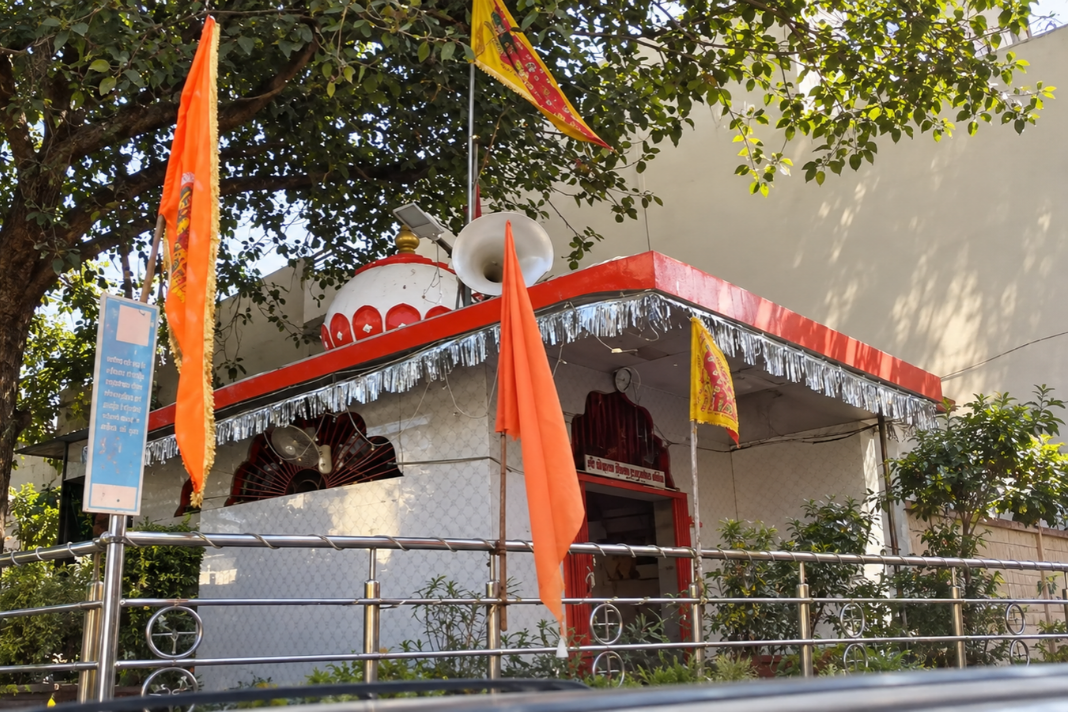
What is Ishaneshwar Mahadev in Ujjain?
Ishaneshwar Mahadev is the sixteenth of Ujjain's 84 Mahadev lingas, with its story in the Skanda Purana, Avantya Khanda, chapter 16 of the Chaturashiti Linga Mahatmya. A great flame rises from the linga and burns Tuhunda, son of Munda, with his army, and the gods get their rights back. The linga is named Ishana because granting lordship is its nature.
The name joins Ishana, a name of Shiva, and Ishwara. Older Hindi lists sometimes print it as इशानेश्वर, with a short first vowel; this article uses Ishaneshwar throughout.
Local tradition places the temple in Modi ki Gali, in the Patni Bazar area of Ujjain, near Indradyumneshwar.
At a glance
- The gods praise Shiva by the names Ishana, Tatpurusha, Vamadeva, Aghora and Sadyojata.
- A great flame wrapped in smoke rises from the middle of the linga.
- It burns Tuhunda, son of Munda, along with the army around him.
- The linga is named Ishana because giving lordship is its nature.
Ishaneshwar Mahadev: quick facts
| Topic | Detail |
|---|---|
| Meaning of the name | The Lord (Shiva) named Ishana |
| Deity | Shiva, in linga form |
| Source text | Skanda Purana, Avantya Khanda, Chaturashiti Linga Mahatmya, Chapter 16 (5.2.16) |
| Position among the 84 Mahadevs | Sixteenth |
| Narrator and listener | Shiva speaking to Parvati |
| Place in the story | Behind Indradyumneshwar (verse 11) |
What is the story of Ishaneshwar Mahadev in the Skanda Purana?
Shiva opens the chapter by naming the linga:
ईशानेश्वरसंज्ञं तु षोडशं विद्धि पार्वति ।
यस्य दर्शनमात्रेण ऐश्वर्यं जायते नृणाम् ॥
Meaning: know the one named Ishaneshwar as the sixteenth, Parvati; by merely seeing him, lordship and prosperity (aishvarya) arise for people (Skanda Purana 5.2.16.1).
Where the text places the linga
A later verse tells those addressed where to settle and what to serve:
इन्द्रद्युम्नेश्वरस्यैव पश्चाद्भागे व्यवस्थिताः ।
सेवध्वं परमं लिङ्गमीशानेश्वरसंज्ञकम् ॥
Meaning: settled behind Indradyumneshwar, serve the supreme linga named Ishaneshwar (Skanda Purana 5.2.16.11).
The sage Ishana and the Ishanakalpa
The chapter then goes back to the Ishanakalpa. In that age, it says, the sage Ishana, learned in the Vedas and engaged in reciting them, easily gained a place on the head of Shankara.
The gods' hymn
The gods then praise Shiva in a long hymn, and the names they use are Ishana, Tatpurusha, Vamadeva, Aghora and Sadyojata.
The flame and the name
A great flame, wrapped in smoke, rises from the middle of the linga. It burns Tuhunda, son of Munda, together with the army around him, and the gods receive their rights back.
The chapter then explains the name. Giving lordship is the nature of this linga (aishvaryashilam), so it will be famous in the three worlds as Ishana. Shiva closes the account and tells Parvati that the next chapter is about Apsareshwar.
What does the Skanda Purana promise for worshipping Ishaneshwar Mahadev?
The closing verses of the chapter list these results:
- Merely seeing the linga brings lordship and prosperity to people (the opening verse).
- The worshipper gains fame, lasting wealth, siddhi and affection.
- The worshipper goes to heaven in a celestial vehicle.
- People of all four castes, and women and girls, receive the fruit they desire.
Which popular claims about Ishaneshwar Mahadev don't match the text?
The story of Ishaneshwar Mahadev is often retold with changes. These are the claims that do not match the Skanda Purana.
| Popular claim | What the Skanda Purana says | Status |
|---|---|---|
| Tuhunda was the son of Mandasura | He is Tuhunda, son of Munda (mundaputra) | Contradicts the text |
| Ishana was a king who won back a lost kingdom in the Ishanakalpa | Ishana is a sage reciting the Vedas, who gains a place on Shankara's head; no kingdom is mentioned | Contradicts the text |
| The gods performed tapasya | The gods praise Shiva in a hymn, using the names Ishana, Tatpurusha, Vamadeva, Aghora and Sadyojata | Contradicts the text |
| Thick smoke came first, then the flame | A great flame wrapped in smoke (dhumavrita mahajvala) rises from the middle of the linga | Partly in the text |
| Tuhunda was burned with his family | He is burned together with the army around him | Contradicts the text |
| The name comes from King Ishana | The name comes from the linga's nature of giving lordship (aishvaryashilam) | Contradicts the text |
| Devotees get back a lost kingdom and their rights | Regaining rights belongs to the gods in the story; the results for worshippers are fame, wealth, siddhi, affection and heaven | Not in the text |
| The linga gives victory over enemies | The chapter's results do not name victory over enemies | Later wording |
Is Tuhunda of this chapter the same as Tuhunda in other texts?
The name Tuhunda belongs to more than one story, and none of them tells the others' tale.
| Text | Who Tuhunda is |
|---|---|
| Skanda Purana, Avantya Khanda 5.2.16 | Son of Munda, burned by the flame from the linga along with the army around him |
| Mahabharata, Adi Parva | One of the forty sons of Danu, "Tuhunda of great strength," born on earth as King Senavindu |
| Vayu Purana | Attacks Subrahmanya together with Tarakasura and is killed by Kundodara, an attendant of Ganapati |
| Brahmanda Purana II.16.65 | The name of a tribe of the Vindhya region |
| Harivamsha | One of the two sons of Hrada, Suka and Tuhunda |
The story of a Tuhunda, son of Munda, burned by a flame from a linga is told only in this chapter, so do not blend the other versions into it.
Monier-Williams lists "Ishanakalpa" as the name of a kalpa, and the Purana Index calls Ishana the name of the tenth kalpa, citing the Matsya Purana (290.5). The Linga Purana also has a chapter, "Glory of Ishana," in which Brahma praises Shiva as Ishana. So the Ishanakalpa in this chapter is a named age, not a place or a kingdom.
Ishana, Tatpurusha, Aghora, Vamadeva and Sadyojata are the five faces of Shiva (Panchabrahma). Of these, Ishana is regarded as the topmost face.
The results for visiting Ishaneshwar come with no tithi, no month and no weekday. The chapter also promises no regaining of a lost kingdom to worshippers. Any fixed day for this linga is later tradition.
What else do people ask about Ishaneshwar Mahadev?
Where does the text place Ishaneshwar in relation to Indradyumneshwar?
Verse 11 says to settle behind Indradyumneshwar and serve the supreme linga named Ishaneshwar. The word is "pashchad-bhage," behind, and "pashchat" can also mean west in Sanskrit. Some websites place it north or north-east of Indradyumneshwar, but those directions are not in the chapter.
Does the Purana link Ishaneshwar to the Pushya nakshatra?
No. Chapter 16 names no nakshatra, no zodiac sign and no donation. Some astrologers assign Ishaneshwar to the Pushya nakshatra and advise donating silver there. That belongs to an astrologer's tradition of pairing the 84 Mahadevs with stars and signs, and the Skanda Purana does not say it.
What does regular darshan of Ishaneshwar give, according to the text?
The chapter says a person who sees Ishaneshwar by rule suffers no loss for a hundred births, and a person who sees it every day becomes capable in all undertakings. These lines come in the closing verses on results, which name no date, month or weekday.
Is today's temple the spot the Purana describes?
The Purana places the linga behind Indradyumneshwar. Today's Ishaneshwar temple is identified by tradition, in Modi ki Gali in the Patni Bazar area. No source shows that the temple's position matches "behind," so the link between the text and the shrine is a matter of faith.
Why is Ishaneshwar the sixteenth in Ujjain's 84 Mahadev order?
The Sanskrit text of chapter 16 itself calls the linga "shodasham," the sixteenth. The tirtha name list (5.1.70) carries the same run: the famous Indradyumneshwar, thereafter Ishaneshwar.
Chapter 17 follows and belongs to Apsareshwar. For the full sequence, see the complete guide to Ujjain's 84 Mahadev temples.
Which linga comes after Ishaneshwar in the 84 Mahadevs?
The next chapter, 17, is Apsareshwar. Indradyumneshwar, the 15th, comes just before.
Comments
No comments yet. Be the first to share your thoughts!
Leave a Comment