

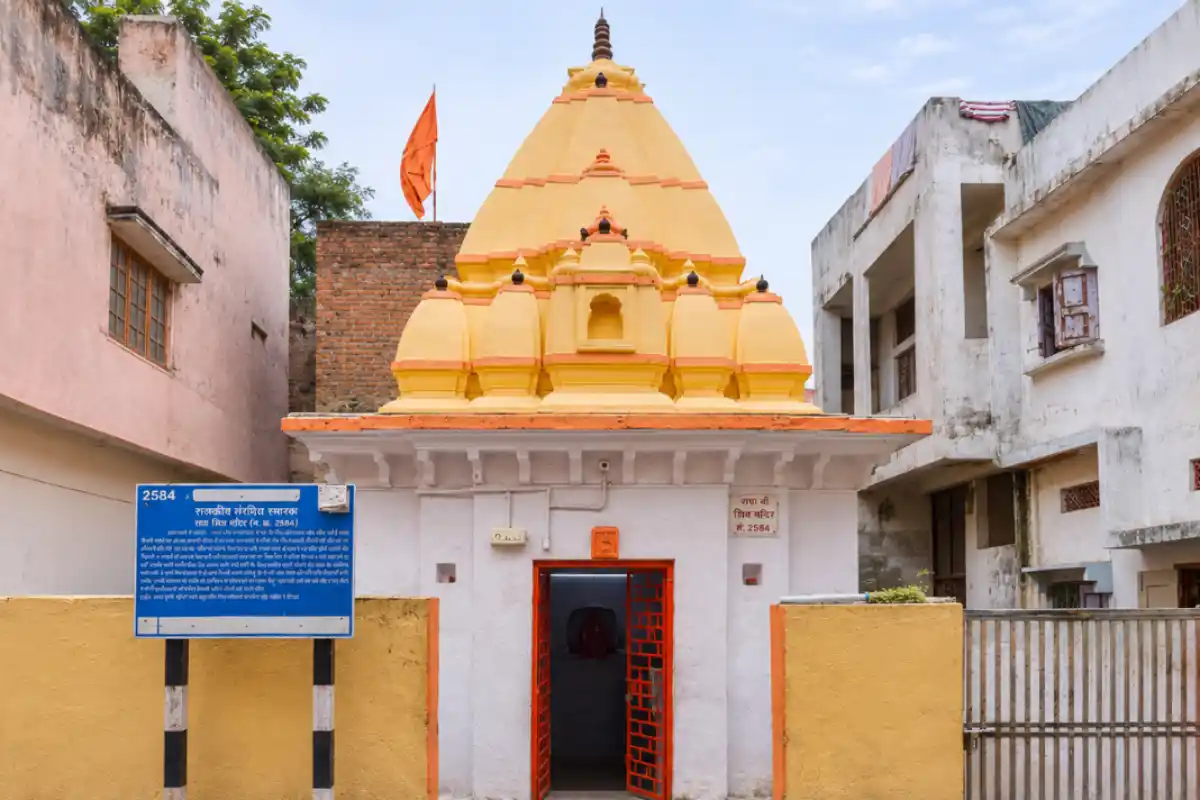
What is Mukteshwar Mahadev in Ujjain?
Mukteshwar Mahadev is the twenty-fifth of Ujjain's 84 Mahadev lingas, told in the Skanda Purana, Avantya Khanda, chapter 25 of the Chaturashiti Linga Mahatmya. The text calls it Muktishvara and says its darshan alone brings liberation. The chapter's story has a Brahmin named Mukti, a hunter and a tiger.
Mukti means liberation and Ishvara means lord, so the name reads "Lord of liberation". Alternate forms you will see are Muktishwar, Muktishvara and Mukteshvara.
Local tradition places the temple in Khatriwada, in the same lanes as Mahalayeshwar, the 24th.
At a glance
- Shiva opens the chapter by naming the twenty-fifth deity: Muktishvara.
- A Brahmin called Mukti practises yoga for thirteen years near Mahakala.
- A hunter and a tiger reach liberation before him, at the same river.
- The chapter says that touching the linga gives liberation, and nothing else does.
Mukteshwar Mahadev: quick facts
| Topic | Detail |
|---|---|
| Meaning of the name | Lord (Ishvara) of liberation (mukti) |
| Deity | Shiva, in linga form |
| Source text | Skanda Purana, Avantya Khanda, Chaturashiti Linga Mahatmya, Chapter 25 (5.2.25), 72 verses in one Sanskrit edition |
| Position among the 84 Mahadevs | Twenty-fifth |
| Narrator and listener | Shiva (Shri Hara) speaking to Parvati |
| Place in the text | North of Mahalayeshwar (24th), since chapter 24 places Mahalayeshwar to its south |
| Main characters | Brahmin Mukti, a hunter, a tiger that was the cursed king Dirghabahu |
What does the Skanda Purana say about Mukteshwar Mahadev?
Shiva opens with the number and the promise in one verse:
पंचविंशतिकं देवं विद्धि मुक्तीश्वरं प्रिये ।
यस्य दर्शनमात्रेण मुक्तिर्भवति पार्वति ॥
Meaning: "Know, dear one, the twenty-fifth deity as Muktishvara, by whose mere sight liberation comes, O Parvati" (Skanda Purana 5.2.25.1).
The Brahmin who practises yoga for thirteen years
Near Mahakala there lives an excellent Brahmin named Mukti. He performs penance and yoga for thirteen years and bathes in the Shipra, and he still does not reach liberation.
The hunter who merges into the linga
One day a hunter comes to the river to kill him. The hunter gives up the idea, and in the same moment, the text says, he takes a divine body and disappears into the linga:
तत्क्षणाद्दिव्यदेहस्तु तस्मिँल्लिंगे लयं गतः ॥
Meaning: "At that very moment, with a divine body, he merged into that linga" (5.2.25.15, first line).
The tiger that was a king
Later, a tiger closes in on the Brahmin as he moves in the water. He speaks the name of Narayana:
अंतर्जलचरं विप्रं यावद्व्याघ्रो जिघृक्षति ।
नमो नारायणायेति तावद्वाक्यं द्विजोऽब्रवीत् ॥
Meaning: "Just as the tiger was about to seize the Brahmin moving in the water, the twice-born spoke the words 'Namo Narayanaya'" (5.2.25.19).
व्याघ्रेणापि श्रुतो मंत्रोऽजहात्प्राणांश्च तत्क्षणात् ॥
Meaning: "The mantra was heard by the tiger too, and in that moment it gave up its life" (5.2.25.20, first line).
The tiger was Dirghabahu, a king whom Brahmins had cursed for his arrogance. Freed, he says to the Brahmin:
त्वत्प्रसादाद्द्विजश्रेष्ठ मुक्त्वा शापान्निरामयः ॥
Meaning: "By your grace, best of the twice-born, I am freed from the curse and free of disease" (5.2.25.21, first line).
The question the Brahmin asks
Mukti is troubled. His own long austerity brought him nothing, yet a hunter and a tiger passed ahead of him in a single moment. The answer the chapter gives is the linga itself, which the next section quotes.
What does the Skanda Purana promise for worshipping Mukteshwar Mahadev?
The chapter's results are short and all of one kind:
- Darshan of the linga brings liberation (verse 1).
- Touching the linga brings liberation, and nothing else does (verse 67).
- Whoever worships the eternal Mukti linga with devotion reaches the supreme state, even if burdened with sin (verse 67).
अस्य लिंगस्य संस्पर्शान्मुक्तिर्भवति नान्यथा ।
येऽर्चयंति सदा भक्त्या मुक्तिलिंगं सनातनम् ।
अपि पापसमायुक्तः स याति परमां गतिम् ॥
Meaning: "By touching this linga, liberation comes, not otherwise. Those who always worship the eternal Mukti linga with devotion, even if joined with sin, reach the supreme state" (5.2.25.67).
The verse after it turns on the Brahmin's puzzle. It rebukes those who rely on austerities, and Tagare's translation says that penance and gifts without this linga are of little worth.
Which popular claims about Mukteshwar Mahadev don't match the text?
Short temple pages and online lists repeat several things that the Skanda Purana does not say.
| Popular claim | What the Skanda Purana says | Status |
|---|---|---|
| The opening verse is "anek janma sanshuddha ..." | Verse 1 is "panchavimshatikam devam viddhi muktishvaram priye" | Wrong verse |
| The Brahmin's story is only a Varaha Purana tale | Chapter 25 of the Skanda Purana carries it, with Mukti, the hunter and Dirghabahu | Wrong source |
| Mahalayeshwar is the 25th Mahadev | The 25th is Mukteshwar; Mahalayeshwar is the 24th | Wrong number |
| It is "behind Siddheshwar", meaning the Siddheshwar of Bhairavgarh | The newspaper line means the 59th Siddheshwar behind the Gopal temple | Misread |
| The name is printed "Mukakteshwar" or "Multeshwar" in some lists | The text has Muktishvara; the tirtha list has Mukteshvara | Printing errors |
| Rishis, munis and gods worship it | The results in the verses read are darshan and touch giving mukti | Not confirmed |
| Purva Phalguni nakshatra with a gift is prescribed | An astrologer's view; no nakshatra appears in the verses read | Not in the text |
The Brahmin's name is Mukti, and the verse that closes the teaching calls the linga the "mukti-linga". The chapter thus puts its theme into the characters' names: the man who seeks mukti, and the linga that gives it.
Chapter 25 itself says Muktishvara. The tirtha list in the Avanti Khanda (5.1.70), in the English translation, reads Mukteshvara. Both forms have a base in the text, which is why Muktishwar and Mukteshwar are both in use.
The Varaha Purana also tells of a king Dirghabahu who becomes a tiger and is freed on hearing Narayana's name. The Skanda chapter sets the same figure beside Shiva's linga, and Tagare's introduction notes that this Purana adapts older legends to its own places.
How is Mukteshwar different from similar names?
| Name | Context | Link to this chapter |
|---|---|---|
| Mukteshwar, 25th of Ujjain's 84 | Skanda Purana 5.2.25; the linga whose darshan gives mukti | This chapter |
| Pishachmukteshwar, 68th | A separate temple among Ujjain's 84 | Only the name is alike |
| Avimukteshwar, 78th | A separate temple among Ujjain's 84 | Only the name is alike |
| Rinmukteshwar | A separate Shiva temple in Ujjain | Only the name is alike |
| Mukteshwar temples elsewhere (Bhubaneswar, Uttarakhand, Kanchipuram) | Temples in other states with their own histories | None |
What else do people ask about Mukteshwar Mahadev?
Who is the Brahmin in the Mukteshwar story?
The Skanda Purana calls him Mukti. He lives near Mahakala, practises yoga for thirteen years and bathes in the Shipra. A hunter and a tiger reach liberation in front of him, which makes him ask why his own long austerity did not give it.
Who was the tiger in the story?
The tiger was King Dirghabahu, cursed by Brahmins for his arrogance. When the Brahmin spoke "Namo Narayanaya", the tiger heard it, gave up its life and was freed from the curse. The chapter then joins that freedom to the Mukti linga.
Is Mukteshwar the same as Muktishwar?
Yes. Chapter 25 of the Skanda Purana says Muktishvara; the temple and local usage say Mukteshwar. They are one linga, the 25th of the 84. Muktishwar, Muktishvara and Mukteshvara are spelling variants of one name, not different temples, so any of them leads to the same shrine in Ujjain.
Where does Mukteshwar stand in relation to Mahalayeshwar?
Chapter 24 places Mahalayeshwar to the south of Muktishvara, so by the text Mukteshwar lies to its north. Tradition puts both in Khatriwada. No reliable source gives a compass reading, so "close to each other" is safe and "exactly north" is not proven.
Why is Mukteshwar the twenty-fifth in Ujjain's 84 Mahadev order?
Chapter 24 of the Chaturashiti Linga Mahatmya is Mahalayeshwar, and chapter 25 is Mukteshwar. Chapter 25 begins by announcing its own number, which is why the order is fixed by the text and not by a later list.
For the full sequence, see the complete guide to Ujjain's 84 Mahadev temples.
Which linga comes after Mukteshwar in the 84 Mahadevs?
The next chapter, 26, is Someshwar, the twenty-sixth, and it opens by naming its own number in the same way. Mahalayeshwar, the 24th, comes just before.
Comments
No comments yet. Be the first to share your thoughts!
Leave a Comment