

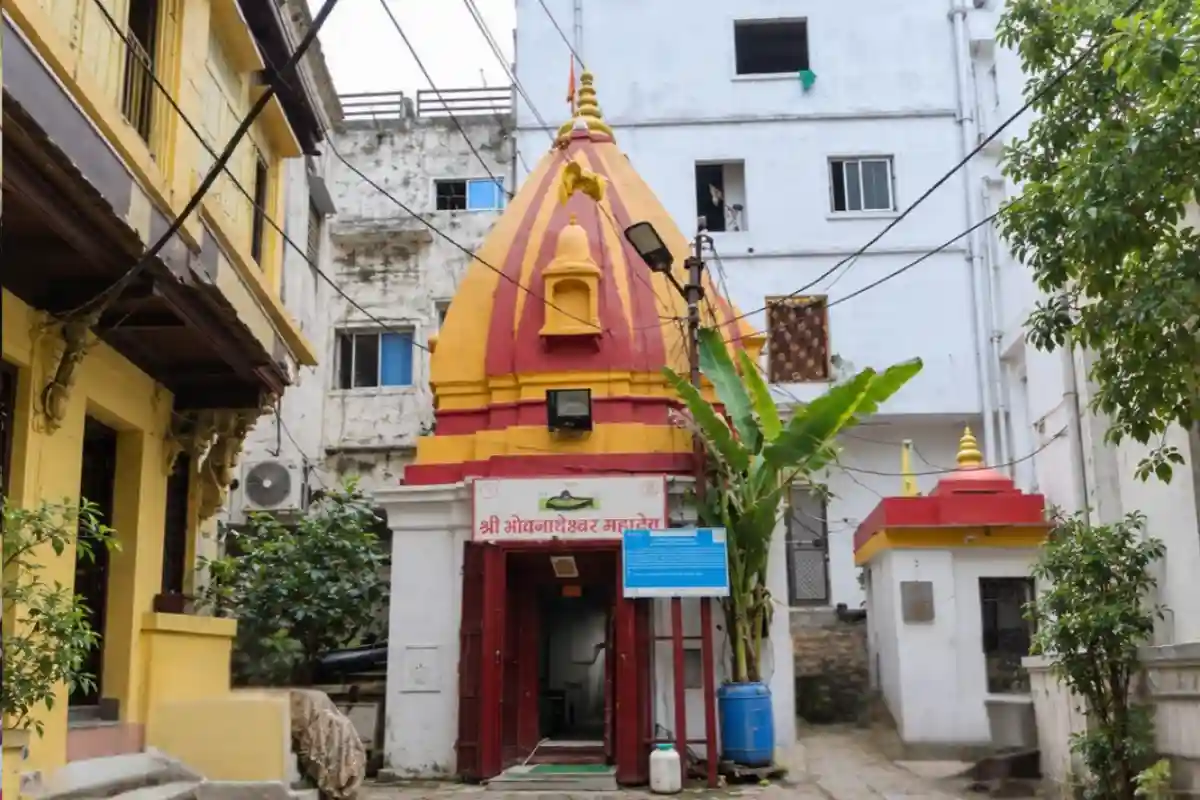
What is Meghanadeshwar Mahadev in Ujjain?
Meghanadeshwar Mahadev is the twenty-third of Ujjain's 84 Mahadev lingas, with its story in the Skanda Purana, Avantya Khanda, chapter 23 of the Chaturashiti Linga Mahatmya. A twelve-year drought, caused by the wicked king Madandha, ends when the gods praise this linga and clouds rise from it with a roar.
Megha means cloud and nada means roar, so the name means the Lord of the cloud's thunder. It has no link to Meghnad, the son of Ravana; this article uses Meghanadeshwar throughout.
Local tradition places the temple in Chhota Sarafa, behind the Narsingh temple, in the first lane on the road from Sati Gate toward the Gopal temple.
At a glance
- King Madandha's wickedness brings a twelve-year famine.
- Vishnu, in Shvetadvipa, tells the gods where a rain-giving linga stands in Mahakalavana.
- The gods praise it, and clouds rise from the middle of the linga.
- The roar of the clouds gives the linga its name, Meghanadeshwar.
Meghanadeshwar Mahadev: quick facts
| Topic | Detail |
|---|---|
| Meaning of the name | Lord (Shiva) of the clouds' roar (meghanada) |
| Deity | Shiva, in linga form |
| Source text | Skanda Purana, Avantya Khanda, Chaturashiti Linga Mahatmya, Chapter 23 (5.2.23), 41 verses |
| Position among the 84 Mahadevs | Twenty-third |
| Narrator and listener | Shiva speaking to Parvati |
| Main characters | King Madandha, Indra and the gods, Vishnu (Janardana, Keshava) |
What is the story of Meghanadeshwar Mahadev in the Skanda Purana?
The chapter opens with Shiva naming the linga:
मेघनादेश्वरं देवि त्रयोविंशतिमं शृणु ।
यस्य दर्शनमात्रेण प्राप्यते सर्वसिद्धयः ॥
Meaning: "Hear, O Devi, of Meghanadeshwar, the twenty-third; by merely seeing it, all siddhis are obtained" (Skanda Purana 5.2.23.1).
A king and a famine
The first verses speak of the king's duty: the welfare of the people, good rain and the very age depend on him. Then comes Madandha, a king both wicked and proud, a thorn to the gods and the Brahmins, who rules in the turn from Dvapara to Kali.
Because of his fault, twelve years pass without rain. Rivers dry up, and sacrifice, Vedic study, farming, cattle keeping and trade all fail.
शून्यभूयिष्ठनगरा दग्धग्रामनिवेशिनः ।
गोजाश्वमहिषैर्हीना भक्ष्यमाणाः परस्परम् ॥
Meaning: "Cities stood mostly empty and settled villages were burnt; with no cows, goats, horses or buffaloes, people were eaten by one another" (5.2.23.9).
The gods go to Vishnu
Indra and the other gods go to Shvetadvipa, on the northern shore of the ocean of milk, to take refuge with Janardana. They praise him and ask for a cure for the drought.
Keshava looks in meditation and sends them to Mahakalavana. He says a linga that brings showers was installed there long ago by the clouds themselves, and that all rain-bearing clouds are in that linga.
प्रतीहारेश्वराद्देवादीशाने विद्यते सुराः ।
तस्य तद्वचनं श्रुत्वा वासुदेवस्य पार्वति ॥
Meaning: "O gods, it stands to the north-east of the god Pratihareshwar. Hearing those words of Vasudeva, O Parvati..." (5.2.23.23).
Clouds from the linga
The gods go there and praise the deity. Then clouds rise from the middle of the linga, sounding the sky, and rain falls on the earth.
लिंगमध्यात्समुत्तस्थुर्वादयंतो नभस्तलम् ।
अन्योन्यवेगाभिहता ववृषुर्भूतले तदा ॥
Meaning: "From the middle of the linga they rose, making the sky resound; striking one another with force, they then rained on the earth" (5.2.23.31).
The darkness clears and a cool wind blows. The stars circle the moon, the planets grow calm, and the seas are still. The gods then give the linga its name.
मेघनादेश्वरं नाम भविष्यत्यस्य सर्वतः ।
मेघनादेश्वराख्यानं मया ते कथितं प्रिये ॥
Meaning: "Its name will be Meghanadeshwar everywhere. The story of Meghanadeshwar has been told to you, dear" (5.2.23.38).
What does the Skanda Purana promise for worshipping Meghanadeshwar Mahadev?
The chapter lists these results:
- Merely seeing the linga brings all siddhis (verse 1).
- People all over the earth are fulfilled by its power, and by seeing it rain falls as one desires.
- A person who bathes the linga is honoured in Rudra's world for thousands of crores of kalpas.
- Wherever the story of Meghanada is read, heavy rain follows on the earth.
The closing verses say this in the text's own words:
भविष्यंति नरा भूमौ कृतार्थास्तत्प्रभावतः ।
दर्शनादस्य लिंगस्य कामवृष्टिर्भविष्यति ॥
Meaning: "Men on earth will be fulfilled by its power; by seeing this linga there will be rain as one desires" (5.2.23.39).
कल्पकोटिसहस्राणि कल्पकोटिशतानि च ।
कुर्वंल्लिंगस्य स्नपनं रुद्रलोके महीयते ॥
Meaning: "One who bathes the linga is honoured in Rudra's world for thousands of crores and hundreds of crores of kalpas" (5.2.23.40).
प्रभावः पठ्यते यत्र मेघनादस्य पार्वति ।
अतिवृष्टिश्चैव ततो भविष्यति च भूतले ॥
Meaning: "Where the power of Meghanada is read, O Parvati, there will then be heavy rain on the earth" (5.2.23.41).
Which popular claims about Meghanadeshwar Mahadev don't match the text?
The story of Meghanadeshwar Mahadev is often retold with errors. These are the claims that do not match the Skanda Purana.
| Popular claim | What the Skanda Purana says | Status |
|---|---|---|
| The temple is tied to Meghnad (Indrajit), son of Ravana | The name comes from the roar of clouds; Ravana's son is not in the chapter | Contradicts the text |
| An asura troubled the gods | The trouble is a drought caused by King Madandha | Contradicts the text |
| Seeing the linga gives peace to ancestors | The results named are siddhis, rain as one desires, honour in Rudra's world and heavy rain where the story is read | Not in the text |
| The gods took the rain for nectar | The translation says they drank the rain "as though" it were nectar, a comparison | Mostly right |
| A special tithi, or Magha nakshatra with a gift of sesame, is prescribed | An astrologer's view; the chapter names no day or nakshatra | Not in the text |
| It cures Kalasarpa or other modern doshas | The chapter has no such remedy | No basis |
| The 1987 list spelling "Madhanashwar" | The name is Meghanadeshwar | Spelling error |
Vishnu says the rain-giving linga was installed in Mahakalavana by the clouds. So here the clouds are not a result of the linga; they come first, as its worshippers. The linga then sends them back into the sky.
The Pratihareshwar chapter (20) gives no direction at all. This chapter does it for them: Meghanadeshwar stands north-east of Pratihareshwar. Today, Pratihareshwar is placed near Patni Bazar and Meghanadeshwar in Chhota Sarafa, and no source has checked that line on a map. All we can say is that both are in the old city.
The last verse promises ativrishti, which means excess rain, to places where the chapter is read. Retellings usually soften it to "plentiful rain." The verse itself does not call it a blessing or a flood.
How is Meghanadeshwar different from other Meghanads?
| Name | Source | Link to this chapter |
|---|---|---|
| Meghanadeshwar, 23rd of Ujjain's 84 | Skanda Purana 5.2.23 | This story: the clouds' roar and the drought of King Madandha |
| Meghnad, also called Indrajit | Ramayana | None; he is the son of Ravana and Mandodari |
| Meghanada tirtha on the Narmada | Skanda Purana, Reva Khanda (5.3.35) | None; a different place and story |
| Meghnad temples in other states | Local tradition | Often tied to Indrajit; do not mix |
What else do people ask about Meghanadeshwar Mahadev?
Is Meghanadeshwar linked to Meghnad, the son of Ravana?
No. The name comes from meghanada, the roar of clouds, and the chapter never mentions Ravana, Indrajit or any asura. Tagare's chapter note says the same: heavy rain fell by thundering clouds, hence the name. Nothing connects this temple to the Ramayana.
Why did Vishnu send the gods to this linga?
Vishnu, in meditation, saw that this linga had been installed in Mahakalavana by the clouds, and that all rain-bearing clouds belonged to it. The gods came to him for a cure for the drought, so he named the one linga where clouds already gathered, and told them where to find it.
Does the Purana say to read the story for rain?
The last verse says that wherever the power of Meghanada is read, heavy rain follows on the earth. The chapter names no day, month or ritual for this. It also does not say anything about a rain ceremony at the temple today, so do not read one into it.
Is today's temple the spot the Purana describes?
The chapter gives one direction, north-east of Pratihareshwar, which no source has matched to a map. The shrine in Chhota Sarafa is identified by tradition. No reliable source gives its age, builder, rebuilding, timings or priest, so those details are left out here.
Why is Meghanadeshwar the twenty-third in Ujjain's 84 Mahadev order?
Chapter 22 of the Chaturashiti Linga Mahatmya is Karkateshwar, and chapter 23 is Meghanadeshwar. Chapter 24 is Mahalayeshwar. The tirtha list (5.1.70) also carries the name as "the meritorious Meghanadeshwar."
For the full sequence, see the complete guide to Ujjain's 84 Mahadev temples.
Which linga comes after Meghanadeshwar in the 84 Mahadevs?
The next chapter, 24, opens with Mahalayeshwar as the twenty-fourth. Karkateshwar, the 22nd, comes just before.
Comments
No comments yet. Be the first to share your thoughts!
Leave a Comment