

Key highlights
- Ghatakarpara was a Sanskrit poet, the Navaratna associated with the yamaka style. No source of any kind, Sanskrit dictionary, colonial encyclopedia, or modern scholarship, calls him a diplomat, administrator, or policy expert. Those descriptions are fabricated.
- His name (ghata = pot, karpara = broken piece/potshard) means "broken pot." It's almost certainly a literary nickname. A traditional story says he earned it from a wager: he promised to carry water with a broken pot for any poet who defeated him in yamaka composition.
- Two works are attributed to him: the Ghatakarpara-kavyam (a short messenger poem in yamaka style) and the Nitisara (ethical aphorisms), both confirmed in Aufrecht's Catalogus Catalogorum and printed in Haeberlin's Kavya-Sangraha (1847).
- The Ghatakarpara-kavyam is a dutakavya (messenger poem): a separated lover sends a cloud as messenger to the beloved during the monsoon. Every stanza uses yamaka. It's one of the earliest surviving examples of the sandeshaкavya genre.
- Abhinavagupta (c. 950-1020 CE), the great Kashmir Shaivite philosopher and aesthetician, wrote a commentary on this poem, called the Ghatakarpara-kulaka-vivriti. However, Abhinavagupta's commentary treats the poem as Kalidasa's work, not as the work of a separate poet named Ghatakarpara. This attribution question remains unresolved in scholarship.
- A famous legend holds that Ghatakarpara challenged Kalidasa to a yamaka competition, and Kalidasa responded with the Nalodaya. But mainstream scholarship (A.B. Keith, A.S. Ramanatha Ayyar) holds the Nalodaya is not Kalidasa's work, its real author was a 9th-century Keraja poet named Vasudeva.
- The Navaratna tradition is legend, not history, same as for Shanku, Vetala Bhatta, and Amarasimha. In some list variants, Ghatakarpara's name is replaced by Harishena or Vararuchi.
A necessary correction: Ghatakarpara was a poet, not an administrator
Some accounts describe Ghatakarpara as a policy expert, diplomat, or court administrator. Every authoritative source, Wisdomlib drawing on Böhtlingk-Roth and Apte, the Cambridge Sanskrit Manuscripts database, Aufrecht's Catalogus Catalogorum, the Vedveer Arya research, identifies him as a poet. The Böhtlingk-Roth dictionary entry calls him "Name of a poet, the author of a highly artificial poem." The Cambridge manuscript catalogue calls his poem a "dutakavya or messenger poem." No Sanskrit dictionary, no colonial encyclopedia, no academic source of any kind connects him with administration, statecraft practice, or diplomatic office.
The Nitisara attributed to him is a niti poem, ethical aphorisms in verse, exactly the same kind of work as Vetala Bhatta's Niti-Pradipa. Writing niti poetry was a poet's role, not a bureaucrat's. The Nitisara says nothing about a personal court title.
What "Ghatakarpara" means and how he got the name
The name is a Sanskrit compound: ghata (pot, jar) + karpara (broken piece, fragment, potshard). Wisdomlib confirms this, drawing on the Apte Practical Sanskrit Dictionary: "a piece of a broken jar, pot-sherd." The word appears in the final verse (verse 22) of his own poem in precisely this literal sense.
The traditional story of how he got this name, recorded in Vedveer Arya's research from Satyaagrah and MeriBhiSuno, and in the Indic Tales account, is that he posed a public challenge: any poet who defeated him in yamaka composition would have him carry water for them with a broken pot (ghata-karpara). The name stuck. Whether this story is biographical fact or literary legend built backwards from the name itself cannot be determined, but this is consistent with Sanskrit literary culture's fondness for poet-nicknames derived from memorable episodes or lines.
Ghatakarpara is not the only Navaratna whose name looks more like a literary epithet than a birth name. Vetala Bhatta ("scholar of spirits") may be a title. Kshapanaka is a common noun for a Jain ascetic, not a personal name at all. The Navaratna list appears to preserve poet-names as they were known in literary circles, which often meant epithets, pen names, or nicknames, rather than civil registry names.
The Ghatakarpara-kavyam: a yamaka messenger poem
The Ghatakarpara-kavyam is a dutakavya (duta = messenger, kavya = poem), the genre in which a separated lover sends a messenger, often a natural element like a cloud or bird, to carry a message to the beloved. According to Wikipedia's Sandesha Kavya article, this poem is "the earliest example of a sandeshaкavya", placing it at the beginning of an entire genre that would later include Kalidasa's famous Meghaduta.
The verse count and precise theme vary slightly across sources:
| Source | Verse count | Theme description |
|---|---|---|
| Wisdomlib (Böhtlingk-Roth, Apte) | 22 verses | "Hero sends message to his wife who has only recently been married" |
| Wikipedia (Sandesha Kavya article) | 24 stanzas in five metres | "Love-lorn woman appeals to a morning cloud to carry her message to her lover" |
| Cambridge Manuscripts database | Not specified | "Dutakavya or messenger poem", yamaka in every stanza |
| Vedveer Arya / MeriBhiSuno | Not specified | 8 commentaries exist; Abhinavagupta wrote one |
Sources: Wisdomlib (wisdomlib.org/definition/ghatakarpara); Wikipedia (Sandesha Kavya, en.wikipedia.org); Cambridge Digital Library (cudl.lib.cam.ac.uk); MeriBhiSuno (meribhisuno.in), August 2026. The discrepancy in verse count (22 vs 24) and theme (husband sending message vs wife sending message) may reflect different manuscript recensions of the poem.
What all sources agree on: every stanza uses yamaka, the repetition of identical-sounding syllables at fixed positions in a verse to produce completely different meanings. Composing an entire messenger poem where every stanza maintains this constraint without fail is what made the Ghatakarpara-kavyam a landmark in Sanskrit literary technique.
What yamaka actually is
Yamaka (from yama, "twin" or "pair") is a figure of sound, the most technically demanding of the shabdalankara (sound ornaments) in Sanskrit poetics. In yamaka, a sequence of syllables recurs at fixed verse positions while carrying completely different meanings each time. The syllables sound identical; the meanings diverge sharply.
This is not ordinary rhyme. In rhyme, similar sounds pair with similar meanings. In yamaka, identical sounds carry different meanings, which requires the poet to locate word-combinations that are phonetically identical but semantically distinct. The Cambridge database, drawing on Gerow (1977: 223-238), calls it "paronomasia or better 'cadence'." In the Sanskrit alamkara-shastra (poetics tradition), yamaka is classified as a major figure, one requiring complete command of the language at the syllable level.
The Nitisara: second attributed work
Aufrecht's Catalogus Catalogorum records a Nitisara attributed to Ghatakarpara, and Böhtlingk-Roth confirms it. Sanskrit Documents (sanskritdocuments.org) lists it as "Nitisaram, mahakavi ghatakarpara virachitam" (composed by the great poet Ghatakarpara), noting it was edited in Haeberlin's Kavya-Sangraha (1847) and Jibananda Vidyasagara's edition (1888). A Nitisara is a work of ethical maxims, "essence of right conduct", in the same genre as Vetala Bhatta's Niti-Pradipa and Bhartrhari's Nitishataka. A niti work of this kind was never a government document and says nothing about its author holding a court office.
The Abhinavagupta puzzle: whose poem is it?
Here is the most intellectually significant, and most underreported, fact about Ghatakarpara. Abhinavagupta (c. 950-1020 CE), one of the greatest thinkers of Kashmir Shaivism and author of the Abhinavabharati commentary on the Natyashastra, wrote a commentary on the Ghatakarpara-kavyam called the Ghatakarpara-kulaka-vivriti (or Ghatakarpara-kulaka-vritti). This was published as Kashmir Sanskrit Series No. 67, edited by Pandit Madhusudan Kaul Shastri (Srinagar, 1945), and is available at the Internet Archive and Scribd.
The critical detail: Abhinavagupta's commentary and the Kashmir Sanskrit Series title both treat the poem as the work of Kalidasa, not of a separate poet named Ghatakarpara. The Cambridge Sanskrit Manuscripts database notes: "In some traditional accounts and on the paper sleeve used as manuscript cover the poem is attributed to Kalidasa." The Internet Archive listing calls it "Ghatakarpara Kavya of Kalidasa with Abhinavagupta Commentary."
An academic article in Asian Literature and Translation (Cardiff University, Tieken 2018) takes this up directly: it notes that Abhinavagupta attributes the poem to Kalidasa, and asks "what may have led Abhinavagupta to ascribe the Ghatakarpara to Kalidasa." The article's analysis of the final stanza (stanza 21 in that edition) finds the poet challenging colleagues to surpass him in yamaka, itself a yamaka demonstration, which may have created the persona of "Ghatakarpara" as a literary identity.
The Exotic India Art description of a scholarly book on Abhinavagupta adds another layer: it argues that the poem Ghatakarpara "goes beyond simply reversing the Meghaduta motif" of a love-lorn lady in the rainy season sending a message to her lover, and argues the word "Kulaka" in the title means a type of "musical poetic composition (Gita-Kavya)... meant for presentation on the stage."
Three possible readings emerge from this evidence:
Scholarship hasn't settled this. The honest position for a publication: a celebrated Sanskrit yamaka poem called the Ghatakarpara-kavyam exists, Abhinavagupta commented on it, and the authorship question between Kalidasa and a separate poet named Ghatakarpara remains open.
The Kalidasa competition legend, and the Nalodaya problem
The most famous story about Ghatakarpara, recorded in Wisdomlib, the Online Sanskrit Dictionary, and Manuscrypts.com, is that he challenged Kalidasa to a yamaka competition, Kalidasa responded with the Nalodaya (a yamaka poem on the Nala story), and Kalidasa "vanquished" him. Ghatakarpara then composed a witty verse echoing a line from Kalidasa's Kumarasambhavam while acknowledging defeat, itself a yamaka.
This legend communicates something real about Sanskrit literary culture: yamaka was taken seriously as the ultimate test of poetic command, and a public challenge of this kind was a recognized literary event. But as a documented historical event, the legend faces a critical problem: A.B. Keith, in A History of Sanskrit Literature (Oxford, 1928), called the attribution of the Nalodaya to Kalidasa "still more ludicrous" than other false attributions, describing it as "a rimed poem of intolerable affectation." A.S. Ramanatha Ayyar showed in the Journal of the Royal Asiatic Society (April 1925, pp. 263-275) that the Nalodaya's real author was a Keraja poet named Vasudeva who lived in the first half of the 9th century CE. With the Nalodaya not being Kalidasa's work, the competition legend, as a historical event, cannot stand.
The Navaratna tradition: same judgement as for Shanku and Vetala Bhatta
Readers of this site's earlier Navaratna articles will recognise the pattern. The list first appears in the Jyotirvidabharana, a text falsely attributed to Kalidasa, dated by V.V. Mirashi to the 12th century or later. D.C. Sircar called the tradition "absolutely worthless for historical purposes." Wikipedia's Navaratnas article confirms that in some versions of the list, Ghatakarpara's name is replaced by Harishena or Vararuchi, a variation that shows the list was never fixed as a historical roster.
Wikipedia's Navaratnas article is direct: "Not much is known about Shanku, Vetala Bhatta, Kshapanaka and Ghatakarpara." Ghatakarpara's inclusion in the list signals recognition of his reputation as a yamaka poet. That list was never a court document.
What you can see in Ujjain connected to Ghatakarpara
Ghatakarpara has no dedicated temple, inscription, or manuscript in Ujjain. His connection to the city is through the Navaratna tradition, the legendary Vikramaditya's capital was Ujjain, making it the symbolic home of all nine gems.
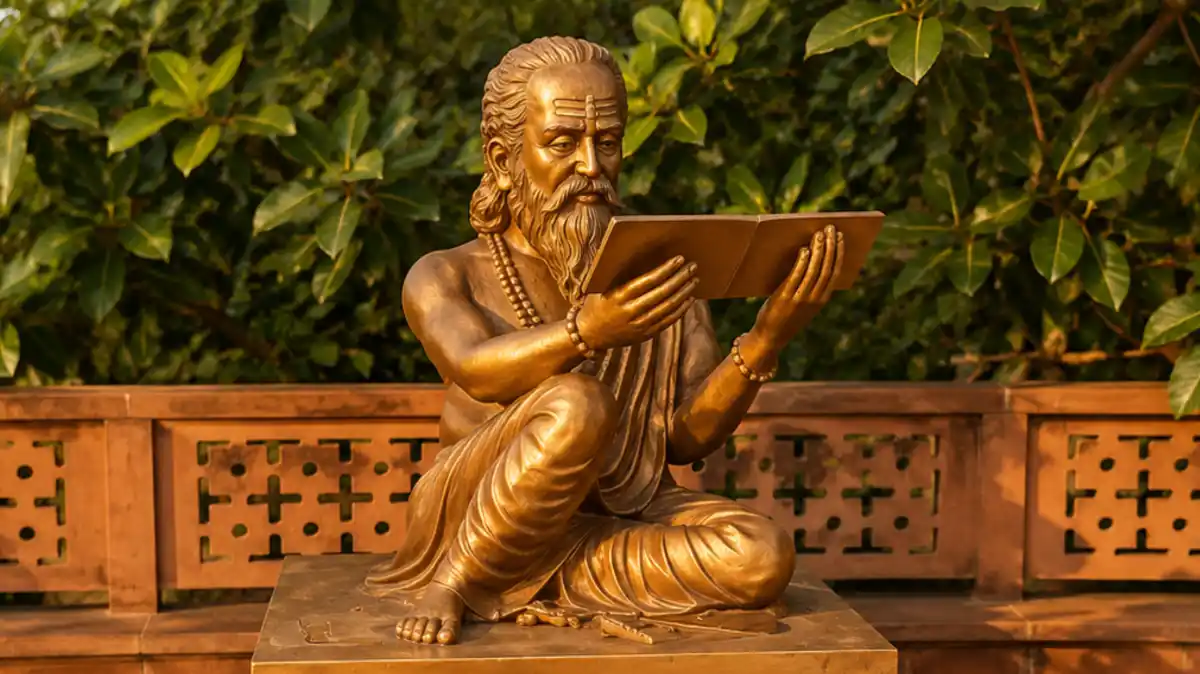
Vikram Tila (Vikramaditya Singhasan Battisi): On the island in Rudrasagar lake behind MahakaleshwarExplore the divine Mahakaleshwar Jyotirlinga in Ujjain.. The 2016 brass memorial shows Vikramaditya enthroned with all nine Navaratnas, Ghatakarpara included, sculpted around him. Free entry; 15 to 20 minutes.
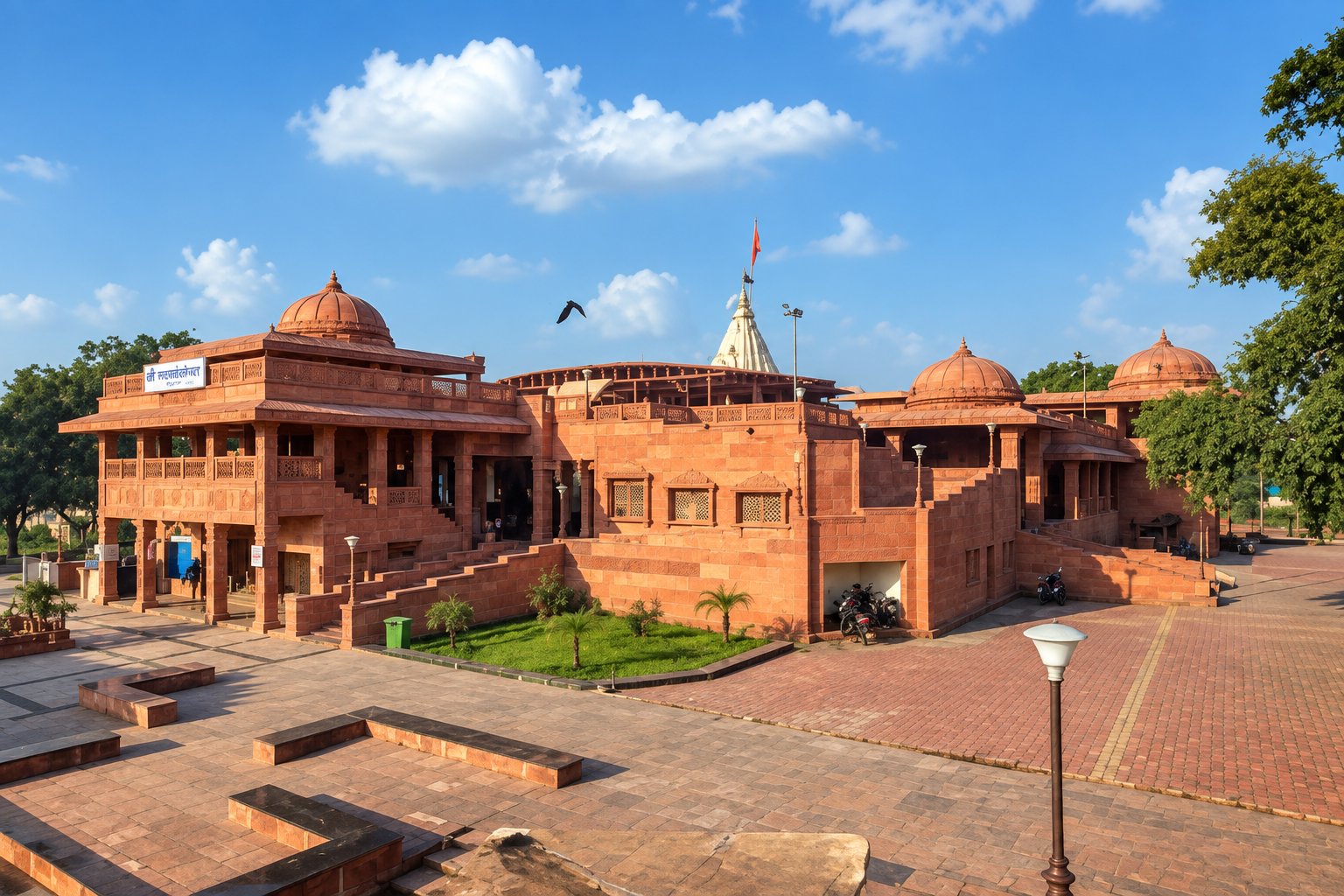
Vikram Kirti Mandir / Scindia Oriental Research Institute (SORI): About 4 km from Mahakaleshwar. Holds approximately 18,000 manuscripts in Sanskrit, Prakrit, Arabic and Persian. The SORI is where the manuscript tradition that preserved both the Ghatakarpara-kavyam and Abhinavagupta's commentary on it lives as a working institution. Allow 1 hour; closed Mondays.
This thread works well for
- Readers interested in Sanskrit literary technique, yamaka is the most demanding device in classical Sanskrit poetics, and understanding what Ghatakarpara did places the Navaratna legend in a genuinely interesting intellectual frame.
- Readers familiar with Abhinavagupta, the fact that Kashmir's greatest philosopher-aesthetician wrote a commentary on this poem, and attributed it to Kalidasa, is a remarkable detail that reveals how the poem circulated at the highest levels of Sanskrit scholarship.
- Visitors interested in the dutakavya tradition, the Ghatakarpara-kavyam may be the oldest surviving messenger poem in Sanskrit, predating even Kalidasa's Meghaduta in the genre.
Plan differently if you are
- Looking for a dedicated Ghatakarpara monument, there isn't one. He appears only as part of the nine-gems group at Vikram Tila.
- Expecting a diplomat or administrator story, that description has no basis in any scholarly source. Ghatakarpara's legacy is entirely literary.
Comments
No comments yet. Be the first to share your thoughts!
Leave a Comment