

Key highlights
- Bhartrihari is traditionally remembered as the elder brother of King Vikramaditya of Ujjain who renounced the throne to become a yogi. This is a legend of the Nath sampradaya, not confirmed history.
- The historical Bhartrihari is a Sanskrit poet-grammarian dated by most scholars to the 5th century CE. He wrote the Shatakatraya (three centuries of verses on ethics, love and renunciation) and the Vakyapadiya, a foundational work on the philosophy of language.
- Whether the poet and the legendary king are the same person is a live scholarly question. Medieval Indian tradition assumed they were; modern scholars are divided.
- The cave is a Nath-panth worship site with a perpetual dhuni (sacred fire), a seated statue of Bhartrihari, and shrines to Gorakhnath and the Navnath. Nath sadhus meditate there, especially during festivals.
- Gadkalika temple and the Pir Matsyendranath samadhi are adjacent. All three can be visited in one stop.
Two Bhartriharis, one cave
The name Bhartrihari attaches to at least two distinct traditions, and the cave in Ujjain is where they merge.
The first is a historical Sanskrit author, dated by most modern scholars to roughly the 5th century CE. Encyclopaedia Britannica gives a later estimate of roughly 570 to 651 CE, derived from the Chinese pilgrim I-Tsing's account, but that dating is now a minority position because the Buddhist logician Dignaga, who lived around 480 to 540 CE, quotes the Vakyapadiya directly, which pushes Bhartrihari earlier. The scholarly consensus treats him as a 5th-century figure. He was a poet of striking precision and a grammarian who wrote one of the most influential treatises on the philosophy of language.
The second is a legendary king of Ujjain who renounced his throne, gave the kingdom to his younger brother Vikramaditya, and withdrew to a cave on the Kshipra to practise austerities. This figure belongs to the oral tradition of the Nath sampradaya, the Shaiva yogic order tracing to Matsyendranath and Gorakhnath. In that tradition, Bhartrihari becomes a disciple of Gorakhnath after his renunciation and is venerated as one of the Nath siddhas.
The cave in Ujjain honours the second figure while inheriting the literary reputation of the first. Whether they were the same person is a question scholars have not settled. The leading textual scholar of the poems, D.D. Kosambi, argued plainly that the poet could not have been a king. The Sanskritist Daniel Ingalls, writing in 1968, saw no reason the same person could not have written both poetry and grammar. Present-day scholarship leans toward a single author for the poems and the grammar but doesn't claim the royal biography as historical fact.
Any implied link between this Bhartrihari and the legendary 57 BCE Vikramaditya (the figure associated with the Vikram Samvat calendar) is chronologically impossible. The 5th-century CE dating puts him roughly five to six centuries after that legendary king, and about a century after the Gupta emperor Chandragupta II, who is the historical ruler most often identified with the Vikramaditya title.
Every guidebook and signboard in Ujjain states the brother relationship as settled fact. It's not. Kosambi's verdict was blunt: the poet could not have been a king, whatever the fablists narrate. The legend is culturally important and worth knowing, but presenting it as biography misleads visitors about what the historical record actually supports. Treat the royal story as you would the Vikram-Betal tales: beloved tradition, not documented chronology.
The legend of the magic fruit
The renunciation story most commonly told in Ujjain goes like this. A Brahmin, or in some versions Guru Gorakhnath himself, gives King Bhartrihari a fruit of immortality. The king, wanting to give eternal life to the person he loves most, passes it to his queen, Pingala. The queen, secretly in love with the army chief, passes the fruit to him. Through a further chain of hands it eventually returns to Bhartrihari, exposing the betrayal in a single stroke and shattering his faith in worldly attachment.
The shock of that discovery, the legend says, is what drove him to renounce the throne. He handed the kingdom to his younger brother Vikramaditya and withdrew to the cave above the Kshipra.
This story is a Nath-tradition folktale, not a passage from Bhartrihari's own verses and not a documented historical event. Variants circulate across Rajasthan, Uttar Pradesh, Bengal, Punjab, Haryana, Bihar and Chhattisgarh, sometimes attached to Bhartrihari, sometimes to other legendary kings. The queen's name is usually Pingala; some versions give Anangasena. The scholarly reference for the oral tradition is Ann Grodzins Gold's study of the sung tale in Rajasthan, published by the University of California Press in 1992.
A parallel legend, also from the Nath tradition, has Bhartrihari killing a deer during a hunt; Gorakhnath revives the animal, and the king, shaken, becomes his disciple. Both stories arrive at the same destination: the cave.
The three Shatakas and the Vakyapadiya
Bhartrihari's lasting reputation rests on two bodies of work, and the draft you may have read elsewhere mentions only one of them.
The Shatakatraya: three centuries of verse
The Shatakatraya comprises three collections of roughly a hundred verses each: the Niti Shataka on ethics and statecraft, the Shringar Shataka on love and beauty, and the Vairagya Shataka on renunciation and detachment. Barbara Stoler Miller, the Columbia University translator, rendered the three sections as "Among Fools and Kings," "Passionate Encounters," and "Refuge in the Forest."
| Collection | Theme | What it is known for |
|---|---|---|
| Niti Shataka | Ethics, discernment, statecraft | Verses on the difference between true knowledge and mere cleverness, the company one keeps, the obligations of a ruler |
| Shringar Shataka | Love, beauty, desire | A frank meditation on romantic longing, praised for its candour about desire while already sensing impermanence |
| Vairagya Shataka | Renunciation, detachment | The most quoted of the three: verses on the emptiness of worldly pursuit and the turn toward spiritual seeking |
Sources: Encyclopaedia Britannica and Barbara Stoler Miller's Columbia University Press edition, cross-checked August 2026. Verse counts are approximate because recensions vary; Kosambi identified a stable core of about 200 verses across all three collections, with roughly 700 circulating in total.
Later readers have often taken the three-part sequence as autobiography: the arc of a man who lived through worldly engagement, worldly attachment and then release. That reading is a later interpretive tradition, not an authorial plan. The poems are individual, unlinked stanzas, and the section titles were added by later anthologists. Britannica notes that most scholars are confident only about the Shringar Shataka's authorship; full-set attribution is genuinely uncertain.
The Vakyapadiya: the philosophy of language
The work most articles about the cave never mention is the Vakyapadiya, a treatise on the philosophy of language that remains influential in linguistics and Indian philosophy. Its central argument is the sphota theory: that meaning bursts forth as an indivisible whole rather than being assembled letter by letter or word by word. The related concept of shabda-brahman, "word as ultimate reality," links grammar to metaphysics in a way that made Bhartrihari as significant a philosopher as he was a poet.
The Swiss linguist Ferdinand de Saussure reportedly consulted the Vakyapadiya for his doctoral work on Sanskrit. The Internet Encyclopedia of Philosophy devotes a full entry to Bhartrihari's philosophy, treating the poet and the grammarian as a single author.
I-Tsing, the Chinese pilgrim who visited India between roughly 671 and 695 CE, recorded that the grammarian Bhartrihari had died about forty years before his account, which would place the death around 651 CE. I-Tsing also recorded a famous anecdote: that Bhartrihari oscillated seven times between Buddhist monkhood and worldly life. Scholars have noted that I-Tsing erred in calling him a Buddhist; Bhartrihari's own verses praise Shiva, and the Vakyapadiya's philosophical positions contradict Buddhist arguments on several points. The seven-times anecdote is nonetheless one of the most cited stories about him in academic literature.
The cave today
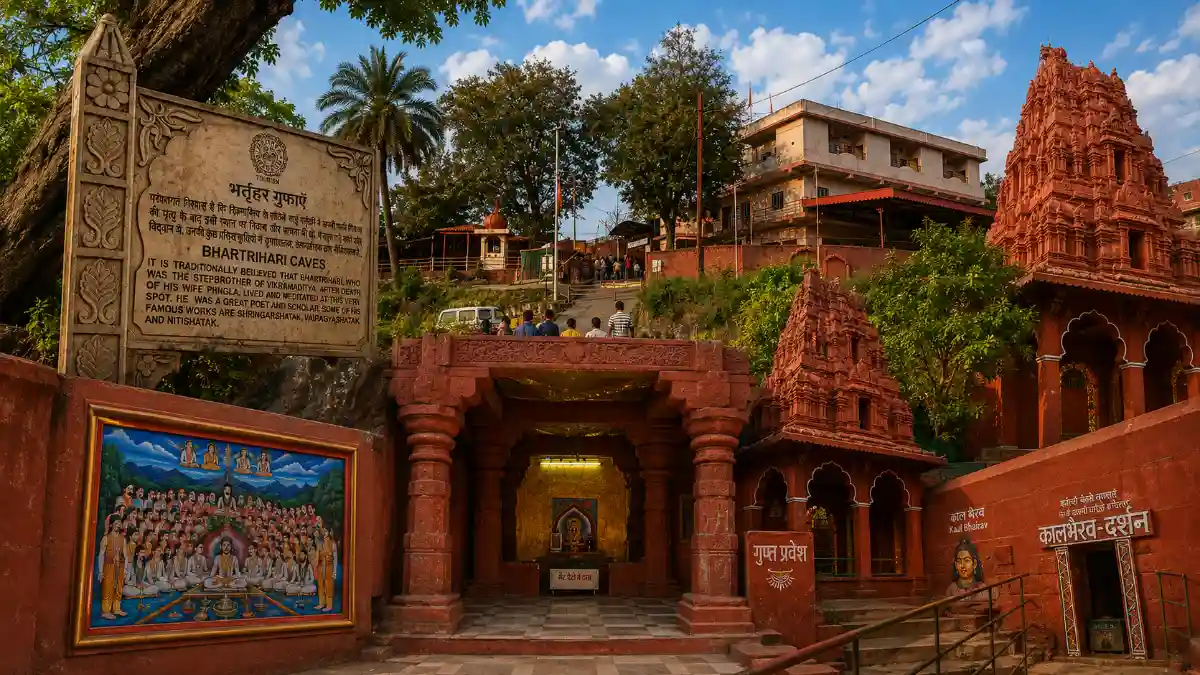
Bhartrihari Cave sits on the eastern bank of the Kshipra, on a raised mound on the riverbank, adjacent to Gadkalika temple and the Pir Matsyendranath samadhi. It's about 4 km from Ujjain Junction railway station and roughly 5 to 7 km from MahakaleshwarExplore the divine Mahakaleshwar Jyotirlinga in Ujjain. Temple, about 15 to 20 minutes by auto-rickshaw.
The complex is partly rock-cut, partly masonry, entered by narrow passages and roughly 40 to 50 steps down. The interior is poorly ventilated in its depths. Inside you will find a seated stone statue of Bhartrihari, a Shiva trident, an ever-burning dhuni (sacred fire) linked to Gorakhnath, carved wall images, and a Nath/Navnath shrine with idols including Gorakhnath. A modern three-tier gateway was added in recent years, and a large pipal tree above is said to mark Bhartrihari's samadhi.
Tourism sources attribute the built structure to the Paramara period, 10th to 11th century CE, describing the remains of a double-storied monastery that became a Nath-cult centre by the 14th or 15th century. That attribution echoes Madhya Pradesh government tourism copy but is not backed by a peer-reviewed excavation report. Colonial surveyors in the early 19th century described an ancient masonry building of uncertain purpose. Treat the 11th-century date as a traditional attribution rather than confirmed archaeology.
The site doesn't appear on the ASI list of Centrally Protected Monuments. It functions as a living Nath-sampradaya shrine, and entry is free. General visiting hours are roughly 6 AM to 9 PM.
The passages are narrow, dark and low-ceilinged. Visitors with claustrophobia, back problems or respiratory issues should assess honestly before going down. Carry a torch or phone light. There are no handrails in the lower sections, and the steps can be slippery. If you are travelling with elderly family members or small children, the upper courtyard with the pipal tree and the Nath shrine gives the site's atmosphere without requiring the descent.
What is next to the cave: Gadkalika and Matsyendranath
Two other sites sit within a few hundred metres and are worth visiting in the same stop.
Gadkalika (Garhkalika) temple is a revered Kali shrine described in some traditions as a Shakti Peeth, where the upper lip of Sati fell. Its fame in literary history is the legend that the poet Kalidasa gained his genius through the goddess's blessing here. The temple was renovated in the 7th century under Harshavardhana and later by the Gwalior (Scindia) state. The thematic pairing is worth noticing: Kalidasa blessed into worldly genius and Bhartrihari renouncing worldly life, a few hundred metres apart.
The Pir Matsyendranath samadhi, also adjacent, marks the traditional resting place of the Nath patriarch Matsyendranath (Macchindranath), whom the tradition holds as the guru of Gorakhnath, who in turn is the guru of Bhartrihari. So the guru-lineage runs Matsyendranath, Gorakhnath, Bhartrihari, all commemorated within walking distance of each other on the Kshipra bank.
The Nath tradition and the Bharthari-Gopichand ballad cycle
The cave's living identity is Nath. The Nath sampradaya is a Shaiva yogic order with roots conventionally dated to the 12th or 13th century CE, which is later than the historical poet-grammarian. Bhartrihari's inclusion in the Nath lineage is a devotional and legendary layer grafted onto the earlier author. Whether or not the history supports it, the devotional link is real in practice: Nath sadhus pitch tents outside the caves and meditate there, especially during festivals and mela seasons.
In Nath tradition, Bhartrihari's nephew Gopichand (Gopichandra), a king of Bengal and son of his sister Menavati, likewise renounced his throne. The Bharthari-Gopichand ballad cycle is one of the most widely performed oral epics of North India, sung across Rajasthan, Uttar Pradesh, Bengal, Punjab, Haryana, Bihar and Chhattisgarh. If you have heard either story in folk performance, the cave is where the Bhartrihari half of that cycle is set.
Visitors who want to distinguish the Ujjain cave from a different Bhartrihari site should note that a separate Bhartrihari temple and samadhi stands near Alwar in Rajasthan, about 35 km from the town, near Sariska. That is the principal Nath-tradition samadhi shrine for Bhartrihari and hosts a large annual fair in Bhadrapada. They are different sites.
How does this connect to Simhastha 2028?
Simhastha 2028Explore the world's largest spiritual gathering in Ujjain. runs from 27 March to 27 May 2028, a window of about 62 days. The three Amrit Snan (Shahi Snan) dates are 9 April, 23 April and 8 May 2028, though one source listing the Ujjain Police's official presentation gives 27 April instead of 23 April as the second date. Confirm the middle date against the final government gazette notification before booking non-refundable travel.
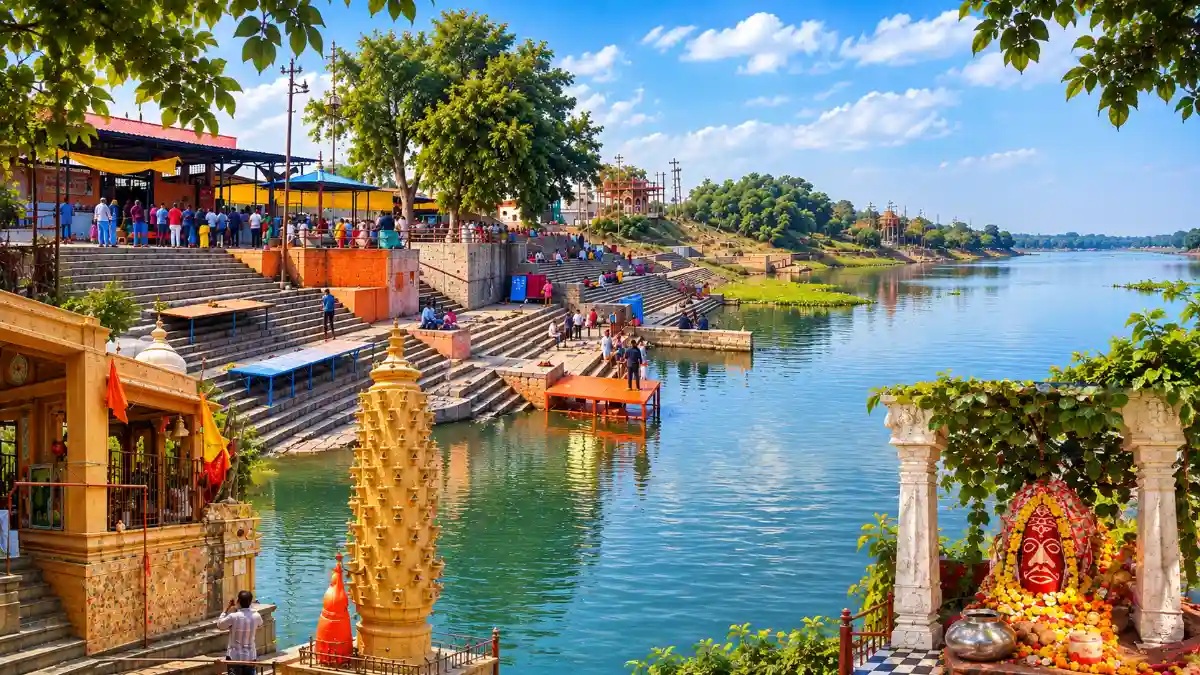
The cave is not on the Shahi Snan bathing routes, which are centred on Ram GhatRam Ghat, the most prominent bathing ghat in Ujjain. and the Kshipra ghats. Thirteen akhadas process to the river on those days, across three traditions: Shaiva, Vaishnava and Udasin-Nirmal. The Nath sampradaya is not among the processing akhadas, but Nath sadhus are present in Ujjain during Simhastha, and the cave draws them specifically.
For pilgrims, the practical value of the cave is contrast. The Shahi Snan days are spectacle, crowd, procession and noise. The cave is silence, descent and solitude. Pairing the two gives a fuller sense of what Ujjain's spiritual identity actually contains.
Fitting the cave into a Simhastha day
Situation
You have a full day in Ujjain on a Parva Snan date or a non-snan day, you are staying near the Mahakal area, and you want to pair the main temple experience with the Bhartrihari stop. Budget roughly ₹300 to ₹600 for a round-trip auto from the temple zone to the cave and back.
Early morning, 4 AM to 8 AM. Bhasma Aarti at Mahakaleshwar if you hold a confirmed booking, or a standard early darshan.
Mid-morning, 9 AM to 10:30 AM. Auto to Bhartrihari Cave. Visit the cave, the upper courtyard, the Nath shrine, then walk to Gadkalika temple and the Matsyendranath samadhi. Allow 45 minutes to an hour for all three.
Late morning, 11 AM onward. Return to the temple zone or your accommodation and rest through the afternoon heat.
Key lesson: The cave works best as a late-morning add-on after the Mahakaleshwar darshan, not as a standalone destination. On a peak Amrit Snan day (9 April, 23 April or 8 May 2028), skip the cave entirely and spend all your time at the ghats; the cave will be there the next morning when the crowds are lighter.
Who should visit and who should plan differently
This stop works well for
- Pilgrims staying 2 or more days: you have time for the quieter heritage layer after doing the main temple and ghats on day one.
- Anyone interested in Sanskrit literature or Indian philosophy: the Vakyapadiya and the Shatakatraya are canonical texts, and standing where they are traditionally associated with adds a dimension reading alone doesn't.
- Visitors who find crowds exhausting: the cave draws a fraction of Mahakaleshwar's footfall and is a genuine break from sensory overload.
- Students of the Nath tradition: the Gorakhnath dhuni, the Navnath shrine and the adjacent Matsyendranath samadhi form a compact Nath-lineage circuit.
Plan differently if you are
- On a single-day visit during Amrit Snan: your time is better spent at the ghats and Mahakaleshwar. The cave is not a substitute for the core Simhastha experience.
- Travelling with mobility-limited family members: the steep, narrow, dark stairway is not accessible. Stay in the upper courtyard instead of descending.
- Expecting Mahakaleshwar-level facilities: there are no large food stalls, restrooms or organised parking at the cave. It's a small, quiet site.
- Claustrophobic or respiratory-sensitive: the inner chambers are low, unventilated and can feel oppressive. Assess honestly before going down.
Expert Tip — Umesh Kant Sharma
"Visitors often plan Simhastha around the big, visible moments — and they should, those moments are extraordinary. But Ujjain's spiritual identity was built by people like Bhartrihari long before the mela existed in its current form. Spending even half an hour at his cave gives context to everything else you'll see on the ghats: the sadhus, the akhadas, the entire culture of renunciation on display during Shahi Snan didn't appear from nowhere. It has roots, and this cave is one of the places you can physically stand in them."
Visiting etiquette
- What should I wear? Modest, simple clothing. This is an active meditation site managed by Nath sadhus, not a monument with a ticket counter.
- Can I take photographs? Ask before photographing inside the cave or near the dhuni. The sadhus and regular worshippers may prefer you don't.
- Is there an entry fee? Entry is free as of August 2026. No ticket counter operates at the site. Confirm locally if this changes closer to Simhastha 2028.
- What are the opening hours? Roughly 6 AM to 9 PM. These have not been independently verified against an official notice and may shift during the mela window.
- Should I bring anything? A torch or phone light for the lower chambers. Water, since there are no reliable refreshment stalls on-site. Footwear you can remove easily.

Comments
No comments yet. Be the first to share your thoughts!
Leave a Comment