

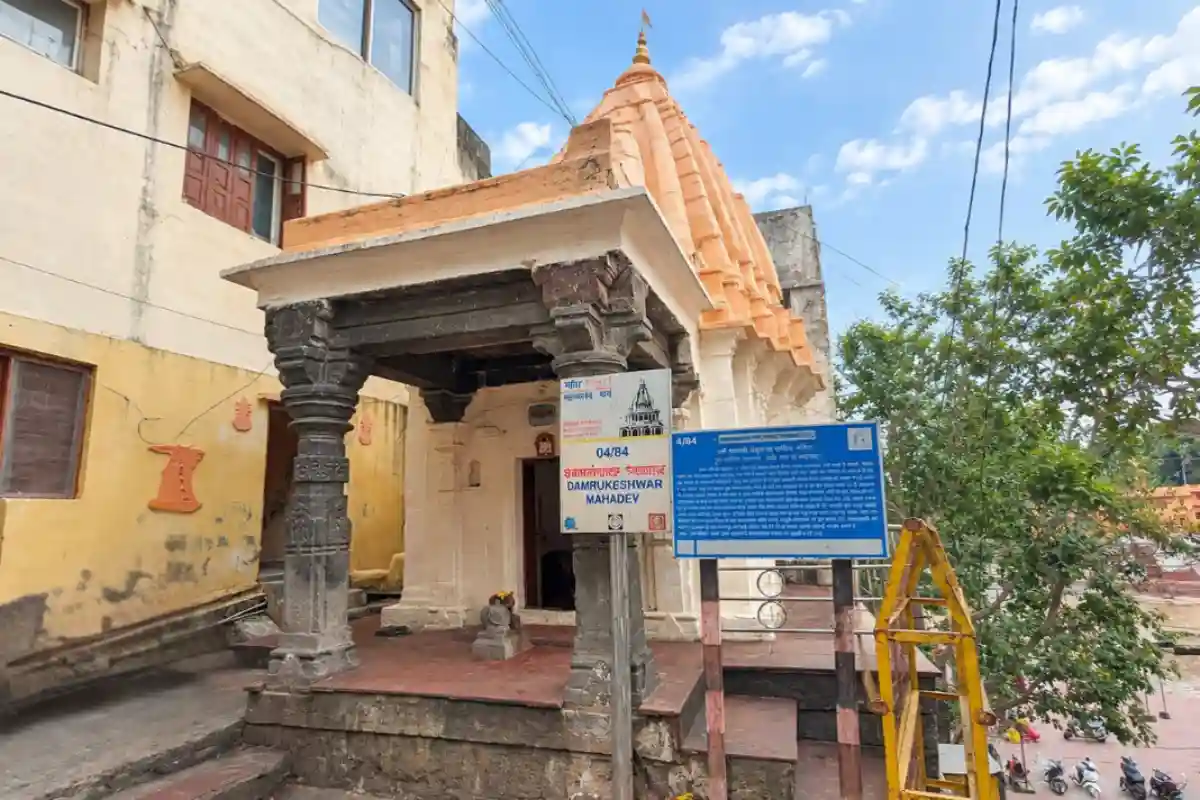
What is Damarukeshwar Mahadev in Ujjain?
Damarukeshwar Mahadev is the fourth linga among Ujjain's 84 Mahadevs. Its story is told in the fourth chapter of the Chaturashiti Linga Mahatmya, in the Avantya Khanda of the Skanda Purana. The Purana says this linga broke through the earth at the sound of Shiva's damaru, and that is how it got its name.
The Sanskrit form is "Damarukeshvara". In English it is also written Damrukeshwar, and in Hindi Damarukeshwar or Damrukeshwar.
Local accounts place the temple on the Harsiddhi road, above the Ram Sidhi steps.
At a glance
- Vajra, son of the demon Ruru, drove the gods out of heaven and shut down the Vedic recitation and sacrifices.
- Kritya, born of a mass of radiance, and the maidens born of her laughter fought Vajra, but his tamasi illusion made them faint.
- On Narada's report Shiva returned in a terrible form and sounded the damaru.
- The linga that rose at that sound sent out flame and wind that burned the whole demon army.
What are the key facts about Damarukeshwar Mahadev?
| Item | Detail |
|---|---|
| Basis of the name | Emerging at the sound of the damaru (Shiva's hand drum) |
| Deity | Shiva, in linga form |
| Source text | Skanda Purana 5.2.4 (Avantya Khanda, Chaturashiti Linga Mahatmya, chapter 4) |
| Place in the 84 Mahadevs | Fourth |
| Characters | Shiva, the demon Vajra, his father Ruru, Kritya, Narada, Brahma |
| Setting in the story | Mahakalavana |
| Narrator | Shiva, speaking to Parvati |
The whole Chaturashiti Linga Mahatmya is Shiva speaking to the Devi, so in the Damarukeshwar chapter he reports his own actions: "I sounded the terrible damaru." Shiva himself gives the account of how the linga appeared.
What is the Skanda Purana story of Damarukeshwar Mahadev?
In the very first verse of the chapter, Shiva says that this fourth deity, Damarukeshwar, is well known in Avanti, and that his darshan destroys sins. Then he explains how the linga appeared.
Vajra, son of Ruru
In the Vaivasvata kalpa there was a great demon named Ruru. His son Vajra was strong, huge and sharp-fanged. He threw the gods out of their posts and out of heaven, and took all their wealth.
Even Brahma ran
The gods went to Brahma. The Purana says Brahma was afraid too, and, knowing Vajra could not be defeated, fled with the gods.
Vajra then killed the brahmins and others who performed sacrifices and austerities. On earth the recitation of scripture and the cry of "vashat" stopped, the sacrificial festivals ended, and cries of "Ha! Ha!" rose everywhere.
Kritya appears
The grieving gods and great sages were still thinking of a way to kill the demon when a huge body, ringed with radiance, appeared before them. A lotus-eyed divine Kritya rose from it and asked, "Why was I brought forth?"
The gods listed Vajra's crimes. She laughed loudly, again and again, and lotus-eyed maidens kept coming out of her laughter. Their forms were fearsome, their faces covered in flames, and they carried nooses and goads. They fought Vajra's army in a fierce battle.
Tamasi illusion and refuge in Mahakalavana
The Purana calls these maidens the Matrigana. Before them the demon army began to fall back. Then Vajra created an illusion called "tamasi". The maidens started fainting and thick darkness spread.
Frightened, the goddess Kritya took the maidens to the excellent Mahakalavana, where the skull-bearing Hara stood in linga form. Vajra followed into Mahakalavana with an army of crores of chariots.
Narada's report
Just then Narada reached Shiva on Mount Mandara and said (Skanda Purana 5.2.4.25):
महाकालवने देव ताडितास्त्त्रिदशाः प्रभो ।
वज्रेण रुरुपुत्रेण तस्माद्याहि महेश्वर ॥
Meaning: O Lord, in Mahakalavana Vajra, son of Ruru, has struck down the gods. Therefore, O Maheshvara, please come.
The terrible form and the sound of the damaru
Shiva returned to Mahakalavana in a terrible form, adorned with serpents and surrounded by his ganas. The moment he arrived he beat the dreadful damaru, and the sound enchanted Vajra's army.
At that same sound an excellent linga, ringed with flames, pierced the earth and rose. From one side of the linga a great flame spread through the whole cosmic egg, and from the other side a violent wind blew. The whirling wind fed the flames, and the demon army burned to ashes.
The naming
With Ruru's son dead, the gods rejoiced. According to the chapter, since this deity originated on the earth at the sound of the damaru, he would be known as "Damarukeshvara" and would grant all desires.
What fruits does the Skanda Purana promise for Damarukeshwar darshan?
The closing verses of the Damarukeshwar chapter list these fruits:
- Darshan destroys sins (verse 1).
- Those who visit and worship are freed from misery and feverish ailments.
- Worship brings the merit of hundreds of Chandrayana vows properly performed.
- Darshan gives the fruit of a thousand horse-sacrifices, a hundred Vajapeyas and a gift of a thousand cows.
- A hero who goes to battle after darshan defeats his enemies and is finally honoured in Rudraloka.
Verses 39 and 40 put the Rudraloka promise like this (Skanda Purana 5.2.4.39 and 40):
अस्मिन्स्थाने स्थितं लिंगं भक्त्या डमरुकेश्वरम् ।
प्रसंगादपि पश्यंति ह्यपि पापपरा नराः ॥
तेऽप्यवश्यं तु यास्यंति रुद्रलोकं सनातनम् ।
भक्ताः स्तोष्यंति ये लिंगं ख्यातं डमरुकेश्वरम् ॥
Meaning: even sinful people who happen, by chance, to see the Damarukeshvara linga standing in this place will surely go to the eternal Rudraloka. The same holds for devotees who praise this famous linga.
The chapter names no tithi, month or weekday. The fruits are tied to darshan and worship.
Which popular claims about Damarukeshwar Mahadev do not match the Purana?
A few things have attached themselves to the Damarukeshwar story that are not in the Skanda Purana text, or that circulate with wrong names.
| Popular claim | In the Skanda Purana | Status |
|---|---|---|
| The demon was named "Rudra" | The demon is Ruru and his son is Vajra. The Sanskrit verse reads "rurūputreṇa" | Wrong name |
| Shiva came in an "uttam Bhairav" form | Shiva comes in a "terrible form". The word "excellent" (uttama) is used for the linga | Differs from the text |
| The gods and sages first gathered in Mahakalavana | The gods first went to Brahma. Mahakalavana became a refuge later, when Kritya came with the maidens | Order reversed |
| The maiden arose from a mantra rite | Kritya rises from a mass of radiance. "Mantra" is only an alternative reading in the translation | Partly true |
| Donate ghee-mixed kheer under the Rohini nakshatra | The chapter mentions no nakshatra or donation | Astrological interpretation |
| Special worship here in Sawan and on Mahashivratri | The chapter names no tithi or festival. The Sawan link belongs to the 84 Mahadev yatra tradition | Tradition |
| The temple is centuries old and built of black stone | The text gives no date or build for any temple structure | Unverified |
In the Damarukeshwar chapter the damaru does a plain job: its sound enchants the demon army, and the same sound makes the linga break through the earth. Readings that link the damaru to nada-brahma or the Maheshvara Sutras exist elsewhere in Shaiva tradition, but this chapter does not mention them.
What else do people ask about Damarukeshwar Mahadev?
Who is Kritya, and who were the maidens?
In the Damarukeshwar chapter Kritya is a divine power who rises from a huge body of radiance in front of the gods. The lotus-eyed maidens born of her laughter are called the Matrigana by the Purana. They fight Vajra's army with nooses and goads, but his tamasi illusion makes them faint.
Does Damarukeshwar darshan bring victory in a battle or contest?
The Skanda Purana's phalashruti says a hero who goes to battle after Damarukeshwar darshan defeats his enemies. That is the fruit the Purana states. It promises nothing for a present-day contest or court case. The chapter gives no separate rite or day for this fruit.
Is there a special day for Damarukeshwar darshan?
The Skanda Purana's Damarukeshwar chapter names no special tithi, month or weekday for darshan. The 84 Mahadev yatra runs in Sawan and in the extra month (Adhik Maas), and Damarukeshwar is its fourth halt. That is a yatra tradition, not a Purana rule.
What are the darshan timings of Damarukeshwar Mahadev?
No confirmed official darshan timing is available for Damarukeshwar Mahadev. Timings at small shrines change with the priest's convenience and the season, so ask a local priest before you go.
Where does Damarukeshwar sit in Ujjain's 84 Mahadev tradition?
In the order of the Chaturashiti Linga Mahatmya, Agastyeshwar is first, Guheshwar second, Dhundheshwar third and Damarukeshwar fourth. Anadikalpeshwar follows as fifth and Svarnajvaleshwar as sixth. The tirtha list in chapter 70 of the Avantikshetra Mahatmya gives the same order.
According to G. V. Tagare's introduction to this section of the translation, it deals with the 84 temples that existed in the Mahakalavana area when the Purana was composed. The introduction also notes that the author modifies a Puranic legend to suit his purpose, or attaches a new legend to mythological names. So the Damarukeshwar story is best read as Puranic tradition, not as a historical event.
For the full list, see the complete circuit guide to Ujjain's 84 Mahadev temples.
After Damarukeshwar, which linga does the 84 Mahadev story move to?
The Damarukeshwar chapter ends on the promise of Rudraloka. The next chapter is Anadikalpeshwar's, the fifth linga.
Comments
No comments yet. Be the first to share your thoughts!
Leave a Comment