Key highlights
- "Vikramaditya" is a title meaning sun of valour, carried by several real rulers including the Gupta emperor Chandragupta II (about 375 to 415 CE). The legendary Ujjain king of 57 BCE has no contemporary epigraphic or numismatic record.
- The Vikram Samvat calendar runs about 57 years ahead of the Gregorian year. Inscriptions show it was first called the Krita era, then the Malava era, and only picked up the name "Vikrama" in the 9th century CE.
- The Surya Siddhanta places India's reference meridian through Ujjayini, which is why traditional almanacs still calculate from Ujjain. Greenwich was adopted as the world standard at the 1884 conference in Washington, D.C.
- The Navaratnas, or nine gems, come from a single verse in the Jyotirvidabharana. Varahamihira lived about 505 to 587 CE, so the nine could not have shared one court.
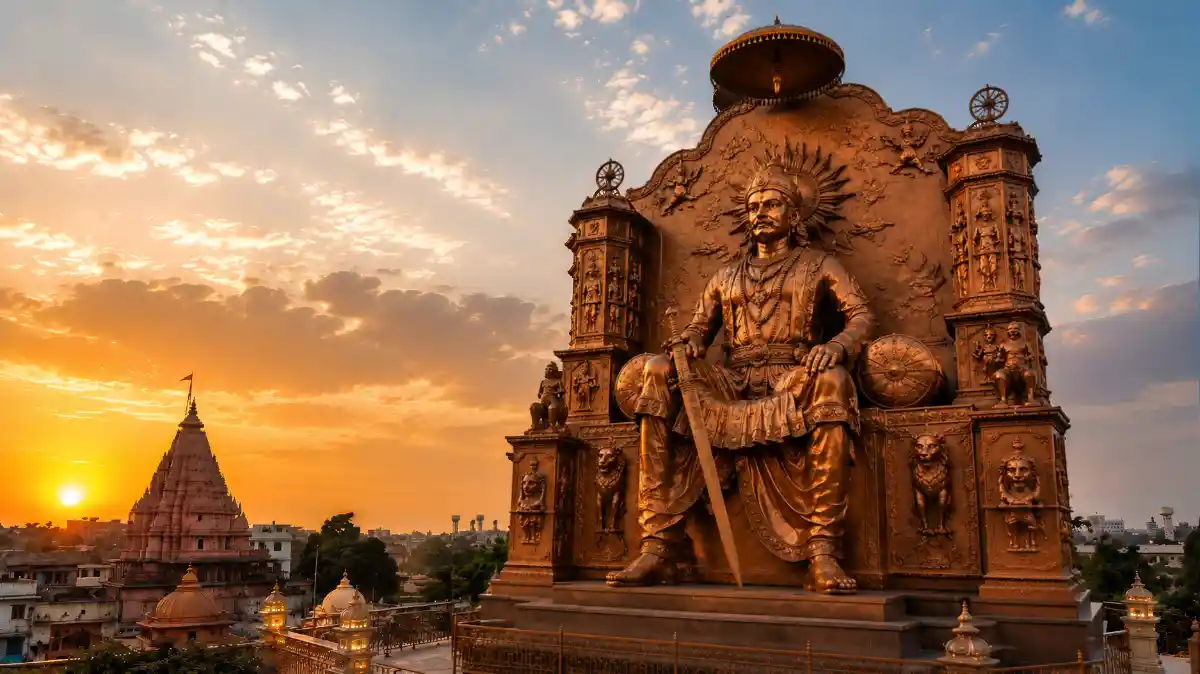
- You can trace the legacy in a single day: the 30-foot brass statue at Vikram Teela, the recreated court with the Singhasan Battisi throne, the Vedh Shala observatory, and the Vedic Clock tower installed in March 2024.
- Simhastha 2028's bathing dates are fixed using the same panchang tradition that Ujjain astronomers formalised centuries ago, which is why understanding Vikramaditya's legacy helps you understand the mela itself.
Who was Raja Vikramaditya, and did he actually exist?
Vikramaditya is a title, not a birth name. It joins vikrama, meaning valour or prowess, with aditya, the sun. Sun of valour.
Indian tradition attaches two more epithets to him: Sahasanka, the daring one, and Shakari, enemy of the Shakas. That second name points to the founding story, in which a king of Ujjain drives the Shaka invaders out of Malwa and starts a new era to mark the victory.
Here is the honest position on his historicity. Mainstream scholarship treats the 1st century BCE Vikramaditya of Ujjain as legendary or composite. A peer-reviewed study of the sources describes his historical narrative as ambiguous and lacking in epigraphic evidence, while noting that the legend itself remains culturally durable. No coins, no inscriptions, no contemporary record. What survives is a story cycle that grew for a thousand years.
That doesn't make the name empty. Several documented rulers took the title, and one of them is the strongest candidate for the person the legend eventually absorbed.
| Ruler | Period | Why the title matters here |
|---|---|---|
| Chandragupta II | about 375 to 415 CE, Gupta dynasty | The ruler most often identified with the Vikramaditya legend. Traditionally the patron of Kalidasa, and the reason the legend picked up a Gupta-era glow. |
| Skandagupta | about 455 to 467 CE, Gupta dynasty | Also used the title Vikramaditya, showing it functioned as an imperial honorific rather than a personal name. |
| Yashodharman | 6th century CE, Malwa | A Malwa ruler who defeated the Hunas, keeping the title tied to this region. |
| Chalukya kings | 7th to 12th century CE | Vikramaditya I, II and VI ruled from the Deccan, which shows how far the title travelled from Ujjain. |
| Paramara rulers | 10th to 13th century CE, Malwa | Claimed the Vikramaditya legacy directly, including King Bhoja of Dhar. |
| Hemachandra Vikramaditya (Hemu) | 1556 CE, Delhi | Took the title on his coronation, roughly 1,600 years after the legendary king. |
Sources: Encyclopaedia Britannica, New World Encyclopedia, and a peer-reviewed IJIERT paper on the Vikramaditya tradition, checked August 2026. Regnal dates for early Indian rulers vary by a few years between scholars.
So when Ujjain talks about "our king," it's talking about a cultural memory, not a birth certificate. The city has held on to that memory for two thousand years, which is itself a historical fact worth respecting.
Signage at Vikram Teela and in most local guidebooks presents the 57 BCE dating and the nine-gem court as settled history. It isn't, and you'll notice the gap the moment you check any date. Treat the plaques as a record of what Ujjain believes about itself, which is genuinely interesting, and keep the scholarly timeline separately in your head. Both are worth carrying.
Why does the Vikramaditya story belong to Ujjain specifically?
Because Ujjain was already a capital when the legend needed one.
One correction worth making, since almost every article gets it wrong. Avanti was the region, one of the sixteen Mahajanapadas listed in early Buddhist texts. Ujjayini was its capital city. The Vindhyas split Avanti into a northern half ruled from Ujjayini and a southern half centred on Mahishmati. The region later took the name Malwa, after the Malava tribe. Saying "Ujjain was then called Avanti" collapses a region into a city.
The city carried other names too. Ujjayini in Sanskrit, Avantika in devotional usage, and Ozene in Ptolemy's Greek geography of the 2nd century CE. Ptolemy knew about it, which tells you how far its trade reach ran.
Under the Mauryas, Ujjain governed the province of Avantirashtra, and Ashoka served as its viceroy before he became emperor. That posting put Ujjain second only to Pataliputra in the empire. The city sat on the Dakshinapatha, the great southern trade route running down to the port of Bharukaccha, modern Bharuch, which is how Malwa cotton and Deccan goods reached the Arabian Sea.
A city with that much money, traffic and administrative weight is exactly the kind of place a legend of ideal kingship attaches itself to. Ujjain didn't become important because of Vikramaditya. The Vikramaditya story became important because it was set in Ujjain.
What are the Vikram-Betal stories, and where do they come from?
The Vetala Panchavimshati, known in Hindi as Baital Pachisi and to most Indians as Vikram aur Betaal, is a cycle of 25 tales.
The frame story is macabre and famous. A tantric mendicant asks the king to fetch a corpse hanging in a cremation ground. The corpse is animated by a vetala, a spirit. Each time the king carries it back, the vetala tells a riddle-story and demands an answer, warning that if the king knows the answer and stays silent, his head will burst. The king answers every time, the vetala flies back to the tree, and the walk starts again. Twenty-four rounds, until the last tale.
The king is named Vikramaditya or Trivikramasena, depending on the recension. So yes, the popular association is textually correct.
Authorship is where the usual telling slips. The tales are anonymous and older than any surviving version, descending from the lost Brihatkatha of Gunadhya, composed somewhere between the 1st and 3rd century CE. Two Kashmiri poets preserved them: Kshemendra in the Brihatkathamanjari around 1037 CE, and Somadeva in Book 12 of the Kathasaritsagara around 1070 CE. Independent Sanskrit recensions by Shivadasa and Jambhaladatta followed between the 11th and 14th centuries. The Hindi Baital Pachisi most people grew up with was rendered by Lallu Lal at Fort William College in the early 19th century.
Calling Somadeva "the author" is a shortcut. He preserved one version of a much older anonymous cycle.
Read as parables rather than biography, the tales do something specific: every riddle is a problem of judgment. Who is guilty. Who deserves what. Which of three claimants has the better case. That's why the name Vikramaditya became shorthand for a fair judge across a thousand years of Indian storytelling.
Who were the Navaratnas, and were they really one court?
The nine gems could not have sat in one court. The chronology rules it out.
Here's the tradition first. A verse in the Jyotirvidabharana (22.10) lists nine luminaries at Vikramaditya's court. That verse is the origin of the entire Navaratna idea, and no earlier text mentions such a group.
The problem is the source. The Jyotirvidabharana is ascribed to Kalidasa, but the ascription is pseudonymous. V. V. Mirashi dated the work to the 12th century and demonstrated Kalidasa could not have written it, pointing to grammatical faults and anachronisms in the text. D. C. Sircar's verdict on the Navaratna tradition was blunter: absolutely worthless for historical purposes.
Then there's the arithmetic. Varahamihira lived roughly 505 to 587 CE. The legendary Vikramaditya belongs to 57 BCE. That's a gap of about six centuries, and still about a century even if you shift the king to Chandragupta II.
| Name | Field | What the record actually shows | Status |
|---|---|---|---|
| Kalidasa | Poetry and drama | Author of Abhijnanashakuntalam, Vikramorvashiyam, Malavikagnimitram, Raghuvamsha, Kumarasambhava, Meghaduta and Ritusamhara. Most scholars place him in the Gupta era, roughly the 4th to 5th century CE. | Historical person, court link traditional |
| Varahamihira | Astronomy and astrology | About 505 to 587 CE, working in or near Ujjain, son of Adityadasa. Author of the Pancha-Siddhantika, Brihat Samhita and Brihat Jataka. | Historical person, cannot be a 57 BCE courtier |
| Dhanvantari | Medicine | Primarily the divine physician who rises from the churning of the ocean carrying amrita. Britannica notes the name was later applied to other semi-legendary and historical physicians. | Mythological |
| Amarasimha | Lexicography | Author of the Amarakosha, probably Buddhist. Oxford Reference dates him to about the 5th or 6th century CE, and he appears to have known Kalidasa's work. | Historical person, Gupta era or later |
| Vararuchi | Grammar and poetics | A name attached to several figures. Often identified with the grammarian Katyayana of about the 3rd century BCE, though that identification is not fully accepted. The Prakrit grammarian of the Prakrita Prakasha is dated to roughly the 3rd to 5th century CE. | Disputed identity |
| Kshapanaka | Astrology | Traditionally a Jain astrologer at the court. No independent documentation survives. | Undocumented |
| Shanku | Architecture and measurement | Associated with construction and measurement sciences in the tradition. No independent documentation survives. | Undocumented |
| Vetala Bhatta | Esoteric knowledge and poetry | Named in the tradition as a magician-poet. No independent documentation survives. | Undocumented |
| Ghatakarpara | Poetry | Credited with the short Ghatakarpara Kavya. Little else is known. | Barely documented |
Sources: Encyclopaedia Britannica, Oxford Reference, and the Wikipedia entries for Varahamihira, Kalidasa, Amarakosha and Vararuchi, cross-checked against V. V. Mirashi's and D. C. Sircar's positions as reported in reference literature, August 2026. Dates for early Sanskrit authors are contested and quoted here as scholarly ranges.
The Navaratna list is a compressed statement of what Ujjain meant to Sanskrit civilisation: poetry, astronomy, medicine, lexicography, grammar, all in one place. A later tradition gathered the greatest names it knew and seated them at the table of its greatest king. That's a cultural ideal, and it's worth understanding as one.
Of the nine, Varahamihira matters most to a Simhastha pilgrim. His astronomical work helped formalise the calculating system that traditional panchangs still use to fix ritual dates, including the Simha Rashi alignment that gives Simhastha its name.
What is Vikram Samvat, and how does it fix Simhastha's dates?
Vikram Samvat is a lunisolar calendar with an epoch of 57 BCE. Its year number runs about 57 ahead of the Gregorian year, or about 56 ahead during roughly January to April, before the Vikram Samvat new year turns.
| Gregorian year | Vikram Samvat year | Relevance |
|---|---|---|
| 2026 | 2082 to 2083 | Current year of planning and booking for Simhastha |
| 2027 | 2083 to 2084 | Final year of infrastructure delivery before the mela |
| 2028 | 2084 to 2085 | Simhastha Kumbh Mela year, 27 March to 27 May 2028 |
Sources: Encyclopaedia Britannica entry on the Vikrama era and standard calendar concordances, checked August 2026. Each Gregorian year spans two Vikram Samvat years because the VS new year begins in Chaitra, around March or April.
Regional practice differs on when the year starts. North India begins it in Chaitra, around March or April. Gujarat begins it the day after Diwali, in Kartik. Nepal, where Vikram Samvat is the official civil calendar, begins it in Baishakh in mid-April. India's official national civil calendar, for the record, is the Saka calendar, not Vikram Samvat.
Now the part that most articles skip. The era was not originally named after Vikramaditya at all.
Inscriptions dated in this era from the 4th and 5th centuries CE call it the Krita era (343 and 371 CE) or the Malava, sometimes Malava-gana, era (424 CE). Others just say samvat. The earliest known inscription calling it "Vikrama" is from 842 CE, issued by the Chauhana ruler Chandamahasena, found at Dholpur and dated Vikrama Samvat 898. The earliest inscription linking the era to a king named Vikramaditya is dated 971 CE, and the earliest literary work making that connection is the Subhashita-Ratna-Sandoha of 993 to 994 CE, by the Jain author Amitagati.
That's a gap of roughly nine centuries between the era's start and the attachment of the king's name to it. Sircar read "Krita" as connected to kirta, meaning purchased. Rival theories credit the Malava tribal republic, or the Indo-Scythian and Indo-Parthian rulers Azes and Vonones, with founding the era. Marshall and Vincent Smith argued the foreign-ruler case; Raychaudhuri and Sircar argued against it.
The calendar is real, continuously used, and central to Hindu ritual life. Its link to Vikramaditya is a later tradition, and saying so costs the story nothing.
How the calendar actually decides your bathing date
Simhastha dates aren't set by the Vikram Samvat year number. They're set by planetary position, and the panchang, calculated within this calendar framework, is what converts that position into a date you can book a train for.
Why is Ujjain called the Greenwich of ancient India?
Because classical Indian astronomy used Ujjain as its zero longitude.
The Surya Siddhanta describes a prime meridian running through Ujjayini, referred to as Avanti, and Rohitaka, modern Rohtak, with related reference points at Kurukshetra and the equatorial marker Lanka. Indian astronomers computed planetary positions, eclipse timings and calendar calculations relative to that line, then applied a longitude correction for their own location. That's structurally the same thing the world does now with Greenwich.
Ujjain sits at roughly 23 degrees 11 minutes north, 75 degrees 47 minutes east.
Two honest corrections to the version you'll hear from most guides.
First, the Tropic of Cancer. It sits at about 23.44 degrees north. Ujjain is at about 23.18 degrees north, so the Tropic passes just south of the modern city, not exactly through it. Earth's axial tilt oscillates between roughly 22.1 and 24.5 degrees over about 41,000 years, so any exact alignment belongs to a different millennium. The tradition is meaningful; the precision claim isn't.
Second, Greenwich. The International Meridian Conference that adopted Greenwich as the world's prime meridian met in Washington, D.C., in October 1884, voting on 13 October and issuing its resolutions on 22 October. Greenwich won 22 votes to 1. Plenty of Indian articles place that conference in London. It wasn't.
The Vedic Clock, and what it does
Ujjain's meridian claim got a physical monument in 2024. The Vikramaditya Vedic Clock sits on an 85-foot tower at Jantar Mantar in Ujjain, next to the Government Jiwaji Observatory. The foundation stone was laid on 6 November 2022, and Prime Minister Narendra Modi inaugurated it virtually on 1 March 2024.
It displays Vikram Samvat panchang data, tithi, nakshatra, muhurat and planetary positions, alongside Indian Standard Time and GMT, computing its day from sunrise to sunrise rather than midnight to midnight. It was developed under the Maharaja Vikramaditya Research Institute. A second unit, weighing about 700 kg, was later installed at Kashi Vishwanath Dham in Varanasi.
You'll also see coverage of a proposed "Mahakal Standard Time," floated at a conference in Ujjain in April 2026 by Union Education Minister Dharmendra Pradhan alongside Chief Minister Mohan Yadav. Treat that as a proposal under discussion. It's not adopted policy, and no timekeeping standard has changed.
What is the Vedh Shala, and is it still working?
Yes, and the confusing part is that three names describe one place. Jantar Mantar Ujjain, Vedh Shala, and the Government Jiwaji Observatory are the same site.
Maharaja Sawai Jai Singh II built it around 1725, while he was governor of Malwa, as part of a construction programme running roughly from 1723 to 1730. He built five such observatories in total: Jaipur, Delhi, Ujjain, Mathura and Varanasi. Ujjain's is generally described as the earliest of the group and the only one still used for active astronomical work. Maharaja Madhav Rao Scindia of Gwalior renovated it in 1923.
The masonry instruments include the Samrat Yantra, a large sundial; the Nadi Valaya Yantra; the Digamsha Yantra; the Shanku Yantra; and the Bhitti Yantra, a transit instrument usually described as distinctive to this site.
The working detail worth knowing: according to the Ujjain district administration's own portal, the observatory has been bringing out an ephemeris, the annual panchang, every year since 1942. There's also a small planetarium and telescope on site, and daily weather observations are recorded there.
Entry fees and opening hours for the observatory have been revised more than once, and third-party travel pages carry old figures. The district portal page for the observatory is the primary source. The same rule applies to Bhasma Aarti slots at MahakaleshwarExplore the divine Mahakaleshwar Jyotirlinga in Ujjain.: use mahakaleshwar.nic.in, not an aggregator, because booking windows and ID rules change without much notice, and they will change again as Simhastha 2028 approaches.
What did Vikramaditya have to do with Mahakaleshwar?
Tradition credits his patronage with raising the temple's standing. There's no historical documentation of it, and the article you're reading isn't going to pretend otherwise.
What is well established is Mahakaleshwar itself. It's one of the 12 Jyotirlingas, and the only one that is Dakshinamukhi, south-facing, toward the direction associated with Yama. The lingam is regarded as swayambhu, self-manifested. The Shiva Purana's account of the shrine's origin involves King Chandrasena and the demon Dushana, a separate story from the Vikramaditya cycle entirely.
The temple's documented history is harder-edged. It was sacked by Iltutmish of Delhi in 1234 to 1235 CE. The present structure was rebuilt in the 18th century by the Maratha general Ranoji Shinde, of the Scindia line. The building rises through five levels, with Mahakal at the base, Omkareshwar above, and Nagchandreshwar at the top, the last opening to devotees only on Nag Panchami.
The temple's surroundings changed completely in the last few years. Phase 1 of the Shri Mahakal Lok corridor was inaugurated on 11 October 2022: a 900-metre approach lined with 108 carved sandstone pillars and more than 50 murals from the Shiva Purana, wrapped around the revived Rudrasagar Lake. Phase 1 cost roughly ₹351 crore within a total project of about ₹856 crore under Ujjain Smart City. Phase 2 was inaugurated on 20 November 2023.
If you visited Ujjain before 2022 and haven't returned, the approach to Mahakaleshwar is not the place you remember.
Where can you actually see the Vikramaditya legacy in Ujjain today?
This is where most write-ups blur three separate objects into one. They're distinct, and knowing which is which saves you a wasted walk.
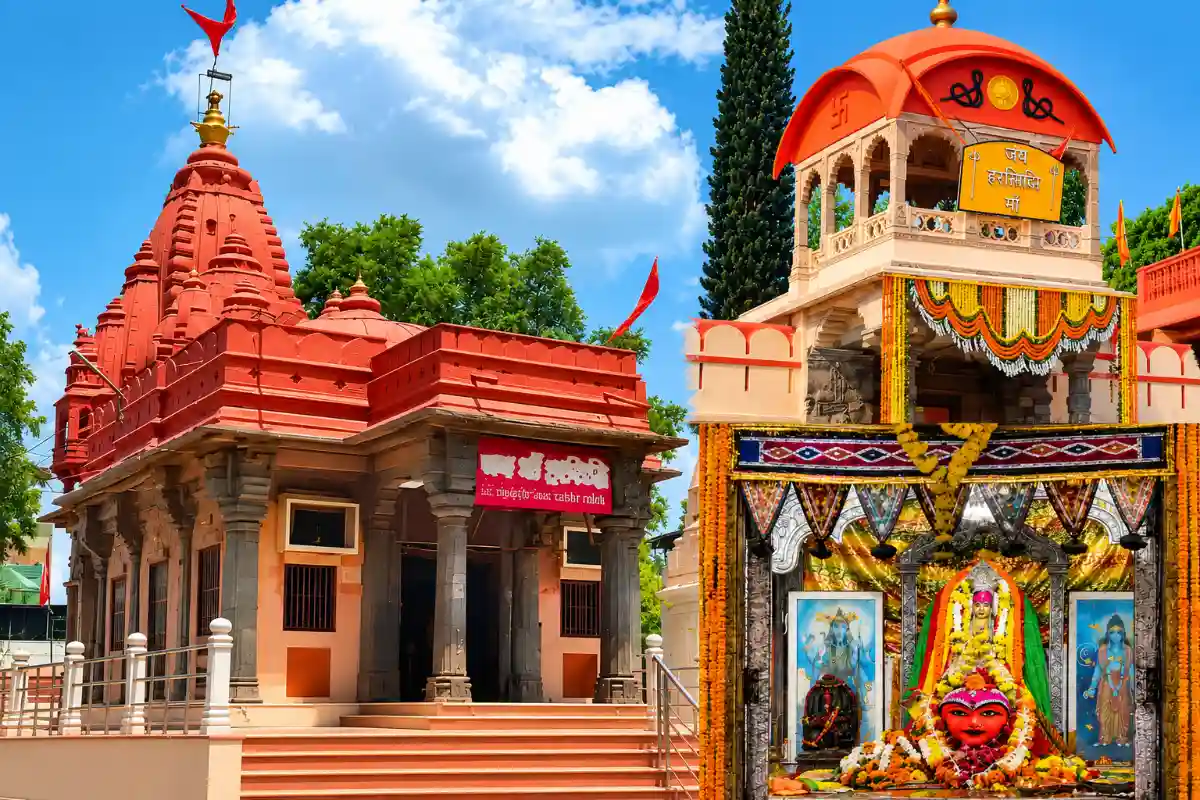
Vikram Teela is itself part of the legend. The hillock is traditionally said to be where Vikramaditya's throne lies buried, which is the same throne that surfaces in the Singhasan Battisi frame story. Nobody has excavated a throne.
Ujjain then and now: what changed, what didn't
| Aspect | Vikramaditya's Ujjain (tradition and antiquity) | Ujjain in 2026, before Simhastha 2028 |
|---|---|---|
| Role in timekeeping | Reference meridian of the Surya Siddhanta; the era later named Vikram Samvat begins in this region | Panchang published from the Vedh Shala since 1942; Vedic Clock installed 2024; Simhastha dates still fixed by planetary calculation |
| Religious centre | Mahakaleshwar already established; royal patronage credited by tradition | Mahakaleshwar with the Mahakal Lok corridor, phase 1 in 2022 and phase 2 in 2023 |
| Scholarly community | The Navaratna tradition; Kalidasa writing Ujjayini into the Meghaduta | Samrat Vikramaditya University, the Vikramaditya Shodh Peeth, and the working observatory |
| How people arrive | The Dakshinapatha trade route toward the port of Bharukaccha | Ujjain Junction, Indore airport about 55 km away, and the Indore-Ujjain greenfield corridor under construction |
| Scale of gathering | Regional pilgrimage and a royal court | Crore-scale attendance projected for Simhastha 2028, with organised accommodation, ghat allocation and crowd routing |
Sources: Ujjain district administration portal, Ujjain Smart City project records, and major-outlet reporting on the Indore-Ujjain corridor, checked August 2026. Attendance figures are projections, not counts, and are discussed below.
How does this history connect to Simhastha 2028?
Directly, through the calculation that sets the dates.
Simhastha 2028 runs from 27 March to 27 May 2028, a window of about 62 days. That's roughly double the one-month 2016 edition. Some older pages still quote a 30-day core of 9 April to 8 May, which reflects an earlier plan; the two-month window is the current position from the Madhya Pradesh government.
| Date (2028) | Type of snan | What to expect |
|---|---|---|
| 27 March | Parva Snan | Opening bathing day of the mela window |
| 4 April | Parva Snan | Individual bathing, lighter crowds |
| 9 April | Amrit Snan (Shahi Snan) | Akhara processions to the river, the heaviest crowd days of the mela |
| 14 April | Parva Snan | Individual bathing |
| 19 April | Parva Snan | Individual bathing |
| 23 April | Amrit Snan (Shahi Snan) | Second royal bath, full Akhara procession |
| 1 May | Parva Snan | Individual bathing |
| 5 May | Parva Snan | Individual bathing |
| 8 May | Amrit Snan (Shahi Snan) | Third and final royal bath |
| 15 May | Parva Snan | Closing-phase bathing day |
Sources: Madhya Pradesh government announcements as reported by The Daily Pioneer and the Simhastha information portals, checked August 2026. The three Amrit Snan dates are consistently reported; the seven Parva Snan dates are widely reported but should be confirmed against the official Simhastha portal and Ujjain district administration notices before you book non-refundable travel.
The difference between the two types matters for planning. Amrit Snan, also called Shahi Snan, is when the 13 Akharas process to the Shipra together in ceremonial order. Those are the days of maximum crowd density and maximum restriction on public movement. Parva Snan days are astrologically auspicious for individual bathing, without Akhara processions, and they're far easier for families and older pilgrims.
Attendance and budget figures, reported honestly
The numbers in circulation vary widely, and any article giving you one confident figure is hiding the spread. Here's the actual state of the reporting as of August 2026.
On attendance: the Madhya Pradesh government's own assessment puts likely participation at about 12 crore. Many outlets report about 14 crore. A separate planning figure of about 30 crore appears in an IIM Indore crowd-management study conducted with the Ministry of Tourism, and Chief Minister Mohan Yadav has publicly cited a target of nearly 40 crore visitors to the state. For context, Ujjain already records the highest religious-tourism footfall in Madhya Pradesh, around 7.32 crore visitors.
On budget: two project totals circulate, ₹15,751 crore across 102 projects and ₹18,840 crore across 523 projects. The gap comes from different stages in the planning cycle. Separately, the Madhya Pradesh state budget for 2025 to 2026, presented on 12 March 2025, earmarked ₹2,005 crore specifically for Simhastha as that year's allocation within a total state budget of ₹4.21 lakh crore.
Read those as planning projections and evolving allocations, not as facts about an event that hasn't happened.
Getting there, and what's being built
| Route | Current position | Status for 2028 |
|---|---|---|
| Air | Devi Ahilya Bai Holkar Airport, Indore, about 55 km from Ujjain, currently 1.5 to 2 hours by road | Operational, the standard arrival point for foreign and long-distance pilgrims |
| Indore-Ujjain greenfield corridor | Foundation stone laid 20 June 2025; 48.1 km, four-lane, access-controlled, about ₹2,935 crore | Targeted to cut the airport run to roughly 30 to 35 minutes |
| Rail | Ujjain Junction being redeveloped under the Amrit Bharat Station Scheme at about ₹421 crore, expanding toward 11 platforms and 16 lines; Nagda and Ujjain bypass lines approved at about ₹600 crore | Under construction, with satellite stations at Vikram Nagar, Pingleshwar and Pawasa being upgraded |
| Metro | Indore-Ujjain metro DPR complete: about 45 km, 11 stations, roughly ₹12,000 crore | Officials have confirmed it will not be operational before Simhastha 2028. Don't plan around it. |
Sources: Swarajya on the greenfield corridor, Free Press Journal on the metro timeline, and rail-sector reporting on the Amrit Bharat works, checked August 2026. Infrastructure timelines shift; confirm project status closer to travel.
A one-day walk through Vikramaditya's Ujjain
Scenario 1: One free day before or after your Simhastha bath
Situation
You have a single full day in Ujjain, you're staying near Mahakal, and you want the history rather than just the temple queue. Budget roughly ₹600 to ₹1,200 for local auto or cab movement across the day, plus entry tickets, and start early because everything from 11 am onward is hotter and more crowded.
Morning, 4 am to 8 am. Bhasma Aarti at Mahakaleshwar if you hold a confirmed booking, made in advance through mahakaleshwar.nic.in with a government photo ID. If you don't have a slot, do a standard early darshan instead and keep the morning shorter.
Late morning, 9 am to 11 am. Walk the Mahakal Lok corridor properly, then continue to Vikram Teela behind the temple for the 30-foot brass statue and the recreated court with the Singhasan Battisi throne and the Navaratna figures. This is the densest hour of the day for the actual Vikramaditya story.
Afternoon, 12 pm to 3 pm. Break for lunch, then the Vedh Shala. Time it near local noon if you want to see the Samrat Yantra sundial doing its job, and ask whether the planetarium show is running that day. The Vedic Clock tower is at the same site.
Late afternoon, 4 pm to 6 pm. The Bhartrihari Caves near Gadkalika, for the renunciation half of the legend.
Evening, 6 pm onward. Ram GhatRam Ghat, the most prominent bathing ghat in Ujjain. on the Shipra for the aarti. This is the river the whole mela is organised around, and it's worth seeing it quiet before you see it at Simhastha scale.
Key lesson: the Vikramaditya sites cluster within a few kilometres of Mahakaleshwar, so the day works comfortably. The one thing that can't be improvised is the Bhasma Aarti slot, so book that before you plan anything else around it.
Who should build this into their trip, and who should plan differently?
This trail works well for
- First-time pilgrims arriving 2 or 3 days early: the history makes the ritual legible, and you'll be acclimatised to the city's layout before the crowds arrive.
- Foreign visitors: the astronomy and calendar material gives a non-devotional way into a religious event, and the observatory is genuinely interesting on its own terms.
- Families with school-age children: the Vikram-Betal connection lands instantly with anyone who grew up on the stories, and the recreated court is visual rather than textual.
- Anyone visiting outside the mela window: every site here is open year-round and far more pleasant without Simhastha density.
Plan differently if you are
- Travelling on an Amrit Snan day: 9 April, 23 April and 8 May 2028 will have movement restrictions across the temple and ghat zone. Do the history circuit on a different day.
- A senior citizen or anyone with mobility limits: the Vikram Teela and Bhartrihari Cave approaches involve steps and uneven ground. Split this across two mornings instead of one day.
- On a single-night stopover: pick either Mahakaleshwar or the history circuit. Compressing both into one evening means doing neither properly.
- Travelling in peak May heat: Ujjain regularly crosses 40°C in May. Shift everything into the 6 am to 10 am window and rest through the afternoon.
Temple etiquette at Mahakaleshwar: what's expected
Most of this circuit runs through an active place of worship that draws heavy crowds even outside mela season. The rules are enforced, not advisory.
- What's the dress code for Bhasma Aarti? Men wear a dhoti, women wear a saree, for entry into the ritual zone and the Garbhagriha. Salwar-kameez is accepted for some general darshan, but a saree is expected for ritual participation. Devotees not meeting the code can be turned away even with a confirmed booking.
- Are leather items allowed? No. Belts, wallets and even leather watch straps are prohibited inside the complex during Bhasma Aarti. Leave them at your accommodation rather than at the counter.
- Can I photograph the Bhasma Aarti? No. Photography inside the Garbhagriha is prohibited, including during the aarti. Phones and cameras go into the official lockers before you enter.
- Can I touch the Jyotirlinga? Sanctum access is restricted and the rules have been revised more than once, including a tightened dress-code requirement introduced alongside changes to sanctum entry. Check the current notice on mahakaleshwar.nic.in rather than relying on what a friend did last year.
- What about footwear and phones generally? Footwear comes off before the temple premises, with free cloakrooms outside, and mobile phones are restricted near the sanctum across the complex at all times, including outside the aarti.
Summary: key takeaways
- Vikramaditya is a title and a legend cycle, not a documented individual king. Real rulers carried the name, most notably Chandragupta II, and the 57 BCE king of Ujjain has no contemporary record.
- The Vikram Samvat calendar is real and continuously used; its name is a later attachment. Inscriptions call it Krita, then Malava, and only "Vikrama" from 842 CE onward.
- Ujjain's meridian tradition is genuine. The Surya Siddhanta sets zero longitude here, and the Vedh Shala has published a panchang every year since 1942.
- The Navaratnas are a cultural ideal, not a staff list. Varahamihira's dates alone rule out a shared court.
- Three separate monuments carry the name in Ujjain. The 30-foot statue and the 26-foot court figure at Vikram Teela, and the 85-foot Vedic Clock tower at Jantar Mantar.
- Simhastha 2028 runs 27 March to 27 May, with Amrit Snan on 9 April, 23 April and 8 May, all fixed by Jupiter's entry into Simha Rashi.
What to do next
If you're planning Simhastha 2028, do two things now, in this order.
First, decide whether you want an Amrit Snan day or a Parva Snan day, because that single choice determines your accommodation cost, your crowd exposure and how far you'll walk. Families and senior pilgrims are usually better served by a Parva Snan date.
Second, confirm your chosen dates against the official Simhastha portal and Ujjain district administration notices before booking anything non-refundable. The dates in this guide reflect the best current reporting as of August 2026, and the administration will publish a final, detailed snan calendar closer to the event.
Then, if you have a spare day, walk the Vikramaditya circuit. The bath makes more sense once you know why Ujjain, of all the cities on all the rivers in India, is where the calculation points.

Comments
No comments yet. Be the first to share your thoughts!
Leave a Comment