

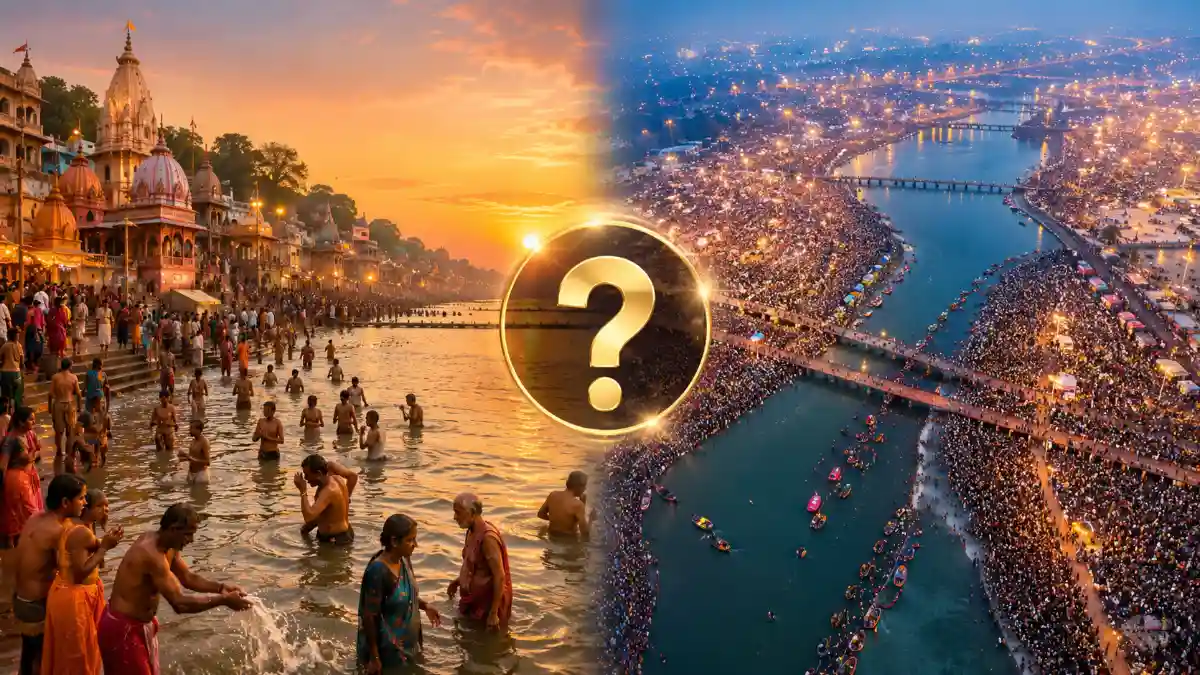
Is Simhastha the same as Kumbh Mela?
Yes. Kumbh Mela is the umbrella name for four sacred bathing festivals, held at Haridwar, Prayagraj, Nashik, and Ujjain, on a rotation tied to the positions of Jupiter and the Sun. When Jupiter enters Leo (Simha Rashi), the festival at Ujjain takes on the name Simhastha. It's the same underlying tradition, just Ujjain's specific edition of it.
Ujjain also happens to be the only one of the four that sits on the Shipra (Kshipra) river, and the only one that houses a Jyotirlinga, at the Mahakaleshwar temple. That combination is why Simhastha carries its own name instead of just being called "Kumbh Ujjain."
Key Highlights
- Simhastha 2028Explore the world's largest spiritual gathering in Ujjain. in Ujjain runs March 27 to May 27, 2028 (a two-month window; a shorter April 9-May 9 window appears on some older sources, so confirm closer to the date).
- 3 Amrit Snan (Shahi Snan) dates: April 9, April 23, and May 8, 2028.
- 7 Parva Snan dates spread across the two months.
- Ujjain is the only Kumbh city on the Shipra river and the only one with a Jyotirlinga on site.
- Prayagraj remains the largest of the four by footfall; Ujjain and Nashik are comparatively easier to navigate.
Simhastha vs the other 3 Kumbh Melas: comparison table
Here's how the four line up on the basics.
| Location | River | Also called | What makes it distinct |
|---|---|---|---|
| Ujjain, Madhya Pradesh | Shipra (Kshipra) | Simhastha | Only Kumbh city with a Jyotirlinga (Mahakaleshwar) on site |
| Haridwar, Uttarakhand | Ganga | Kumbh Mela | Har Ki Pauri ghat, the point where the Ganga leaves the Himalayas |
| Prayagraj, Uttar Pradesh | Ganga, Yamuna, Saraswati (Triveni Sangam) | Kumbh Mela / Maha Kumbh | Confluence of 3 rivers; typically the largest edition by footfall |
| Nashik-Trimbakeshwar, Maharashtra | Godavari | Kumbh Mela / Simhastha (locally, since it also falls under Leo) | Bathing split across 2 towns, 30 km apart |
Sources: Madhya Pradesh government Simhastha announcements, major travel and pilgrimage guides — January 2026. Dates and figures are subject to official confirmation closer to the event; verify at the Ujjain Municipal Corporation or Madhya Pradesh Tourism site before finalizing travel plans.
A small wrinkle worth knowing
Nashik's Kumbh also falls under the Simha Rashi alignment in some years, so you'll occasionally see it called "Simhastha" too. In everyday use though, "Simhastha" almost always means Ujjain. If a source calls Nashik's edition Simhastha, that's not wrong, it's just less common usage.
How Simhastha 2028 compares on dates and rituals
Each Kumbh location runs on a different 12-year cycle, so they don't happen in the same year. Prayagraj's last full Kumbh was 2025, Haridwar's was 2021, Nashik's was 2015-16, and Ujjain's last Simhastha was also 2016. That's why 2028 is Ujjain's turn again.
| Simhastha 2028 date type | Dates | What happens |
|---|---|---|
| Amrit Snan / Shahi Snan (3 total) | April 9, April 23, May 8, 2028 | 13 Akharas process to the ghats together. Heaviest crowds of the whole event. |
| Parva Snan (7 total) | March 27, April 4, April 14, April 19, May 1, May 5, May 15, 2028 | Individual pilgrim bathing on astrologically significant days, no Akhara procession, lighter crowds. |
Sources: Madhya Pradesh government and Simhastha pilgrimage guides — January 2026. Treat these dates as the current consensus and confirm against official notification closer to March 2028.
Every guide pushes the 3 Amrit Snan dates as the ones to see, and they are the most visually striking, with all 13 Akharas processing together. But for a first-time visitor without Akhara affiliation, a Parva Snan day gives you the same river, the same city, and the same darshan access, at a fraction of the crowd density. You'll actually get to the ghat instead of standing in a barricade line for hours.
Which Kumbh should you actually plan around?
If you're weighing Simhastha against a trip to Haridwar, Prayagraj, or Nashik instead, the honest answer depends on what you're optimizing for: scale, ease of travel, or a specific ritual site.
Simhastha (Ujjain) works well for
- First-time pilgrims — smaller, more compact city than Prayagraj, easier to navigate on foot.
- Anyone combining darshan with the mela — Mahakaleshwar temple sits inside the city, no separate trip needed.
- Families and seniors — Parva Snan days offer the same spiritual merit with far lighter crowds than a Shahi Snan.
Plan differently, or pick another Kumbh, if you
- Want the largest possible gathering — Prayagraj draws bigger numbers and has the Triveni Sangam, which Ujjain doesn't.
- Are traveling from South India — Nashik is closer and has direct rail/road links most South Indian pilgrims already use.
- Need to attend on a fixed 2-3 day window — book around a specific Parva Snan date rather than the Shahi Snan dates, since hotel and transport capacity around Amrit Snan days fills up 6-8 months out.
विशेषज्ञ की सलाह — Ritu Sharma
"People assume Simhastha is smaller because it's less talked about than Prayagraj. It isn't. What's actually smaller is the ground you have to cover, since Ujjain packs the ghats, the Mahakaleshwar temple, and your stay into one walkable city instead of spreading you across a temporary tent town. That's the real difference pilgrims feel on day one, not the crowd count."
A worked comparison: Ujjain vs Prayagraj for a 4-day trip
Situation
A family of 4 debating between a 4-day Simhastha trip to Ujjain and a 4-day Maha Kumbh trip to Prayagraj. Both flying into the nearest metro and taking a connecting train or cab.
Ujjain: fly into Indore, 55-60 km road transfer (90-120 minutes), stay inside Ujjain city itself, walk to Mahakaleshwar and the ghats. Prayagraj: fly into Prayagraj airport directly, but the mela grounds spread across a much larger temporary tent city on the Sangam floodplain, meaning longer internal travel between your stay and the bathing ghats.
Key lesson: Ujjain's compactness cuts your daily transit time, which matters more with kids or elderly family members than the larger scale of Prayagraj does.
Final take
Simhastha and Kumbh aren't competing events, Simhastha is just what you call the Kumbh when it's Ujjain's turn. If you're choosing between attending Ujjain in 2028 versus waiting for the next Prayagraj or Haridwar cycle, the deciding factors are how compact you want the city to be, whether you want the Jyotirlinga darshan bundled in, and how much crowd density you can handle. For most first-time pilgrims, Ujjain in 2028, on a Parva Snan date, is the easier entry point into the Kumbh tradition.