

Why Jai Singh II built it here
Maharaja Sawai Jai Singh II was not just a king who commissioned a building. He was a working astronomer who spent eight years in Ujjain personally observing planetary movements before making any modifications to existing instruments. He was bothered by a specific problem: the panchangs (Hindu astronomical calendars) of his time were full of errors. Eclipse predictions were off. Planetary positions were miscalculated. The small portable instruments scholars used simply weren't precise enough.
His solution was architectural. Build the instruments so large — from stone and masonry — that even small angular differences would show up clearly. A small sundial can't show you half a second. A stone structure 22 feet tall can.
Ujjain was the logical choice. The city had been India's astronomical reference point for over 1,600 years by the time Jai Singh arrived. Ancient Indian texts placed the first meridian of longitude through Ujjain — what modern cartographers would call 75° 47' E. The Tropic of Cancer passes through it too, making solar observations here especially relevant for calendar calculations used across the subcontinent.
Jai Singh sent scholars abroad before he built anything. They returned with manuals and observations from European and Arabic astronomical traditions. He cross-referenced those methods with classical Indian siddhantas and then built instruments that could test both systems against the actual sky above Ujjain.
Key facts at a glance
- Built: 1725 AD (construction period: approximately 1719–1730)
- Builder: Maharaja Sawai Jai Singh II, governor of Malwa
- Location: Chintaman Road, southwest Ujjain; 1 km from railway station, on the north bank of river Shipra
- Total instruments: 13 architectural astronomical instruments
- Renovated: 1923 by Maharaja Madhav Rao Scindia; Digansh Yantra rebuilt 1974; Shanku Yantra rebuilt 1982; major renovation 2003
- Status: Only one of the 5 Jantar Mantars still functioning as an active research observatory today
- Annual output: Publishes an ephemeris (yearly planetary position record) used in Hindu calendar preparation
The five Jantar Mantars: where Ujjain fits
Jai Singh built 5 observatories in total, all between 1724 and 1737: Delhi, Jaipur, Ujjain, Mathura, and Varanasi. The one at Mathura no longer exists. The Delhi and Jaipur observatories are larger and more frequently visited by tourists. Jaipur's in particular is a UNESCO World Heritage Site and considerably more expansive than Ujjain's.
| Observatory | Year built | Status today | Notable feature |
|---|---|---|---|
| Delhi | c. 1724 | Monument (ASI) | First of the five; largest Mishra Yantra |
| Jaipur | 1734 | UNESCO World Heritage Site | Largest Samrat Yantra in the world |
| Ujjain | 1725 | Active research observatory | Only one still publishing annual ephemeris |
| Varanasi | c. 1737 | Preserved monument | Smallest of the surviving four |
| Mathura | c. 1724 | No longer exists | – |
Ujjain's observatory is smaller than Jaipur's. Visitors expecting the scale of Jaipur's complex may find it more modest. But it holds something the others don't: it still works. Astronomers here still prepare the annual ephemeris used by Hindu calendar makers and panchang scholars. That makes it a living instrument, not just a relic.
The instruments inside Vedh Shala
The observatory has 13 instruments in total. The original 4 were built directly by Jai Singh II. The Shanku Yantra was added later under the direction of G.S. Apte, the observatory's first superintendent after its 1923 revival. Here are the main ones worth understanding:
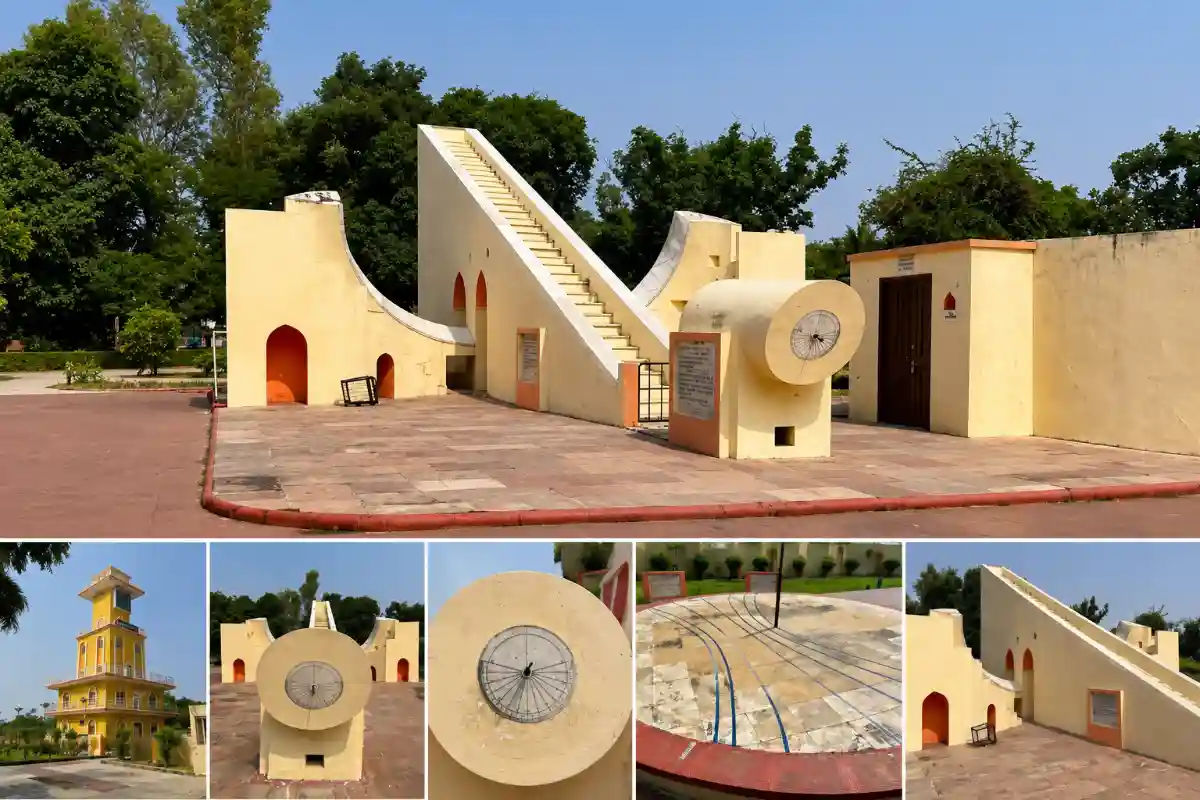
Samrat Yantra (the great sundial)
This is the centrepiece. A massive right-angled triangle, with the hypotenuse (the gnomon wall) inclined at 23 degrees and 10 minutes — exactly the latitude of Ujjain. The shadow the gnomon casts falls onto two quadrant scales on either side, letting you read the local solar time to within half a second of accuracy.
The Samrat Yantra here is 22 feet long. Jaipur's version towers at 27 metres. But the principle is identical: the bigger the gnomon, the slower and more precisely you can read the shadow's movement across the scale.
Nadivalaya Yantra (equatorial sundial)
A cylindrical instrument, 7 feet long and about 3.5 feet in diameter, with its axis fixed in the plane of the meridian. It has 2 faces: one pointing north and one south. When the sun is in the northern hemisphere (roughly April to September), the northern face is lit and gives readings. When it moves to the southern hemisphere (October to March), the southern face takes over.
This instrument directly represents the celestial equator. The time it tells is astronomical time, not clock time — useful for scholars calculating planetary hours and ritual timings.
Digansh Yantra (azimuth instrument)
A circular wall, 32 feet and 10 inches in diameter. It measures the azimuth of any celestial body — the direction from true north, measured as an angle along the horizon. It was rebuilt in 1974 when the original deteriorated beyond use.
Shanku Yantra (gnomon)
A vertical gnomon (a straight vertical rod) fixed at the centre of a circular horizontal platform. The shadow it casts marks 7 lines on the platform, each representing a pair of zodiac signs. From these lines, you can identify the shortest day of the year (22 December), the longest (22 June), and the equinoxes (21 March and 23 September). On equinox days at noon, the shadow directly gives the latitude of Ujjain. Built later than the original instruments, under G.S. Apte's direction.
Dakshinottara Bhitti Yantra (transit instrument)
A wall instrument oriented along the north-south meridian. Used to calculate the zenith distance of a celestial body — how far it is from directly overhead — at the moment it crosses the meridian. This is a transit observation: astronomers would wait for a star or planet to cross the meridian line and then read its zenith distance precisely. The Dakshinottara Bhitti Yantra appears in several of Jai Singh's observatories; Ujjain's version is unique to this site.
The Samrat Yantra shadow moves fastest and most readably around local solar noon (roughly 12:15 to 12:30 PM in Ujjain). At that time, the shadow's position on the graduated scale is at its sharpest. If you arrive mid-morning or late afternoon, the shadow angle makes it harder to see the scale calibrations clearly. The Nadivalaya Yantra works differently by hemisphere: check which face (north or south) is illuminated based on the month you visit.
Ujjain as the "Greenwich of India" — what that actually means
Long before the British established Greenwich as the world's prime meridian in 1884, Indian astronomers had a prime meridian of their own. They called it the Ujjayini meridian or Lanka meridian. Ancient texts — the Surya Siddhanta, Brahmasphuta Siddhanta, and others — placed the reference longitude for Indian astronomical calculation through Ujjain.
This wasn't arbitrary. Ujjain sits at approximately 75° 47' E longitude. The Tropic of Cancer (23° 26' N latitude) runs near it. For a civilization calculating solar positions, eclipse cycles, and seasonal calendars, having a fixed reference point mattered enormously. Ujjain was that point for Indian astronomers for well over a millennium before Jai Singh arrived.
When Jai Singh built Vedh Shala here, he was reinforcing a tradition already 1,500 years old. The instruments he built are calibrated to Ujjain's coordinates — the gnomon of the Samrat Yantra is inclined at exactly Ujjain's latitude, and the meridian instruments are oriented to the local meridian. You can't move these to Jaipur and have them give you the same readings.
The decline and the 1923 revival
After Jai Singh II died in 1743, the observatory gradually fell into neglect. For roughly 2 decades after his death it was more or less abandoned. The instruments deteriorated.
The turnaround came in 1923 when Maharaja Madhav Rao Scindia of Gwalior visited the site and, on the recommendation of scholars Narayanji Vyas (Siddhantvagish) and G.S. Apte (who became the observatory's first superintendent), funded a full restoration. The observatory has run continuously since then.
More restoration followed: the Digansh Yantra was rebuilt in 1974 when the original became too damaged. The Shanku Yantra was rebuilt in 1982. In 1983, marble notice boards in Hindi and English were installed inside the complex. In 2003, then-Commissioner of Ujjain Division Swarnmala Rawala oversaw a further renovation and beautification effort, including solar-powered lighting and improved riverbank access along the Shipra. A Simhastha 2004 addition: an 8-inch automatic telescope for visitors to view planets directly.
What's inside today: the planetarium and ongoing research
Vedh Shala today is more than the outdoor instruments. A small planetarium (taramandel) inside runs 20- and 30-minute shows on planets, constellations, stars, and galaxies. These are aimed at school groups and general visitors, not specialists — accessible and clearly explained.
The astronomical research continues. The observatory still publishes an annual ephemeris: a detailed year-by-year record of planetary positions, used by panchang makers and Hindu calendar scholars across India. This is what makes Ujjain's observatory genuinely different from the others. The Jaipur Jantar Mantar is a World Heritage Site visited by millions — but it doesn't publish an ephemeris. Ujjain does.
The observatory is managed under the Government of Madhya Pradesh and is connected to the Jiwaji University in Ujjain, which has an astronomy and astrophysics department that uses the site for research.
Historical significance for Indian astronomy
Jai Singh's observatories came at a specific moment in history. He was working in the early 18th century, aware of European astronomical advances (he sent scholars to European observatories and had texts translated), and wanted to reconcile those advances with the classical Indian siddhantas. The instruments he built were not copies of either tradition — they were an independent architectural approach to the same problems.
The mathematician behind several instrument designs was Jagannatha Samrat, a scholar at Jai Singh's court who translated Ptolemy's Almagest from Arabic to Sanskrit and who understood both Greek and Indian mathematical frameworks. The observatories reflect that synthesis.
Ujjain's specific contribution was to the panchang tradition. The site's role in calculating Hindu calendar dates — tithi, nakshatra, planetary hora — goes back centuries before Jai Singh. He was formalising and mechanising an intellectual tradition the city had already held for a very long time.
| Timeline | Event |
|---|---|
| c. 5th–6th century CE | Ujjain established as prime meridian in Indian astronomical texts (Surya Siddhanta, Aryabhatiya) |
| 1719–1730 | Jantar Mantar (Vedh Shala) constructed by Sawai Jai Singh II |
| 1743 | Jai Singh II dies; observatory enters period of neglect |
| 1923 | Maharaja Madhav Rao Scindia funds restoration; G.S. Apte becomes first superintendent |
| 1974 | Digansh Yantra rebuilt |
| 1982 | Shanku Yantra rebuilt |
| 1983 | Hindi and English instrument information boards installed |
| 2003 | Major renovation and beautification under Commissioner Swarnmala Rawala |
| 2004 | 8-inch automatic telescope added for public viewing (Simhastha 2004) |
| Present | Annual ephemeris published; Jiwaji University conducts ongoing research |
What visitors can see and do
The site is compact. You can cover the outdoor instruments and interior planetarium in about 90 minutes comfortably. A guided walkthrough adds depth — on-site guides are available and worth the fee, because the instruments are not intuitive without explanation.
The Samrat Yantra is the most immediately impressive piece: you can stand next to it and watch the shadow shift in real time at noon. The Nadivalaya Yantra is smaller but visually interesting — its 2-faced design becomes clear once you know which hemisphere the sun is currently in. The Shanku Yantra's 7 zodiac lines on the ground are best explained in person.
Photography is permitted inside the complex with personal cameras and mobile phones.
Who gets the most from this visit
- Students of astronomy and physics — seeing actual working instruments built on Newtonian optics principles, without modern technology
- History of science enthusiasts — the observatory sits at the intersection of Indian, Arabic, and European astronomical traditions
- Panchang and calendar scholars — the site is still the active source of ephemeris data for Hindu calendar calculation
- Architecture and design students — the instruments are built entirely from stone, marble, and masonry with pure geometric logic
Plan accordingly if you
- Expect Jaipur-scale size — Ujjain's observatory is considerably smaller; adjust expectations
- Visit in peak afternoon heat (April–June) — outdoor instruments are exposed; bring water and sun protection
- Want a planetarium show — show timings are fixed and limited; check current schedule before visiting
Comments
No comments yet. Be the first to share your thoughts!
Leave a Comment