
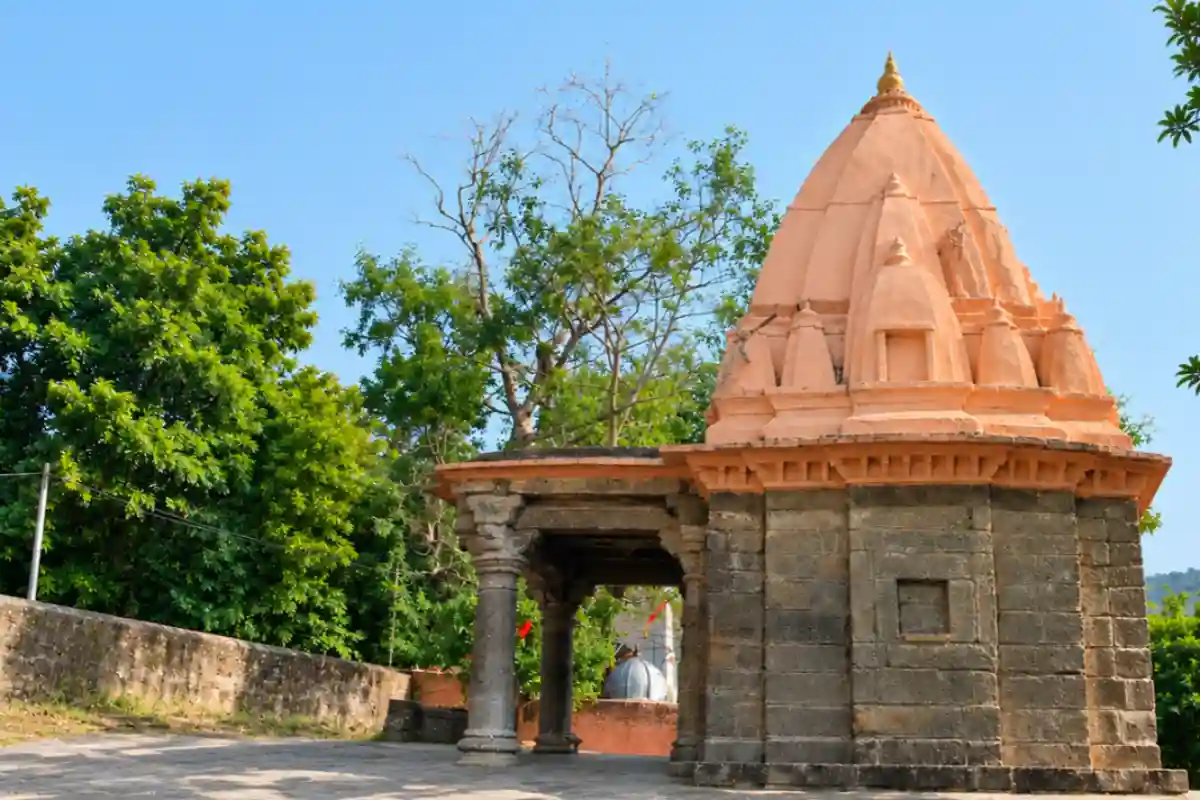
What is Svarnajwaleshwar Mahadev in Ujjain?
Svarnajwaleshwar Mahadev is the sixth linga among Ujjain's 84 Mahadevs. Its story is told in the sixth chapter of the Chaturashiti Linga Mahatmya, in the Avantya Khanda of the Skanda Purana. The Purana says gold, born of Shiva's energy, was purified and given radiance by the darshan of this linga, and the linga took its name from that radiance.
The Sanskrit form is "Svarnajvaleshvara". Some pages write Svarnajaleshwar, which is a popular form and not the Purana's.
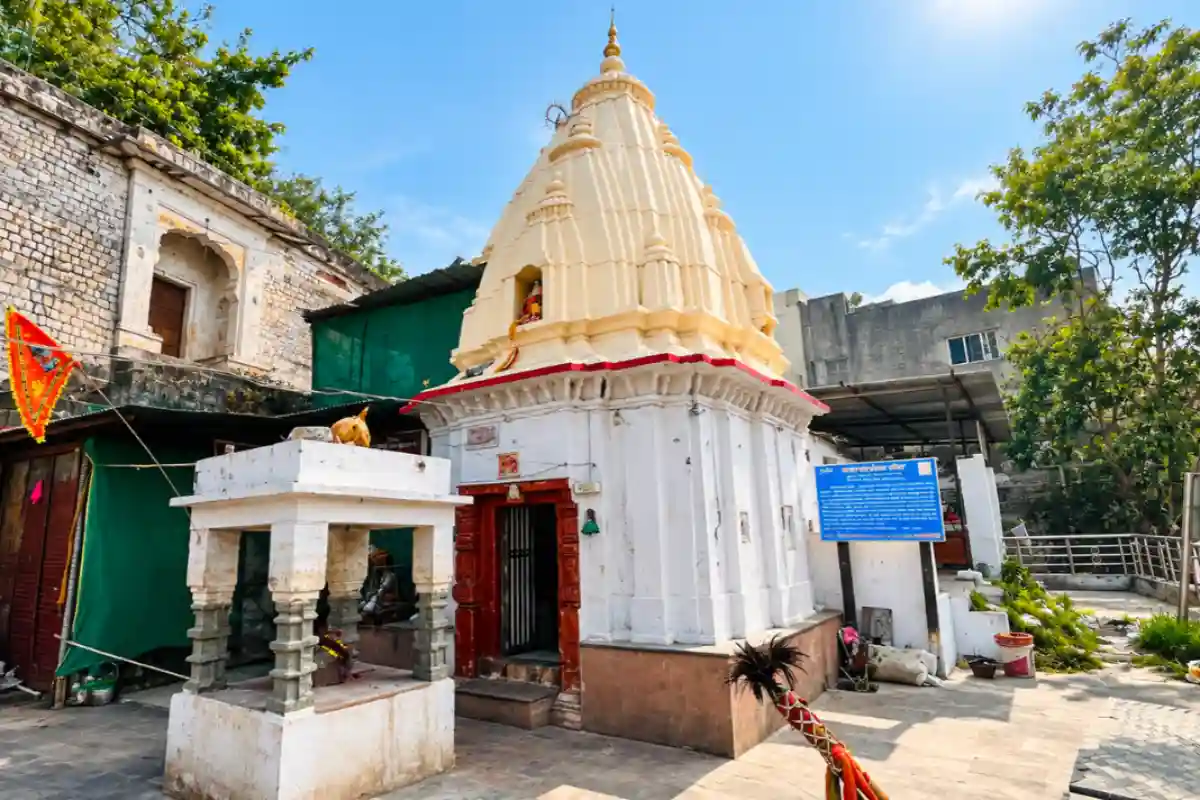
Local accounts place the temple on the Ram Sidhi steps at Ram GhatRam Ghat, the most prominent bathing ghat in Ujjain., above the Dhundheshwar Mahadev temple.
At a glance
- Shiva's energy fell into Agni's mouth, and gold, called "Kanchana", was born of it.
- In greed for the gold the whole world went to war, and the gods took refuge in Brahmaloka.
- At Agni's plea Shiva blessed the gold and sent it to a linga in Mahakalavana.
- Darshan wreathed the gold in flames, and Shiva became "Svarnajwaleshwar".
What are the key facts about Svarnajwaleshwar Mahadev?
| Item | Detail |
|---|---|
| Basis of the name | Shiva's name, from the gold that was wreathed in flames |
| Deity | Shiva, in linga form |
| Source text | Skanda Purana 5.2.6 (Avantya Khanda, Chaturashiti Linga Mahatmya, chapter 6) |
| Place in the 84 Mahadevs | Sixth |
| Characters | Shiva, Parvati, Agni, Kanchana (gold), Brahma, Brihaspati, Indra |
| Setting in the story | Mahakalavana, to the south of Karkotaka |
| Narrator | Shiva, speaking to Parvati |
In the Svarnajwaleshwar chapter Shiva speaks in the first person, and in one place says he gave Agni his word out of greed (verse 39). In the story of gold's birth, the one who acts, the one who holds the gold and the one who agrees to protect it are all Shiva.
What is the Skanda Purana story of Svarnajwaleshwar Mahadev?
The chapter opens with Shiva's words (Skanda Purana 5.2.6.1):
स्वर्णज्वालेश्वरं षष्ठं विद्धि चात्र यशस्विनि ।
यस्य दर्शनमात्रेण धनवानिह जायते ॥
Meaning: O renowned lady (Parvati), know the sixth linga here as Svarnajvaleshvara, by whose mere sight a person becomes wealthy here in this world. Verse 1 speaks only of this fruit. The destruction of sins and other fruits come in later verses.
A hundred divine years, and Agni sent
Shiva tells Parvati that long ago, while he was playing with her in his abode, a hundred divine years passed. Then all the gods sent Agni to Shiva, for the good of the three worlds.
During that play Shiva's energy (the text's word is "virya") fell into Agni's mouth. Burning, Agni went to the Ganga and left it there, but a remainder kept burning him.
The birth of Kanchana
From that remainder a divine, beautiful "Kanchana", gold, was born. It burned with such heat that it was unbearable. The text calls it Agni's first child.
The war over gold
In greed, asuras, suras, gandharvas, kinnaras, yakshas, sadhyas, pishachas, humans, rakshasas, birds, bhutas and vetalas all fell on it crying "Mine, mine!" Fathers and sons, husbands and wives, mothers and sons began killing one another. The text says enmity arose because of gold.
In the terrible battle the earth shook, the gods led by Indra grew afraid, and the oceans were churned up.
Refuge in Brahmaloka
The sages led by the Valakhilyas and the gods led by Indra went to Brahmaloka with Brihaspati at the front. Wounded women went too and told the whole account. Brahma thought it over and brought them all to Shiva.
Shiva asked who had wounded them and which wicked demon it was. The answer: "We have all been ruined by greed, because of gold."
The verdict on gold
Shiva said that whoever causes people to give up their lives is called a brahma-ghataka. So this son of Agni would have a mottled and flawed body. Metals would be part of its body, and it would endure incomparable suffering through cutting, burning and rubbing.
Agni's plea
Afraid for his son, Agni brought the gold to Shiva and pleased him. He said: O Shankara, this is your son, protect him. Keep him in your own storehouse. Only when you are pleased will he be obtained by anyone, and give him to whomever you wish.
Shiva said "So be it." Then he seated Agni's son on his lap, kissed his head and embraced him again and again.
The linga in Mahakalavana
Shiva told the gold that there is a linga in Mahakalavana, which stays imperishable even at dissolution (Skanda Purana 5.2.6.43):
अक्षयं प्रलये पुत्र महाकालवनं शुभम् ।
तत्रैव विद्यते लिंगं कर्कोटकस्य दक्षिणे ॥
Meaning: O son, in the auspicious Mahakalavana, imperishable even at dissolution, there is a linga to the south of Karkotaka. It destroys great sins and gives radiance, and by merely seeing it you will become fulfilled.
Boons for the gold
Shiva told the gold: you will be pure, and hard to reach for the impure. By your grace the low-born will become high-born, the dirty clean and the ugly beautiful. You will be lord of all jewels and dear to gods and worlds.
The naming
At the linga's darshan the gold became divine in form, ringed with garlands of flame and spotless. The linga itself said that from that day the gold would be famous on earth by the name "Kanchana" and would always stay near it. The gold took on a brilliance like crores of suns.
The name's reason comes in the text like this (Skanda Purana 5.2.6.53):
दीप्तिर्लब्धा सुवर्णेन ज्वालामालाकुला तदा ।
अतो देवि सुविख्यातः स्वर्णज्वालेश्वरः शिवः ॥
Meaning: then the gold received a radiance ringed with garlands of flame. Therefore, O Devi, Shiva became famous as "Svarnajwaleshwar".
What fruits does the Skanda Purana promise for Svarnajwaleshwar darshan?
The phalashruti in verses 54 to 61 lists these fruits:
- Darshan makes a person wealthy in this very world (verse 1), and the phalashruti adds victory, kingdom, prosperity, the power to give and endless sons and grandsons.
- Sin committed knowingly or unknowingly is washed away by darshan.
- According to the Purana, worship here brings double the fruit of offering pindas at Gaya.
- The same phalashruti speaks of a great fruit for reciting the Gayatri.
- Worship here gives the merit of all gifts.
- Those who worship Svarnajwaleshwar on the chaturdashi are always adored by Lakshmi, who fulfils their wishes.
Verse 59, on the chaturdashi, reads:
पूजयंति चतुर्दश्यां स्वर्णज्वालेश्वरं तु ये ।
पूज्यंते ते सदा लक्ष्म्या पूरयंत्या मनोरथान् ॥
According to verses 60 and 61, this linga is guarded by gods and ganas, no one deluded by maya knows it, and it is seen only by Shiva's grace.
Which popular claims about Svarnajwaleshwar Mahadev do not match the Purana?
Several claims have attached themselves to this story that are not in the Skanda Purana text, or where the verse itself has been corrupted in print.
| Popular claim | In the Skanda Purana | Status |
|---|---|---|
| Verse 1 reads "dhavanih jayate" and means fulfilment of all wishes and destruction of sins | The text reads "dhanavanih jayate", and verse 1 means only becoming wealthy in this world | Error in the verse |
| The story begins with Shiva having no son to kill the demon Tarakasura, and he is on Kailasa | The chapter names neither Tarakasura nor Kailasa. Shiva plays in his own abode for a hundred divine years | Differs from the text |
| Indra sent Agni | All the gods sent Agni (verse 3) | Differs from the text |
| The gold was named "Svarnajwaleshwar" | The gold's name is "Kanchana". "Svarnajwaleshwar" is Shiva's name (verses 50 and 53) | Differs from the text |
| The special tithi for worship is chaturthi | The tithi in the text is chaturdashi (verse 59) | Error in the tithi |
| Special worship here in Sawan and on Mahashivratri | The chapter mentions neither Sawan nor Mahashivratri | Tradition |
| Donating gold here wipes out sins | The destruction of sin is tied to darshan (verses 44 and 55). The glory of gold's gift is stated in general, not for this temple | Partly true |
| Cutting, burning and rubbing gold is a metaphor for testing its purity | The chapter does not draw that link. These come as the penalty for being a brahma-ghataka | Modern interpretation |
| Worship here completes stalled auspicious work | The text makes no statement about stalled work | Folk belief |
| The temple is near MahakaleshwarExplore the divine Mahakaleshwar Jyotirlinga in Ujjain. | The text gives no hint of today's location. The Purana places the linga south of Karkotaka | Unconfirmed |
| The age and builder of the temple are known | The text gives no date or builder for any temple structure | Unverified |
The Purana places the linga "south of Karkotaka". In the 84 Mahadev list Karkoteshwar is tenth and, by present-day accounts, stands in the Harsiddhi temple complex, while Svarnajwaleshwar is placed on the Ram Sidhi steps, which descend from the Harsiddhi area toward Ram Ghat. So it is not right to say the text's direction and today's location match exactly. The 22nd, Karkateshwar, is a separate temple, and the similar names cause confusion.
What else do people ask about Svarnajwaleshwar Mahadev?
Why does the Purana call gold a brahma-ghataka?
In the Svarnajwaleshwar chapter Shiva says that anything because of which people give up their lives is called a brahma-ghataka. In the war over gold countless lives were lost, so Agni's son, the gold, incurs this fault. As a result its body is described as mottled and flawed.
What glory of donating gold does the Purana state?
In the boon verses Shiva tells the gold that through its gift, acts such as charity, vows, rules, sacrifice, fasting, pilgrimage and pinda offerings become complete. That is the general glory of gifting gold. The text does not link it to a donation made at this temple.
Is the chaturdashi worship of Svarnajwaleshwar in the bright or dark fortnight?
Verse 59 of the Skanda Purana says only "chaturdashi". The text does not make clear whether it is the bright or the dark fortnight. No confirmed information was found on which chaturdashi the temple observes today.
What are the darshan timings of Svarnajwaleshwar?
No confirmed official darshan timing is available for Svarnajwaleshwar Mahadev. Timings at small shrines change with the priest's convenience and the season, so ask a local priest before you go.
Where does Svarnajwaleshwar sit in Ujjain's 84 Mahadev tradition?
In the order of the Chaturashiti Linga Mahatmya, Agastyeshwar is first, Guheshwar second, Dhundheshwar third, Damarukeshwar fourth, Anadikalpeshwar fifth and Svarnajwaleshwar sixth. The seventh is Trivishteshwar, which Tagare's chapter list spells Trivishtapeshvara.
Today the Puranic order and the walking route do not coincide. The Ram Sidhi shrines, the third, fourth and sixth lingas, can be visited together, and the Mahakal complex shrines separately.
For the full list, see the complete circuit guide to Ujjain's 84 Mahadev temples.
After Svarnajwaleshwar, which linga does the 84 Mahadev story move to?
The Svarnajwaleshwar chapter ends on the statement that this linga is guarded by gods and ganas and is seen only by Shiva's grace. The next chapter is Trivishteshwar's, the seventh linga.
Comments
No comments yet. Be the first to share your thoughts!
Leave a Comment