Ancient to modern history
The Udasin tradition traces to Sri Chand (1494-1629), the elder son of Guru Nanak Dev. His father passed the Sikh lineage to Bhai Lehna (Guru Angad), not to Sri Chand. Sri Chand stayed at Kartarpur and built his own path of rigorous renunciation, celibacy, and yogic practice, which became the Udasi Sampradaya. The word "Udasi" comes from the Sanskrit udasina: one who is indifferent to worldly attachments.
The Udasin tradition later split into 2 institutional branches. The Shri Panchayati Bada Udasin Akhara was formally established in 1825 at Har Ki Pauri, Haridwar, by Yogiraj Shree Nirvandev Maharaj. In 1846, Mahant Sudhir Das broke away due to an internal dispute and founded the Panchayati Naya Udasin Akhara. "Naya" means new.
The Nirmal tradition has a distinct origin. By the traditional account of the Nirmalas, Guru Gobind Singh (the tenth Sikh Guru) dispatched five disciples, Bir Singh, Ganda Singh, Karam Singh, Ram Singh, and Saina Singh, known as the Panch Nirmal Gaurik, to Varanasi (Kashi) in 1686 to study Sanskrit and Vedantic texts. On their return to Anandpur, these scholars were given the title Nirmala (Sanskrit: "without blemish"). The formal akhara was established on 7 August 1862 in Patiala by Mahitab Singh.
Historian W.H. McLeod noted that the Nirmala sect is "scarcely mentioned" in Sikh literature before the 19th century, casting doubt on the 1686 founding date. Verify the founding claim against primary academic sources before publishing date-specific assertions.
All 3 Akharas are members of the Akhil Bharatiya Akhara Parishad (ABAP), formally constituted in 1954. On 27 May 2025, following a leadership dispute within ABAP after the death of its president in 2021, the three Udasin-Nirmal Akharas formed their own sub-body, the Udasin Nirmal Parishad, electing Jagatar Muni (Naya Udasin) as president and Mahant Durga Das (Bada Udasin) as secretary.
Founding and tradition
The Udasin tradition is built on a doctrine of radical detachment (udasinata). Sri Chand rejected householder life and promoted celibacy, silent meditation, and renunciation. Where Guru Nanak emphasized participation in society and family life, Sri Chand drew those who wanted to fully withdraw from it.
The Nirmal tradition took a different approach. Its identity is scholarly above everything else. The five disciples Guru Gobind Singh sent to Kashi came back versed in Sanskrit grammar, the Upanishads, and Vedantic philosophy, and they put that knowledge to use in debates with Brahminical scholars, translating Sikh teachings into the idiom of classical Hindu learning.
Both traditions sit at an unusual intersection: they carry Sikh lineage but participate in Hindu monastic structures, recite Guru Granth Sahib, wear saffron robes, and take part in pan-Hindu institutions like the Kumbh Mela. This dual belonging made them targets of criticism from orthodox Sikh reform movements, particularly the Tat Khalsa/Singh Sabha tradition of the late 19th century.
Founder and lineage
Sri Chand (8 September 1494 to 13 January 1629) was born in Sultanpur Lodhi to Guru Nanak and Mata Sulakhni. Some sources give his death year as 1643; the 1629 date appears in the majority of scholarly accounts. He underwent the yajnopavita ceremony, studied at a gurukul, and spent extended periods in wilderness meditation. He established the Udasi sect's main base at Barath, 8 kilometres southwest of Pathankot.
The traditional Udasin understanding of their own lineage goes far deeper than Sri Chand. The sect views him not as a historical founder but as the 165th spiritual master in a chain originating with the Four Kumaras (Sanaka, Sanandana, Sanatkumara, Sanatsujata), whom they believe received divine knowledge directly from Vishnu. Under this framework, Sri Chand is known as Sri Candracarya, an acharya within an eternal lineage, not simply the sect's historical originator. [Note: this internal cosmology is stated by Wikipedia/Udasi but not independently verified in external academic sources.]
For the Nirmal Akhara, the lineage runs through Guru Gobind Singh and the five scholars sent to Varanasi. The Nirmalas accept Khalsa initiation and observe the five Ks of Sikhism while also wearing saffron robes and engaging in Hindu ascetic practice. Their first formally confirmed Sri Mahant was Mahitab Singh (also spelled Mehtab Singh), elected at a general meeting of Nirmalas at Kankhal during the Haridwar Kumbh of 1855.
Guru-shishya (teacher-disciple) tradition
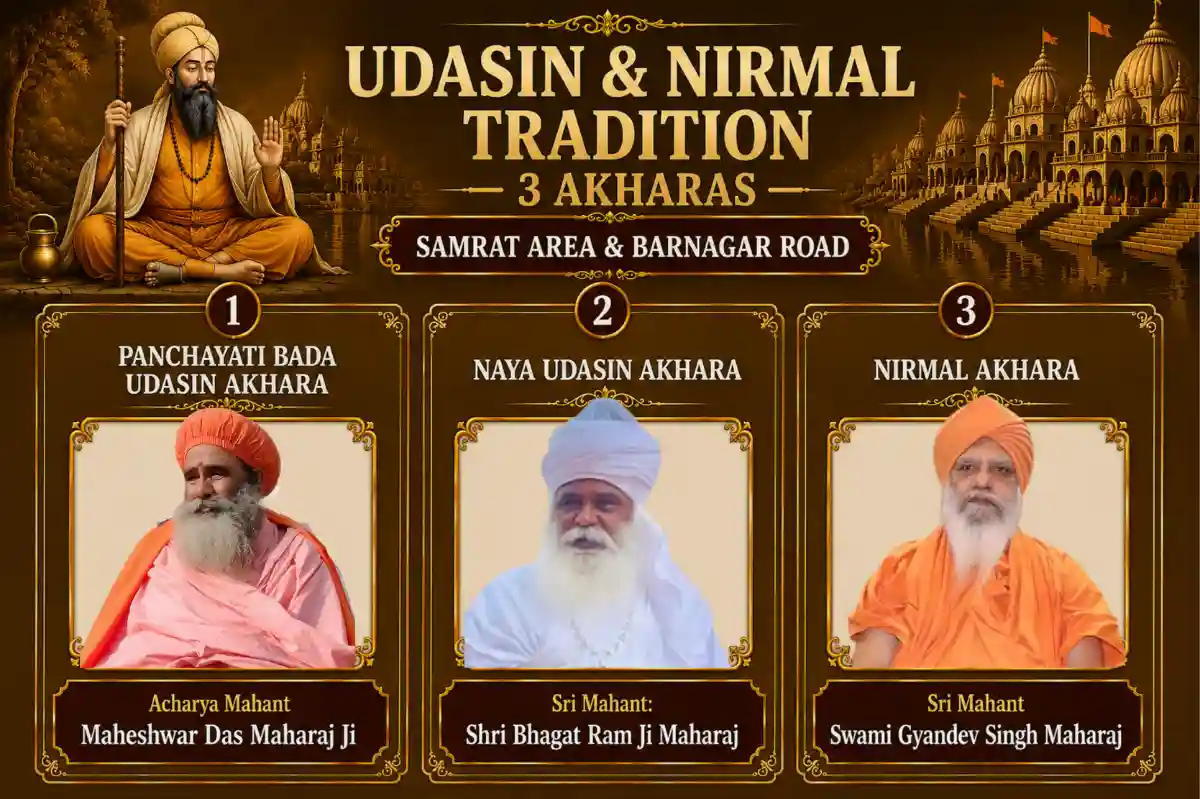
Both Udasin Akharas follow a panchayati system of governance. Authority within the Bada Udasin Akhara rotates among a council of 4 Mahants, each responsible for one of the cardinal directions. As of 2025, the council consisted of Mahant Maheshwar Das Maharaj (president), Mahant Raghu Muni Maharaj, Mahant Durga Das Maharaj, and Mahant Advaitanand Maharaj.
In the Naya Udasin Akhara, the head Mahant is referred to as the Acharya. The Akhara's official website describes its Guru Parampara as beginning with Sri Chand and carried forward by successive Mahamandaleshwars, a title conferred through demonstrated tapasya and seva, not inherited position.
The Nirmal Akhara's guru-shishya tradition is filtered through its scholarly emphasis. Disciples don't just adopt a spiritual father; they enter a curriculum of Sanskrit, Gurmukhi, and Vedantic philosophy. The current Sri Mahant is Swami Gyanadev Singh Maharaj (also listed as Gyan Dev Singh in some sources).
A distinctive feature of the Naya Udasin Akhara: its entry processions have no acharya palanquin and no spears or weapons at the front. It's one of the few Akharas with a documented weapon-free procession.
Religious and spiritual significance
The Udasin spiritual philosophy draws on Advaita Vedanta as formulated by Adi Shankaracharya, even though the Udasins aren't formally Dashanami. Their philosophy is essentially monistic: Brahman is the sole reality, and liberation comes through knowledge (jnana) and detachment.
Sri Chand also introduced panchayatana worship, simultaneous veneration of 5 deities: Shiva, Vishnu, the Sun (Surya), Durga, and Ganesha, while also reverencing Sri Chand himself as Guru-Deva.
For the Nirmal Akhara, spiritual significance flows from scriptural mastery. Nirmalas have historically functioned as scholars and teachers in public religious settings, attending Kumbh Melas and other major tirthas to engage other sampradayas in philosophical debate. Their religious identity integrates Guru Granth Sahib with Sanskrit and Vedantic learning in a way that few other monastic bodies in India do.
Dashanami sect affiliation
The Udasin and Nirmal Akharas are not affiliated with the Dashanami Sampradaya of Adi Shankaracharya. The 10 Dashanami titles (Saraswati, Bharati, Giri, Parvata, Sagara, Tirtha, Aranya, Vana, Ashrama, Charitra) apply to Shaiva Akharas only. The Udasin and Nirmal orders occupy a formally recognised but categorically distinct position within the ABAP structure.
This separation has direct practical consequences at Simhastha. The Shahi Snan sequence places the Udasin and Nirmal Akharas after the Shaiva and Vaishnava Akharas precisely because they sit outside the Shankaracharya lineage hierarchy that governs the Shaiva bathing order.
Ishta-devata (presiding deity)
For the Udasin tradition, there's no single presiding deity in the Shaiva sense. The panchayatana framework means all 5 principal deities receive worship. Sri Chand is also venerated as a divine figure. The Bada Udasin Akhara refers to him as Guru Chandradev; the Naya Udasin Akhara calls him Guru Chandracharya.
Udasi saints closely resemble Shaiva sannyasis in outward form. They wear red or black cloth, apply ash (vibhuti), grow long matted hair (jata), and maintain a sacred fire (dhuni). Distinctive markers include a woollen knitted cap and a small silver crescent ring in the right ear.
For the Nirmal Akhara, worship centres on Guru Granth Sahib recitation alongside general Sanskrit-rooted practice. The Nirmalas wear ochre or saffron robes and maintain unshorn hair (kesh), observing at least one of the five Ks of Sikhism at all times.
Naga Sadhu tradition
The Udasin and Nirmal Akharas don't maintain Naga Sadhu orders in the way the Shaiva Akharas do. Naga SadhusLearn about the mysterious Naga Sadhus of Kumbh Mela., defined by living without clothing and carrying arms in the Shahi Snan procession, are the defining identity of the Shaiva Akharas, particularly Juna Akhara.
The Udasin Akharas send armed saints on some occasions, but their procession culture is quieter. The Naya Udasin Akhara in particular marches without a palanquin or spears at the head of its procession. The Nirmal Akhara's procession identity is built around scholarly and devotional display, not martial display.
Organizational structure
All 3 Akharas operate under the Akhil Bharatiya Akhara Parishad, founded in 1954, now headquartered in Ayodhya under Mahant Ravindra Puri. Within that structure, the 3 Udasin-Nirmal Akharas constituted their own Udasin Nirmal Parishad in May 2025 to manage intra-tradition coordination.
- Bada Udasin Akhara: Panchayati council of 4 Mahants. Headquarters in Prayagraj at 58/46, Kydganj Road, Krishna Nagar. Affiliate branches in UP, Uttarakhand, Bihar, Haryana, Punjab, MP, Maharashtra, Andhra Pradesh, Gujarat, and Telangana. Runs schools, colleges, and hospitals.
- Naya Udasin Akhara: Governed by a Shree Panch council. Headquarters in Kankhal, Haridwar, at Daksha Mandir Road, Mohalla Miaria, Mayapur, 249408. Head Mahant: Mahant Jagtar Muni.
- Nirmal Akhara: Sri Mahant-led. Headquarters at Sati Ghat Road, Mohalla Maiyapur (Mohalla Miaria), Kankhal, Haridwar, Uttarakhand 249408. Website: nirmalakhara.org.
Role in Kumbh Mela (historical)
Udasin saints attended Kumbh Melas well before 1825 when the Bada Udasin Akhara was formally constituted. The Udasi order spread across Punjab and into wider India through the 17th century, following itinerant preaching circuits that passed through major tirthas.
The Nirmalas have a recorded history at Kumbh Melas from at least the mid-19th century, where they set up their dera and engaged in philosophical debates with scholars of other sampradayas. The 1855 Haridwar Kumbh is specifically documented as the occasion where the Nirmalas first elected a central Sri Mahant, the concrete step that led to the formal akhara establishment in 1862.
The Nirmal Akhara participated in the 2025 Maha Kumbh Mela at Prayagraj, entering its camp on 11 January 2025, installing the Dharmadhwaja flag the following day, and bathing last among all 13 Akharas.
Role in Simhastha 2028 specifically
All 3 Udasin-Nirmal Akharas will participate in Simhastha 2028 in Ujjain, as they do at every Kumbh gathering. They'll set up camps in the Simhastha Nagar area, conduct their Peshwai (ceremonial entry procession) into Ujjain before the Shahi Snan dates, and proceed to the Shipra river on April 9, April 23, and May 8, 2028.
Exact camp sector allocation, Peshwai dates, and Shahi Snan sub-sequence for each Akhara at Simhastha 2028 are not yet published as of mid-2026. Confirm these details at simhasthujjain.in or the official MP Government Simhastha portal before publishing or advising pilgrims.
The Udasin Nirmal Parishad formed in May 2025 is actively planning for Simhastha 2028, with an initial council meeting in Prayagraj to expand membership already announced.
Shahi Snan order and sequence
The 13 Akharas bathe in a fixed sequence set by ABAP. In the established protocol, Shaiva Akharas bathe first (led typically by Juna and Mahanirvani), Vaishnava Akharas second, and Udasin-Nirmal Akharas last.
The exact sub-sequence among the 3 Udasin-Nirmal Akharas for Simhastha 2028 is not confirmed in publicly available sources. At the 2025 Maha Kumbh, the Nirmal Akhara bathed last of all 13 Akharas. Verify the precise order for Simhastha 2028 against official ABAP or MP government announcements closer to the event.
For pilgrims: the Udasin and Nirmal Akharas process later in the day on Shahi Snan dates. Expect the Shaiva Naga Sadhu processions to dominate the morning hours, with the Udasin-Nirmal groups arriving in the afternoon. Timings are confirmed by the administration a few days before each Shahi Snan.
Connection and relationship with Ujjain
Ujjain holds deep relevance for the Udasin tradition through its status as one of Hinduism's 7 sacred cities (Sapta Puri) and through the MahakaleshwarExplore the divine Mahakaleshwar Jyotirlinga in Ujjain. Jyotirlinga. Udasin theology venerates Shiva as part of its panchayatana framework. Sri Chand himself, by tradition, undertook extensive travels across the Indian subcontinent including pilgrimage circuits to major tirthas.
For the Nirmal Akhara, Ujjain's significance comes through its Shaiva and Sanskrit scholarly tradition. Ujjain was historically one of India's great centres of Sanskrit learning, and a Nirmala tradition built on Vedantic scholarship naturally gravitates toward the city.
The administrative relationship is direct: MP government land allocation for Simhastha 2028 covers all 3 Udasin-Nirmal Akharas, as it did in 2016.
Ashrams in Ujjain (with addresses where verifiable)
The Udasin and Nirmal Akharas set up camp within the Simhastha Nagar, the purpose-built tent city allocated by the Ujjain administration across the Shipra riverbank area for the duration of the mela. Permanent ashram addresses within Ujjain city for these specific Akharas are not confirmed in publicly available sources.
Pilgrims wishing to visit these Akharas during Simhastha 2028 should look for their camp flags and banners at the Simhastha Nagar entrance. Each Akhara's camp is marked by its distinctive Dharmadhwaja flag. Specific camp sector numbers for 2028 will be published by the Ujjain Simhastha administration closer to the event.
At previous Kumbh Melas, Shaiva Akhara camps, particularly Juna Akhara, draw most pilgrim foot traffic because of the Naga Sadhus. The Udasin and Nirmal camps tend to have a quieter atmosphere, making them more accessible for conversations with sadhus and for witnessing everyday monastic life up close. If that kind of contact is what you're seeking, locate these camps specifically rather than following the largest crowds.
Major ashrams and maths elsewhere in India
The Bada Udasin Akhara's primary headquarters is at 58/46, Kydganj Road, Krishna Nagar, Prayagraj, Uttar Pradesh 211003. It maintains affiliate branches across at least 10 states and runs educational and medical institutions.
The Naya Udasin Akhara is headquartered at Daksha Mandir Road, Mohalla Miaria, Mayapur, Haridwar, Uttarakhand 249408.
The Nirmal Akhara's headquarters is at Sati Ghat Road, Mohalla Maiyapur (Mohalla Miaria), Kankhal, Haridwar, Uttarakhand 249408. Its founding location was Chanarthalian di Haveli, Patiala, Punjab (1862). All 3 Akharas maintain derasaras (monastic centres) across Punjab, Uttarakhand, and Uttar Pradesh. A full list of regional ashrams isn't publicly documented in a centralized source.
Prominent Mahants and Mahamandaleshwars
- Bada Udasin, Mahant Maheshwar Das Maharaj: President as of 2025. Led Akhara preparations for the 2025 Maha Kumbh and emphasized the order's traditions of itinerant spiritual outreach. In December 2024, the Akhara formally installed Ram Naumi Das as Mahant of its Pashchim Panghat branch through traditional coronation rites.
- Bada Udasin, Mahant Durga Das Maharaj: Council member and, as of the Udasin Nirmal Parishad formation in May 2025, secretary of that new body.
- Naya Udasin, Mahant Jagtar Muni: Head Mahant. Elected president of the Udasin Nirmal Parishad in May 2025.
- Naya Udasin, Mahamandaleshwar Shri Mahant Ram Sharan Das Ji Maharaj: Listed as Acharya and spiritual head responsible for doctrinal continuity and monastic governance as of 2025.
- Nirmal Akhara, Swami Gyanadev Singh Maharaj: Sri Mahant and president. Heads institutions in Haridwar and Punjab.
- Nirmal Akhara, Devendra Singh Shastri: Secretary of the Udasin Nirmal Parishad formed May 2025.
Architecture of key ashrams or temples
Information on the architectural features of Bada Udasin, Naya Udasin, or Nirmal Akhara ashrams and temples is not verified across independent sources reviewed for this profile.
At Kumbh Melas, each Akhara erects a temporary camp complex with a Dharmadhwaja flag-pole as the centrepiece, a central sacred fire (dhuni for Udasin), and open halls for pravachans (scriptural discourses). The Nirmal Akhara's Kumbh camps typically feature a Guru Granth Sahib reading setup alongside Sanskrit study areas.
Religious rituals and practices
Udasin sadhus maintain a dhuni (sacred fire) and perform yogic meditation as core daily practices. They recite Guru Granth Sahib passages alongside Vedic mantras. Physical markers, ash application, matted hair, woollen cap, silver crescent ear-ring, are maintained consistently.
The panchayatana worship framework means daily puja addresses all 5 deities. At Kumbh Melas, Udasin sadhus conduct public pravachans on renunciation and the nature of the self.
Nirmal Akhara members perform daily paath (recitation) from Guru Granth Sahib, conduct Sanskrit-language pravachans, and uphold the kesh. They observe the same birth and death rites as Hindu ascetics, and their Kumbh camps run Ganga Puja and philosophical discourses open to the public.
At Simhastha, both traditions perform an Aamantran Puja (invitation ritual to the Shipra) on arrival in Ujjain, followed by the full ceremonial bath on each Shahi Snan date. [Note: site-specific ritual details for these Akharas at Simhastha are not separately documented in public sources; this reflects general Kumbh arrival practice.]
Rare and lesser-known facts
- The Naya Udasin Akhara marches without weapons: While other Akharas carry spears or arms in their Shahi Snan procession, the Naya Udasin Akhara's entry has no acharya palanquin and no spears at the front. It's one of the few Akharas with a documented weapon-free procession.
- The Nirmal Akhara bathed last of all 13 at the 2025 Maha Kumbh: It entered camp on January 11, installed the Dharmadhwaja on January 12, and performed its bath as the final Akhara. This position at the end of the sequence is consistent with the ABAP hierarchy.
- The Singh Sabha accused the Nirmalas of doctrinal syncretism in the 19th century: Reformers of the Tat Khalsa tradition charged that Nirmalas had diluted Sikh teaching by integrating Vedantic and Brahminical concepts. This tension intensified under the 1925 Sikh Gurdwaras Act, which marginalized Nirmalas in gurdwara control.
- The Udasin lineage internally claims 165 masters before Sri Chand: The sect's cosmology traces its spiritual lineage to the Puranic age, back to the Four Kumaras, making Sri Chand the 165th acharya, not the first. This internal cosmology is documented in Wikipedia/Udasi but isn't independently verified in external academic sources.
- All 3 Udasin-Nirmal Akharas formed their own council in 2025 ahead of Simhastha 2028: The Udasin Nirmal Parishad was constituted on 27 May 2025 in response to internal ABAP disputes following the death of ABAP president Mahant Narendra Giri on 20 September 2021. Its influence on Simhastha 2028 planning will become clearer in the months ahead.
Timeline of key events
| Year | Event | Source |
|---|---|---|
| 1494 | Birth of Sri Chand, son of Guru Nanak Dev, at Sultanpur Lodhi | Giani Balwant Singh, Encyclopedia of Sikhism, Punjabi University Patiala |
| c.1600s | Udasi Sampradaya formally active; Sri Chand establishes base at Barath near Pathankot | SikhiWiki/Udasi; Giani Balwant Singh, Encyclopedia of Sikhism, Punjabi University Patiala |
| 1629 (or 1643) | Death of Sri Chand, date disputed across sources | SikhiWiki/Udasi; Fandom/Udasi |
| 1686 (traditional date, historicity disputed) | Guru Gobind Singh sends five disciples to Varanasi, origin of Nirmala tradition. W.H. McLeod questions this date in academic literature | SikhiWiki/Nirmala; nirmalakhara.org; W.H. McLeod cited in Nirmala sect scholarship |
| 1825 | Shri Panchayati Bada Udasin Akhara formally established at Har Ki Pauri, Haridwar, by Yogiraj Nirvandev Maharaj | Hindustan Times, January 2019; Indian Express, January 2025 |
| 1846 | Mahant Sudhir Das breaks from Bada Udasin and founds Panchayati Naya Udasin Akhara following internal dispute | Needs verification, official records not confirmed |
| 1855 | General Nirmala meeting at Haridwar Kumbh elects Mehtab Singh of Rishikesh as first central Sri Mahant | SikhiWiki/Nirmala |
| 7 Aug 1862 | Panchayati Nirmal Akhara formally established at Chanarthalian di Haveli, Patiala, by Mahitab Singh | nirmalakhara.org; SikhiWiki/Nirmala |
| 1954 | Akhil Bharatiya Akhara Parishad constituted; all 3 Udasin-Nirmal Akharas become members | Needs verification, official records not confirmed |
| 20 Sep 2021 | ABAP president Mahant Narendra Giri dies; leadership dispute divides ABAP into rival factions | Times of India, September 2021 |
| Jan 2025 | Nirmal Akhara participates in Maha Kumbh Prayagraj; enters camp 11 Jan, bathes last of all 13 Akharas | Times of India, January 2025 |
| 27 May 2025 | Udasin Nirmal Parishad formed by all 3 Akharas; Jagatar Muni (Naya Udasin) elected president | Needs verification, official records not confirmed |
| 9 Apr 2028 | First Amrit Snan, Simhastha 2028. Udasin-Nirmal Akharas proceed to Shipra River, Ujjain, after Shaiva and Vaishnava groups | MP Government official Simhastha 2028 date announcement |
| 23 Apr 2028 | Second Amrit Snan, Simhastha 2028 | MP Government official Simhastha 2028 date announcement |
| 8 May 2028 | Third Amrit Snan, Simhastha 2028 | MP Government official Simhastha 2028 date announcement |
Sources: SikhiWiki/Nirmala, SikhiWiki/Udasi, nirmalakhara.org, Hindustan Times (January 2019), Indian Express (January 2025), Times of India (September 2021, January 2025), Giani Balwant Singh, Encyclopedia of Sikhism, Punjabi University Patiala. Confirm against official records before publishing.
Comments
No comments yet. Be the first to share your thoughts!
Leave a Comment