
Ancient to modern history
The Nirvani Ani Akhara's history runs through one of the most contested stretches of religious geography in India: Ayodhya. Until the 17th century, Ayodhya was dominated by Shaiva Dashnami Sanyasis. Vaishnava Ramanandis had a devotional presence in the city but no armed organization.
That changed in the early 18th century. Dasnami Sanyasis seized Ayodhya during Ram's birthday celebrations, forcing the Ramanandis out. Swami Balanand, head of the Ramanandis, called a conference at Galata near Jaipur and organized 3 military wings of Vaishnava sects.
Nirvani Akhara was designated "Sena" (army wing). Digambar became Raja (king) and Nirmohi became Mantri (commander). The Nirvani Akhara followed Nirmohi's Govindadas into Ayodhya and claimed Hanuman Tila, a sacred hillock where a Hanuman idol stood, as its base.
The Nagas of Nirvani Akhara drove both Shaiva Nagas and Muslim faqirs away from the Hanuman idol at Hanuman Tila. Then they began building. With land grants from successive Nawabs of Awadh (starting with Saadat Khan, 1722-1739 CE, continuing through Safdarjung and Shuja-ud-Daullah), the Akhara built what is now Hanumangarhi.
By the 19th century Hanumangarhi was the primary sacred landmark in Ayodhya. In 1855, when a Sunni group attempted to seize it, the Nawab of Awadh deployed forces to defend the temple.
In 1949, Mahant Abhiram Das, a Naga Bairagi of Nirvani Akhara based at Hanumangarhi, placed Ram Lalla idols inside the Babri Masjid on the night of December 22-23. He was later revered as "Ram Janmabhoomi Uddharak" (liberator of Ram's birthplace) and died in 1981.
Today, Acharya Satyendra Das, disciple of Mahant Abhiram Das, is chief priest of the Ram Mandir in Ayodhya. The institutional thread from Nirvani Akhara to the Ram temple runs directly through Hanumangarhi.
Founding and tradition
Shri Nirvani Ani Akhara belongs to the Ramanandi Sampradaya, the Vaishnava monastic tradition founded by Jagadguru Swami Ramananda in the 14th-15th century. It's one of 3 akharas (Nirmohi, Nirvani, and Digambar) formally organized in the early 18th century under Swami Balanand at the Galata conference near Jaipur.
Key highlights
- Full name: Shri Nirvani Ani Akhara (also written Shri Panch Ramanandiya Nirvani Ani Akhara).
- Tradition: Ramanandi Sampradaya, Vaishnava. Monks are called Bairagi.
- Role among 3 Bairagi Akharas: Sena (army).
- Principal seat: Hanumangarhi, Ayodhya, UP. Registered address: Shri Nirvani Ani Akhara, Hanuman Gaadi, Ayodhya, Uttar Pradesh.
- Presiding deity: Lord Hanuman, with devotion also to Lord Ram.
- Temple complex: Hanumangarhi spans 52 bighas, including a residential complex for saints.
- Bairagi count: Around 600 at Hanumangarhi; over 15,000 across Ayodhya.
The exact founding year of Nirvani Ani Akhara as a distinct institution is disputed. One source (LinkedIn, Dr. Ravindra Pastor) places it at 1475 CE in Vrindavan; mainstream academic sources (Jain, Pinch) place formal akhara organization in the early 18th century. Confirm against Akhil Bharatiya Akhara Parishad records before publishing any specific founding date.
Founder and lineage
Nirvani Ani Akhara traces its spiritual lineage to Jagadguru Swami Ramananda, the 14th-15th century Vaishnava saint from Prayagraj who founded the Ramanandi Sampradaya. Ramananda built his tradition on devotion to Lord Ram, open to all castes. His disciples included Kabir, Ravidas, and Pipa.
The institutional akhara structure came centuries after Ramananda's death, organized at the Galata conference under Swami Balanand. Govindadas of Nirmohi Akhara entered Ayodhya first; Nirvani Akhara followed and claimed Hanuman Tila.
Abhayaram Das is the saint credited with formally establishing the Hanumangarhi complex. According to tradition, the land grant from Nawab Saadat Khan's administration came after he healed the Nawab's gravely ill son with holy water from the shrine.
The founding legend of Hanumangarhi (Abhayaram Das healing the Nawab's son) is documented as widely circulated tradition. Independent historical verification from Nawabi administrative records has not been traced in available sources. Cross-verify with UP State Archives or Faizabad Gazetteer before publishing as historical fact.
Guru-shishya (teacher-disciple) tradition
The Nirvani Ani Akhara's guru-shishya chain runs from Ramananda through the Ramanandi succession to the present. Each mahant transmits initiation, the Guru-mantra, and monastic discipline to disciples. The chain from Abhayaram Das to Mahant Abhiram Das to Acharya Satyendra Das (now chief priest of Ram Mandir) is a documented instance of this succession.
Initiation is called Diksha. Novices receive the Panch Samskar (5 rituals of formal entry into Vaishnavism) and take vows of celibacy, renunciation, and obedience to the guru. A defining mark of the Nirvani Bairagi tradition is the bow-and-arrow tattoo burned onto the initiate's arm with a heated metal rod, created for identification during 18th-century sectarian conflicts.
The Shree Panch (a 5-member governing council) manages the Akhara's administrative body and is elected every 4 years at Kumbh Mela. Only Mahamandaleshwars are authorized to transmit the Guru-mantra.
Not every bairagi at Hanumangarhi trains in warrior arts. Mahant Premdas noted that while some train in wrestling, sword-wielding, and jungle survival, most spend their time managing ashrams and doing puja-paath.
Religious and spiritual significance
Nirvani Ani Akhara follows Bhakti Yoga (devotion to Lord Ram and Hanuman) as its primary spiritual path. Daily practice includes Ram-nam sankirtan, scripture study (Ramcharitmanas, Bhagavad Gita, Valmiki Ramayana), havan, and bhajan. Evening closes with Aarti.
Hanumangarhi operates as the devotional gateway to Ayodhya's Ram Janmabhoomi circuit. Custom holds that any pilgrim visiting Ram Mandir must first pay homage to Hanuman at Hanumangarhi. This custom predates the Ram Mandir's 2024 consecration and continues shaping pilgrimage behavior today.
The Ramanandi tradition also celebrates Shivratri, despite being Vaishnava, reflecting the theological inclusivity Ramananda advocated throughout his teaching.
Dashanami sect affiliation
Nirvani Ani Akhara is not Dashanami. The Dashanami system (10 monastic orders organized by Adi Shankaracharya in the 8th century) belongs to the Shaiva tradition. Nirvani Ani Akhara belongs to the Ramanandi Sampradaya, a Vaishnava tradition with a completely separate lineage, initiation system, and philosophical basis (Vishishtadvaita, transmitted through Ramananda).
The 7 Shaiva Akharas trace legitimacy to Shankaracharya. Nirvani Ani Akhara, along with Nirmohi and Digambar, traces its legitimacy to Ramananda and the Galata conference. Sacred geography differs too: Vaishnava Akharas are centered on Ayodhya; Shaiva Akharas on Varanasi and the Dashnami circuit.
Ishta-devata (presiding deity)
The presiding deity of Nirvani Ani Akhara is Lord Hanuman, specifically in the form worshipped at Hanumangarhi: Pawansut (son of Pawan, the wind god) seated in the lap of his mother Anjani. This form is distinct from the fierce Panchamukhi Hanuman of some Shaiva traditions.
Devotion to Lord Ram runs alongside Hanuman worship. The Akhara's spiritual identity ties the two together: Hanuman as protector of Ram's birthplace, and the Bairagi monk as the living continuation of that protection.
Naga Sadhu tradition
Nirvani Ani Akhara has a warrior-monk lineage. Its monks are Naga Bairagis, distinct from Shaiva Naga SadhusLearn about the mysterious Naga Sadhus of Kumbh Mela. in dress, initiation, and mythology. Shaiva Nagas are naked and ash-smeared. Bairagi warrior monks wear white unstitched clothes (increasingly saffron), a Tulsi bead necklace, a Urdhvapundra tilak, and carry a kamandal. Their initiation mark is a bow-and-arrow tattoo burned onto the arm.
Mahant Abhiram Das, the key figure in the 1949 Ram Janmabhoomi action, is described in primary sources as "a Naga Vairagi living in Hanumangarhi," a well-built, muscular man from the warrior-monk tradition.
Mahant Premdas says only a small percentage of bairagis still train in warrior arts today. Most manage ashrams and do devotional work. The martial identity is institutional memory more than active practice for most members.
Traditionally, Bairagi monks wear white unstitched cloth, not saffron (which is the Shaiva Naga color). Bairagi Nityanand Das, interviewed at Hanumangarhi by Swarajya Mag in December 2023, wore saffron and explained: "It's the era of saffron." Mahant Premdas confirmed the shift. Pilgrims at Simhastha 2028 will likely see both white-clad and saffron-clad Bairagis in the Nirvani procession.
Organizational structure
The Akhara is governed by a Shree Panch (5-member council representing Brahma, Vishnu, Shiva, Shakti, and Ganesha) elected every 4 years at Kumbh Mela. The Acharya Mahamandaleshwar sits at the top of the spiritual hierarchy. Below come Mahamandaleshwars, Mandaleshwars, and Shri Mahants. Each marhi (sub-unit) is led by a Mahant who runs daily ritual activity.
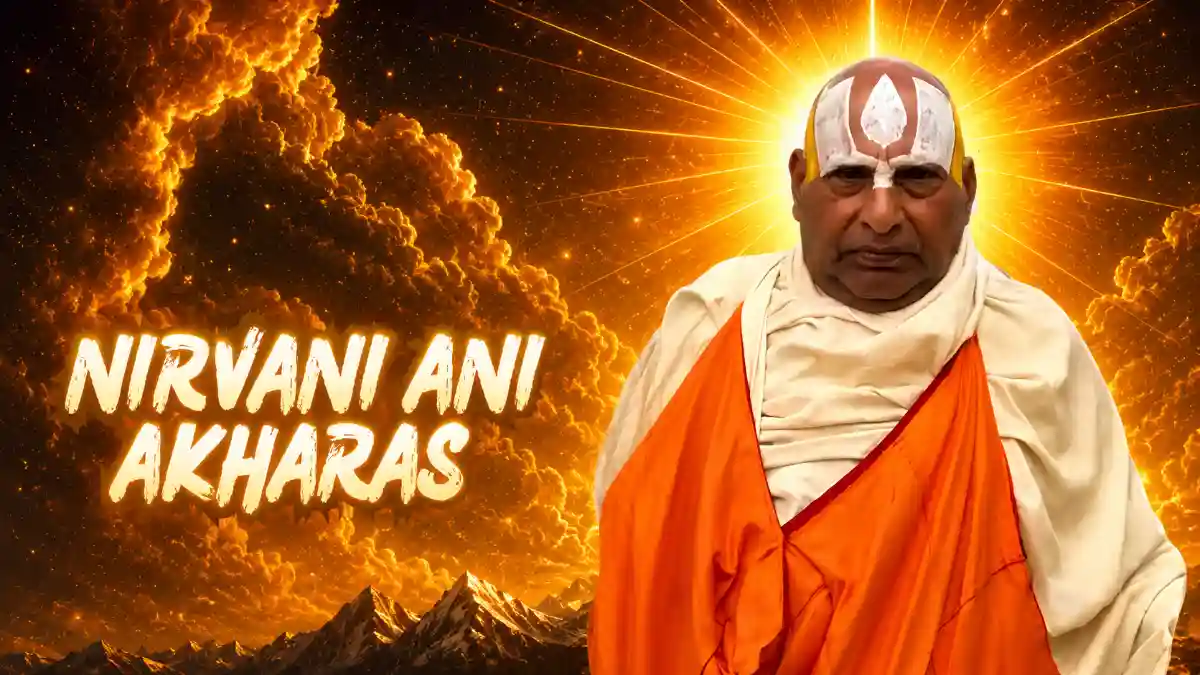
Around 600 bairagis are based at Hanumangarhi, all from Nirvani Akhara. Mahant Premdas is the current Gaddi Nasheen (resident head-priest) of Hanumangarhi and the most prominent living figure associated with the Akhara in credible recent sources.
Current elected Shree Panch membership for Nirvani Ani Akhara was not confirmed from independent sources as of the research date. Contact the Akhil Bharatiya Akhara Parishad or the Akhara directly before publishing current leadership names.
Role in Kumbh Mela (historical)
Nirvani Ani Akhara has participated in all 4 Kumbh Mela sites (Prayagraj, Haridwar, Nashik, and Ujjain) since its formal 18th-century organization. It takes Shahi Snan in the Vaishnava sequence, after the Shaiva Akharas and before Udasin-Nirmal.
The bathing sequence wasn't always peaceful. A Maratha Peshwa copper plate records that approximately 12,000 ascetics died in a clash between Shaivites and Vaishnavites at the 1789 Nashik Kumbh over bathing-sequence precedence. This event directly shaped British colonial policy on Kumbh management and produced the codified sequence still observed today.
The 1921 Ujjain Kumbh holds a specific place in Ramanandi institutional memory: a theological debate between Ramanuja and Ramanandi traditions was declared in favor of the Ramanandis.
Role in Simhastha 2028 specifically
At Simhastha 2028 in Ujjain, Nirvani Ani Akhara will participate in Shahi Snan on April 9, April 23, and May 8, 2028, on the Shipra River. It will take its dip in the Vaishnava sequence, after the 7 Shaiva Akharas and before Udasin-Nirmal. A designated camp zone will be allocated by the MP government and Ujjain district administration.
The event window runs March 27 to May 27, 2028. Parva Snan dates (March 27, April 4, April 14, April 19, May 1, May 5, May 15) are additional auspicious bathing days beyond the 3 Shahi Snan dates.
The precise internal bathing sequence within the 3 Vaishnava Akharas for Simhastha 2028 has not been officially published. A Nashik Kumbh source (epicyatra.com, Jul 2026) notes Nirvani or Digambar usually leads the Vaishnava procession, but Nashik and Ujjain protocols may differ. Confirm with ABAP or the MP Simhastha portal before publishing a sequence.
Shahi Snan order and sequence
The Shahi Snan sequence at Simhastha is fixed by tradition. Shaiva Akharas bathe first, led by Juna Akhara. The 3 Vaishnava Akharas (Nirvani, Nirmohi, and Digambar) follow. Udasin and Nirmal Akharas come after.
On each Shahi Snan date, Nirvani Akhara enters the Shipra in Peshwai (ceremonial procession) form. Saffron-clad and white-clad Bairagi saints ride elephants, horses, and decorated chariots, accompanied by music and flags. The procession draws large crowds separate from the bathing itself.
Connection and relationship with Ujjain
Ujjain hosts the Nirvani Ani Akhara every 12 years as one of 4 Kumbh Mela sites. The city's sacred geography is primarily Shaiva (the MahakaleshwarExplore the divine Mahakaleshwar Jyotirlinga in Ujjain. Jyotirlinga makes it one of Shiva's 12 principal abodes). For the Nirvani Akhara, Ujjain's Simhastha is a pilgrimage duty, not home territory. But the Shipra River's astrological sanctity during the Simhastha alignment is held to transcend sectarian affiliation.
Hanumangarhi in Ayodhya holds properties in Ujjain, along with Vrindavan, Nashik, and Jagannath Puri. This gives Nirvani Akhara a permanent institutional footprint at each of the 4 Kumbh sites.
Ashrams in Ujjain (with addresses where verifiable)
Information not verified across independent sources. Hanumangarhi administration confirms holding properties and akharas in Ujjain, but specific ashram addresses for Nirvani Ani Akhara in Ujjain were not traced from named independent sources as of the research date.
The Simhastha 2028 camp allocation for this Akhara will be governed by the MP government and Ujjain district administration. Check simhasthujjain.in once 2028 allocations are officially announced.
Major ashrams and maths elsewhere in India
- Hanumangarhi, Ayodhya, UP: The Akhara's principal seat. A 52-bigha temple-fortress on a hillock in central Ayodhya, approached by 76 steps. It's the most important Hanuman temple in Ayodhya and the devotional gateway to the Ram Janmabhoomi complex.
- Properties in Vrindavan, Nashik, Ujjain, and Jagannath Puri: Hanumangarhi administration confirms holdings at all 4 Kumbh sites. Specific addresses were not confirmed from independent named sources for this profile. Contact the Akhara directly for current details.
Prominent Mahants and Mahamandaleshwars
- Abhayaram Das: The saint credited with establishing Hanumangarhi on land received from Nawab Saadat Khan's administration (1722-1739 CE). Founding figure of the Akhara's physical home.
- Mahant Abhiram Das (died 1981): The most historically significant figure in Nirvani Akhara's modern history. A Naga Bairagi from Darbhanga, Bihar, based at Hanumangarhi. He placed Ram Lalla idols inside the Babri Masjid on December 22-23, 1949, and was named prime accused in the FIR filed by Ayodhya police. Later revered as "Ram Janmabhoomi Uddharak."
- Acharya Satyendra Das: Disciple of Mahant Abhiram Das. Currently chief priest of the Ram Mandir, Ayodhya. His appointment continues the Nirvani Akhara's spiritual thread into the post-2024 era.
- Mahant Premdas: Current Gaddi Nasheen (resident head-priest) of Hanumangarhi. The most prominent living spokesperson for Nirvani Akhara in credible recent sources. Mahant Dharamdasji and Mahant Mohandas ji were noted as Shree Panch members in 2019 Akhara Parishad records.
Mahant tenure changes. The Shree Panch names above are from 2019 reports. Verify current elected leadership directly with the Akhara or the Akhil Bharatiya Akhara Parishad before publishing.
Architecture of key ashrams or temples
Hanumangarhi has a shrine at this site traceable to the 10th century, though its current fortified structure was built in the late 18th century under Nawabi patronage. The complex spans 52 bighas.
Access is via 76 steps. The main shrine holds a murti of Pawansut (Hanuman) seated in the lap of Anjani. 4 bastions mark the corners of the fortified outer structure, dating to Diwan Tikait Rai's period under Nawabi administration.
Post-independence, the temple's structure was maintained by Nirvani Akhara mahants without major government-led restoration. Gradual improvements to steps and pilgrim access were made in the 1950s and 1960s under UP state initiatives.
The official temple website is hanumangarhiayodhya.com.
Religious rituals and practices
Daily life at Hanumangarhi follows a fixed rhythm. Before dawn: bathing in the Sarayu, puja, Ram-nam chanting. Morning: wrestling practice for those in the warrior track, pravachan for others. Afternoon: rest, then puja-paath again. Evening: Aarti.
At Kumbh Mela, the Nirvani Akhara organizes kirtans, public satsangs, and pravachans at its camp pandal. These are open to pilgrims without invitation.
Custom at Hanumangarhi: pilgrims visit the temple before going to Ram Mandir. Feeding the langurs (considered living representatives of Hanuman) is a devotional act observed at the complex.
Rare and lesser-known facts
- A Muslim administration built Hanumangarhi: The fortified complex was built on land granted by the Nawabs of Awadh (Saadat Khan, Safdarjung, and Shuja-ud-Daullah) to the Nirvani Akhara. The Nawab also deployed forces to defend it from Sunni attackers in 1855. Without that patronage, Hanumangarhi as it stands today wouldn't exist.
- The 1949 idol placement was a Nirvani Akhara act: Mahant Abhiram Das, a Naga Bairagi of Nirvani Akhara, placed the Ram Lalla idols inside the Babri Masjid on December 22-23, 1949. He was named prime accused in the Ayodhya police FIR. That event triggered the mosque's shutdown and, eventually, the Supreme Court's 2019 verdict.
- Shaiva Nagas and Muslim faqirs were both driven out by Nirvani Akhara: When Nirvani Nagas arrived at Hanuman Tila in the early 18th century, a Hanuman idol there was worshipped jointly by Shaiva Nagas and Muslim faqirs. The Nirvani Nagas drove both groups away.
- Saffron is replacing white in Bairagi dress: The Ramanandi tradition requires white unstitched cloth, but a documented shift toward saffron is underway inside Nirvani Akhara. Bairagi Nityanand Das, interviewed at Hanumangarhi (Swarajya Mag, Dec 2023), wore saffron and called it "the era of saffron."
- The warrior track is now a small minority: Out of approximately 600 bairagis at Hanumangarhi, only a small percentage now train in wrestling or sword-wielding. The martial identity is institutional memory more than active practice for most.
Timeline of key events
| Year | Event | Source |
|---|---|---|
| 14th–15th century CE | Jagadguru Swami Ramananda active; founds Ramanandi Sampradaya in Varanasi and Prayagraj | Britannica: Ramananda; William Pinch, Peasants and Monks in British India, University of California Press, 1996 |
| 10th century CE (traditional) | Earliest Hanuman shrine established at Hanuman Tila, Ayodhya, site of future Hanumangarhi | Needs verification, official records not confirmed |
| Early 18th century | Galata conference near Jaipur under Swami Balanand; Nirvani Ani Akhara formally organized as Sena wing; Nirvani Nagas drive Shaiva Nagas and Muslim faqirs from Hanuman Tila | Meenakshi Jain, Rama and Ayodhya, Aryan Books International, 2013; Swarajya Mag, Dec 2023; The Print, Feb 2025 |
| 1722–1739 CE | Land at Hanuman Tila first formally granted to Abhayaram Das during governorship of Nawab Saadat Khan; temple construction begins | Needs verification, official records not confirmed |
| 1739–1793 CE | Nawabs Safdarjung and Shuja-ud-Daullah continue land and revenue grants to Nirvani Akhara; Hanumangarhi fortress temple built out | Krishna Jha and Dhirendra K. Jha, Ayodhya: The Dark Night, HarperCollins India, 2012; The Print, Feb 2025 |
| 1855 | Sunni group attempts to seize Hanumangarhi; Nawab of Awadh deploys forces to defend the temple; Victory Pillar erected | Swarajya Mag, Dec 2023 |
| 22–23 December 1949 | Mahant Abhiram Das of Nirvani Akhara places Ram Lalla idols inside Babri Masjid; named prime accused in Ayodhya police FIR; later revered as Ram Janmabhoomi Uddharak | Krishna Jha and Dhirendra K. Jha, Ayodhya: The Dark Night, HarperCollins India, 2012; Swarajya Mag, Jan 2024 |
| 1981 | Mahant Abhiram Das dies in Ayodhya | Swarajya Mag, Jan 2024 |
| Post-1947, ongoing | Hanumangarhi maintained by Nirvani Akhara mahants; step improvements and pilgrim access works done in 1950s–60s under UP state initiatives | Needs verification, official records not confirmed |
| 2016 | Nirvani Ani Akhara participates in Simhastha Kumbh Mela, Ujjain; Amrit Snan on April 10, April 22, May 21, 2016 | MP Government Simhastha 2016 official records |
| April 9, April 23, May 8, 2028 | First, Second, and Third Amrit Snan, Simhastha 2028; Nirvani Ani Akhara participates in Vaishnava sequence on Shipra River, Ujjain | MP Government official Simhastha 2028 date announcement |
Sources: Meenakshi Jain, Rama and Ayodhya (Aryan Books, 2013); Krishna Jha and Dhirendra K. Jha, Ayodhya: The Dark Night (HarperCollins, 2012); William Pinch, Peasants and Monks in British India (UC Press, 1996); The Print, Feb 2025; Swarajya Mag, Dec 2023, Jan 2024; MP Government official Simhastha 2028 date announcement. Confirm against official records before publishing.
Comments
No comments yet. Be the first to share your thoughts!
Leave a Comment