

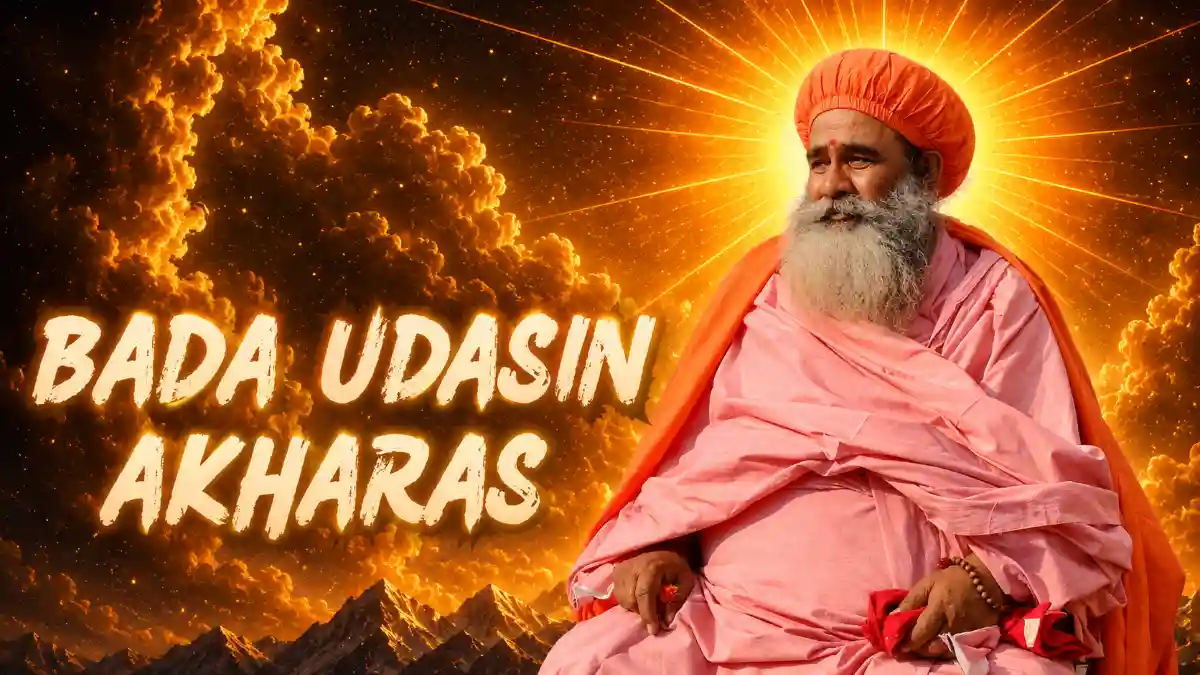
Ancient to modern history
The Udasi ascetic tradition is older than the Bada Udasin Akhara as an institution. A panchayati body to govern the Udasis had been established in 1779 at Prayag (Allahabad), with branches at Kashi (Varanasi) and Kankhal. By the early 19th century, that earlier body had lost ground and the Udasi tradition was in decline.
The Bada Udasin Akhara was formally constituted on Basant Panchami 1825 at Har Ki Pauri, Haridwar, by Yogiraj Shree Nirvandev Maharaj. Its purpose was direct: to revive and consolidate a declining monastic tradition.
Mahant Durga Das, a sitting council member of the Akhara, has stated that Udasi sant Santokh Das was the actual founder, not Nirvandev Maharaj. The website of the Bada Udasin Akhara itself lists "Nirvana Baba Pritam Das Ji Maharaj" as founder. These 3 accounts disagree. Nirvandev Maharaj is the majority consensus across independent sources, but the internal dispute is real and on record.
In 1846, Mahant Sudhir Das broke away from the Akhara following an internal dispute and founded the Udasin Panchayati Naya Akhara. The split created the 2-Akhara structure that exists today.
During the Indian independence movement, the Akhara trained independence fighters, particularly through its Sultanpur Ashram and during the Kumbh gatherings of the 1920s-1930s.
Despite being founded at Haridwar, the Akhara's main ashram is now at Krishnanagar, Prayagraj.
Founding and tradition
The Bada Udasin Akhara is rooted in the Udasi Sampradaya, which Sri Chand established through a life of renunciation, celibacy, and yogic practice. Sri Chand's father, Guru Nanak Dev, passed the Sikh lineage to Bhai Lehna (Guru Angad), not to Sri Chand. Sri Chand built his own path separately.
The Akhara describes its own mission as preserving and propagating Sanatan Dharma through renunciation (tyag), spiritual discipline (sadhana), and service (seva), following the path shown by Sri Chand Ji Maharaj.
The Akhara is classified as Sanatan Sikh. While its lineage is Sikh in origin, it sits much closer to Hindu monastic practice in terms of ritual, theology, and participation in pan-Hindu institutions. It recites gurbani alongside Vedic mantras, worships multiple Hindu deities, and takes part in the Kumbh Mela system governed by the Akhil Bharatiya Akhara Parishad.
Due to mainstream Sikh opposition to these syncretic practices, the Akhara maintains heightened security at its Kumbh Mela camps.
Founder and lineage
The Akhara holds Sri Chand (8 September 1494 to 13 January 1629) as its spiritual progenitor. Sri Chand was the eldest son of Guru Nanak and Mata Sulakhni, born at Sultanpur Lodhi. Some sources give his death year as 1643; the Akhara's own website uses 1643.
Within the Akhara's own theology, Sri Chand is the 165th Acharya of the Udasin sect, not the first. The lineage they trace begins with the 4 sons of Brahma (the Sanakadika Kumaras) and runs through a chain of 164 masters before Sri Chand. The Akhara calls him Guru Chandradev, distinct from the Naya Udasin Akhara which calls him Guru Chandracharya.
The Akhara also holds that Sri Chand was Shiva's incarnation, at Narayana's request. They venerate Sri Chand in a manner akin to Shaivist deity worship, not merely as a historical teacher.
The institutional founder, Yogiraj Shree Nirvandev Maharaj, is the 19th-century figure who gathered the scattered Udasi monastic community and gave it a formal akhara structure in 1825. There is a documented internal dispute about whether Santokh Das or Nirvandev Maharaj was the actual founder.
Guru-shishya (teacher-disciple) tradition
The Bada Udasin Akhara follows the guru-shishya tradition. To become a Naga Sadhu associated with the Akhara, a candidate must be between 12 and 24 years old. On initiation, they shave the head (not required for women and girls), adorn themselves with earrings, a waistcloth, a necklace, and anklets, and swear a lifetime vow to the Akhara and nation on the religious flag and their ishtadeva.
The Akhara is against caste divisions.
Governance follows a Shree Panch council model, with Sri Chand considered the witness and spiritual authority behind the council. The council ensures continuity of tradition, discipline, and the Akhara's values across its maths and activities.
As of 2025, the council consisted of 4 members: Mahant Maheshwar Das Maharaj (president), Mahant Raghu Muni Maharaj, Mahant Durga Das Maharaj, and Mahant Advaitanand Maharaj. Each Mahant heads one of the 4 cardinal directions.
Religious and spiritual significance
The Akhara's spiritual philosophy is monistic Advaita Vedanta, as formulated by Shankara, even though the Udasins aren't formally Dashanami. Brahman is the sole reality; liberation comes through jnana (knowledge) and detachment.
In practice, the Akhara blends Vedantic philosophy, Nath yogic practices, and Bhakti devotion. It actively spreads Vedic knowledge, Upanishadic wisdom, and Bhakti yoga. It runs Sanskrit-specializing educational institutions across its ashram network.
The Akhara holds that Sri Chand was Shiva's incarnation at Narayana's request. Their theology connects across both Shaiva and Vaishnava streams. They affirm that Vishnu's Treta Yuga avatar was Rama and his Dwapar Yuga avatar was Krishna.
Ash (vibhuti) carries specific ritual significance for the Akhara. They hold ash in high regard due to a belief connecting Pritam Das and Baba Bankhandi.
Dashanami sect affiliation
The Bada Udasin Akhara is not affiliated with the Dashanami Sampradaya of Adi Shankaracharya. The 10 Dashanami titles (Saraswati, Bharati, Giri, Parvata, Sagara, Tirtha, Aranya, Vana, Ashrama, Charitra) apply to Shaiva Akharas only.
The Akhara's own website contains a claim that it was "established over two millennia ago by Adi Shankaracharya." This is factually incorrect and contradicts all independent sources, which give a founding date of 1825.
The Udasin-Nirmal Akharas sit in a formally recognised but categorically distinct position within the Akhil Bharatiya Akhara Parishad structure. Their philosophical kinship with the Dashanami tradition exists at the level of Advaita Vedanta, but the lineage and institutional history are separate.
Ishta-devata (presiding deity)
The Bada Udasin Akhara venerates Sri Chand (as Guru Chandradev), the 4 sons of Brahma (Sanakadika Kumaras), Ganesh, Lakshmi, Vishnu, Shiva, Bhagwati, and Suryanarayan.
The Akhara practices panchayatana worship: simultaneous veneration of 5 deities: Shiva, Vishnu, the Sun (Surya), Durga, and Ganesha.
At Kumbh Mela camps, the Akhara installs a 75-foot flag. The Akhara flies a red flag featuring Hanuman on one side and a chakra on the other.
Naga Sadhu tradition
The Bada Udasin Akhara has its own Naga Sadhu initiates, though the tradition differs from the Shaiva Naga Akharas. Where Shaiva Nagas (especially Juna Akhara) are defined by living without clothing and carrying arms in procession, the Udasi Nagas are clothed.
Initiation requires candidates to be between 12 and 24 years old. They shave the head on initiation, wear earrings, a waistcloth, a necklace, and anklets, and swear a lifetime vow.
Udasi ascetics generally wear red or black cloth, apply ash, maintain long matted hair (jata), keep a dhuni (sacred fire), and wear a woollen knitted cap and a small silver crescent ring in the right ear as identifying markers.
Organizational structure
The Akhara is governed by a Shree Panch council of senior seers, with Sri Chand considered the council's spiritual witness. In the 2019 council: Shree Mahant Maheshwar Das, Shree Mahant Raghumuni, Shree Mahant Durgadas, and Shree Mahant Advaitanand. By 2025, Mahant Maheshwar Das Maharaj held the president's position with the same 3 council members alongside. Each Mahant heads one of the 4 cardinal directions.
The Akhara is a member of the Akhil Bharatiya Akhara Parishad (ABAP), formally constituted in 1954. On 27 May 2025, following ABAP leadership disputes after the death of Mahant Narendra Giri in September 2021, the Bada Udasin Akhara joined the 2 other Udasin-Nirmal Akharas in forming the Udasin Nirmal Parishad, a separate coordination body. Mahant Durga Das Maharaj of the Bada Udasin Akhara was elected its secretary.
The Akhara has affiliate branches across at least 10 states: Uttar Pradesh, Uttarakhand, Bihar, Haryana, Punjab, Madhya Pradesh, Maharashtra, Andhra Pradesh, Gujarat, and Telangana. At least 100 ashrams across India are affiliated with it. It operates schools, colleges, hospitals, Ayurvedic clinics, and social service camps. Its educational institutions often specialise in Sanskrit.
Role in Kumbh Mela (historical)
Udasi participation in Kumbh Melas predates the formal 1825 Akhara constitution. The 1779 panchayati body at Prayag was the earlier institutional form.
The Akhara's participation in Kumbh Melas from the 1820s onward is documented in Hindustan Times (2019) and Indian Express (2025) coverage of the Akhara's history. The Sultanpur Ashram of the Akhara was specifically active in training independence fighters during the Kumbh gatherings of the 1920s-1930s.
At the 2025 Maha Kumbh Mela at Prayagraj, Mahant Maheshwar Das Maharaj led the Akhara's preparations. On 17 December 2024, the Akhara appointed Ram Naumi Das as Mahant of its Pashchim Panghat branch through traditional coronation rites.
Role in Simhastha 2028 specifically
The Bada Udasin Akhara will participate in Simhastha 2028 at Ujjain as 1 of the 13 recognized Akharas. It will set up camp in the Simhastha Nagar area, conduct its Peshwai (ceremonial entry procession) into Ujjain before the Shahi Snan dates, and proceed to the Shipra river on 9 April, 23 April, and 8 May 2028.
Exact camp sector allocation, Peshwai dates, and Shahi Snan sub-sequence for the Bada Udasin Akhara at Simhastha 2028 are not yet published by the Madhya Pradesh government or Ujjain administration as of mid-2026. Confirm at simhasthujjain.in before publishing or advising pilgrims.
The Udasin Nirmal Parishad, formed May 2025, is actively coordinating the 3 Udasin-Nirmal Akharas' plans for Simhastha 2028.
Shahi Snan order and sequence
In the ABAP-established Shahi Snan sequence, Shaiva Akharas bathe first, Vaishnava Akharas second, and Udasin-Nirmal Akharas last. The Bada Udasin Akhara bathes within the final group.
The exact sub-sequence among the 3 Udasin-Nirmal Akharas at Simhastha 2028 (which bathes first, second, or third within the group) is not confirmed in publicly available sources. Verify against official ABAP or MP government announcements closer to the event.
The Shaiva Naga Sadhu processions from Juna and Mahanirvani Akharas dominate the early morning hours at Simhastha. The Udasin-Nirmal Akharas process later in the day. If you're specifically there to witness the Bada Udasin Akhara's red Hanuman flag procession and its clothed Naga tradition, position yourself at the ghat after the main Shaiva groups have bathed and moved on. The crowds are more manageable and the Akhara's character is easier to observe up close.
Connection and relationship with Ujjain
Ujjain holds direct relevance for the Bada Udasin Akhara through its Shaiva identity. The Akhara venerates Shiva within its panchayatana framework, and the MahakaleshwarExplore the divine Mahakaleshwar Jyotirlinga in Ujjain. Jyotirlinga makes Ujjain one of the most important Shaiva sites in India. The Udasi tradition also venerates Sri Chand as a Shiva incarnation, which deepens the Ujjain connection.
Ujjain's status as one of the 7 Sapta Puri (sacred cities of Hinduism) and as a major site in the Kumbh Mela rotation places it firmly in the Udasi pilgrimage circuit. Sri Chand himself, by tradition, undertook extensive travel across India's sacred geography.
The MP government allocates land within the Simhastha Nagar for the Bada Udasin Akhara's camp, as it does for all 13 Akharas.
Ashrams in Ujjain (with addresses where verifiable)
A permanent Bada Udasin Akhara ashram address within Ujjain city is not confirmed in publicly available sources reviewed for this profile.
During Simhastha, the Akhara sets up camp within the Simhastha Nagar. The camp is identified by its 75-foot flag and red Hanuman banner. Specific camp sector numbers for 2028 will be published by the Ujjain Simhastha administration closer to the event. Pilgrims should watch for the red flag with the Hanuman ensign at the entrance to the Udasin-Nirmal sector of Simhastha Nagar.
Major ashrams and maths elsewhere in India
Main headquarters: 58/46, Kydganj Road, Krishna Nagar, Kydganj, Prayagraj, Uttar Pradesh 211003. This is the central seat of the Akhara's spiritual and administrative leadership.
The Akhara's website lists ashrams in Kolkata, Bardhaman, and Bondul (West Bengal) among its branches. At least 100 ashrams across India are affiliated with the Akhara. Branch institutions are active across UP, Uttarakhand, Bihar, Haryana, Punjab, MP, Maharashtra, Andhra Pradesh, Gujarat, and Telangana.
The Sultanpur Ashram has specific historical significance: it was active in the Indian independence movement during the 1920s-1930s.
Prominent Mahants and Mahamandaleshwars
- Mahant Maheshwar Das Maharaj (President, 2019 to present): Led the Akhara's preparations for the 2025 Maha Kumbh at Prayagraj. His council appointment covered the North direction. Confirmed as president in both 2019 and 2025 sources.
- Mahant Durga Das Maharaj: Council member heading one of the 4 cardinal directions. Elected secretary of the Udasin Nirmal Parishad when it was formed on 27 May 2025. Has publicly stated that Santokh Das, not Nirvandev Maharaj, was the Akhara's true founder, a claim not found in independent sources.
- Mahant Raghu Muni Maharaj: Council member. Listed in both the 2019 and 2025 council documentation.
- Mahant Advaitanand Maharaj: Council member. Listed in both the 2019 and 2025 council documentation.
- Ram Naumi Das: Appointed Mahant of the Pashchim Panghat branch on 17 December 2024 through traditional coronation rites.
Architecture of key ashrams or temples
Architectural details of the Bada Udasin Akhara's headquarters at Krishnanagar, Prayagraj, or its branch ashrams are not verified in independent sources reviewed for this profile.
The Akhara's website states its Prayagraj headquarters includes an Ayurvedic hospital providing traditional healthcare. At Kumbh Mela sites, the Akhara erects a 75-foot flagpole as the dominant structural marker of its camp, alongside a central dhuni (sacred fire) and open halls for pravachans and daily worship.
Religious rituals and practices
Daily practice for Bada Udasin Akhara sadhus centres on the dhuni (sacred fire), yogic meditation, and panchayatana worship. Gurbani is recited alongside Vedic mantras.
The physical markers of Udasi sadhus are consistent: red or black cloth, ash (vibhuti) applied to the body, long matted hair (jata), a woollen knitted cap, and a small silver crescent ring in the right ear. They maintain a sacred fire, and the Akhara places particular emphasis on ash worship connected to the Pritam Das-Baba Bankhandi tradition.
At Kumbh Melas, the Akhara conducts public pravachans on renunciation, Vedanta, and Sri Chand's teachings. Sanskrit-language education continues as an active mission.
At Simhastha specifically, the Akhara performs an Aamantran Puja to the Shipra river on arrival, followed by the full ceremonial Shahi Snan on each of the 3 Shahi Snan dates.
Rare and lesser-known facts
- The Bada Udasin Akhara's Nagas are clothed: The headline of a 2025 Bhaskar English article specifically notes "the Naga are clothed here", contrasting the Udasi Naga tradition with the Shaiva Naga SadhusLearn about the mysterious Naga Sadhus of Kumbh Mela. of Juna Akhara, who live without clothing.
- Sri Chand is the 165th Acharya in their lineage, not the 1st: The Akhara traces its spiritual parampara from the Sanakadika Kumaras (Sanaka, Sanandana, Sanatkumara, Sanatsujata) through 164 masters before Sri Chand. This internal cosmology places the tradition in a timeless lineage, not a 15th-century founding.
- The Akhara trained independence fighters at its Sultanpur Ashram: During the 1920s-1930s Kumbh gatherings, the Akhara's Sultanpur branch was specifically used for this purpose, a history rarely mentioned in mainstream coverage of the Akhara.
- There is an active internal disagreement about the Akhara's founder: Mahant Durga Das has stated Santokh Das was the founder; the Akhara's website names Nirvana Baba Pritam Das; independent sources identify Nirvandev Maharaj. All 3 are on record.
- The 1925 Sikh Gurdwara Act directly affected the Udasis: When the Akali Movement succeeded in passing the Sikh Gurdwaras Act, Udasi mahants who had historically controlled major Sikh shrines lost custodial authority. The Udasi tradition's current position, active in Kumbh Melas and cautious about mainstream Sikh institutions, partly reflects this 1925 rupture.
- Army soldiers have been deployed to guard the Akhara's Kumbh camps: Due to threats from orthodox Sikh groups opposing the Akhara's syncretic practices, state security has been assigned to its Kumbh camps in recent Melas.
Timeline of key events
| Year | Event | Source |
|---|---|---|
| 8 Sep 1494 | Birth of Sri Chand at Sultanpur Lodhi, son of Guru Nanak Dev and Mata Sulakhni | Giani Balwant Singh, Encyclopedia of Sikhism, Punjabi University Patiala |
| c.1600s | Udasi Sampradaya active; Sri Chand establishes monastic base at Barath near Pathankot | SikhiWiki/Udasi; Giani Balwant Singh, Encyclopedia of Sikhism, Punjabi University Patiala |
| 1629 (or 1643) | Death of Sri Chand, date disputed across sources | SikhiWiki/Udasi; Fandom/Udasi |
| 1779 | Earlier Udasi panchayati akhara formed at Prayag with Kashi and Kankhal branches | Giani Balwant Singh, Encyclopedia of Sikhism, Punjabi University Patiala |
| Basant Panchami 1825 | Shri Panchayati Bada Udasin Akhara formally established at Har Ki Pauri, Haridwar, by Yogiraj Shree Nirvandev Maharaj | Hindustan Times, January 2019; Indian Express, January 2025 |
| 1846 | Mahant Sudhir Das breaks away due to internal dispute and founds Udasin Panchayati Naya Akhara | Hindustan Times, January 2019 |
| 1920s–1930s | Sultanpur Ashram of Akhara trains independence fighters during Kumbh gatherings | Times of India, January 2025 |
| 1925 | Sikh Gurdwaras Act passes; Udasi mahants lose custodial authority over major Sikh shrines | Needs verification, official records not confirmed |
| 1954 | Akhil Bharatiya Akhara Parishad constituted; Bada Udasin Akhara becomes member | Needs verification, official records not confirmed |
| 2016 | Bada Udasin Akhara participates in Simhastha Kumbh Mela, Ujjain | Needs verification, official records not confirmed |
| 20 Sep 2021 | ABAP president Mahant Narendra Giri dies; leadership dispute begins | Times of India, September 2021 |
| 17 Dec 2024 | Ram Naumi Das appointed Mahant of Pashchim Panghat branch through traditional coronation rites | Bhaskar English, December 2024 |
| Jan 2025 | Mahant Maheshwar Das Maharaj leads Akhara's participation in Maha Kumbh Prayagraj | Bhaskar English, January 2025; Hindustan Times, January 2025 |
| 27 May 2025 | Bada Udasin Akhara joins Udasin Nirmal Parishad; Mahant Durga Das elected Parishad secretary | Needs verification, official records not confirmed |
| 9 Apr 2028 | First Amrit Snan, Simhastha 2028. Bada Udasin Akhara proceeds to Shipra River, Ujjain, after Shaiva and Vaishnava groups | MP Government official Simhastha 2028 date announcement |
| 23 Apr 2028 | Second Amrit Snan, Simhastha 2028 | MP Government official Simhastha 2028 date announcement |
| 8 May 2028 | Third Amrit Snan, Simhastha 2028 | MP Government official Simhastha 2028 date announcement |
Sources: Giani Balwant Singh, Encyclopedia of Sikhism, Punjabi University Patiala; SikhiWiki/Udasi; Hindustan Times (January 2019); Indian Express (January 2025); Times of India (September 2021, January 2025); Bhaskar English (December 2024, January 2025). Confirm against official records before publishing.

Comments
No comments yet. Be the first to share your thoughts!
Leave a Comment