

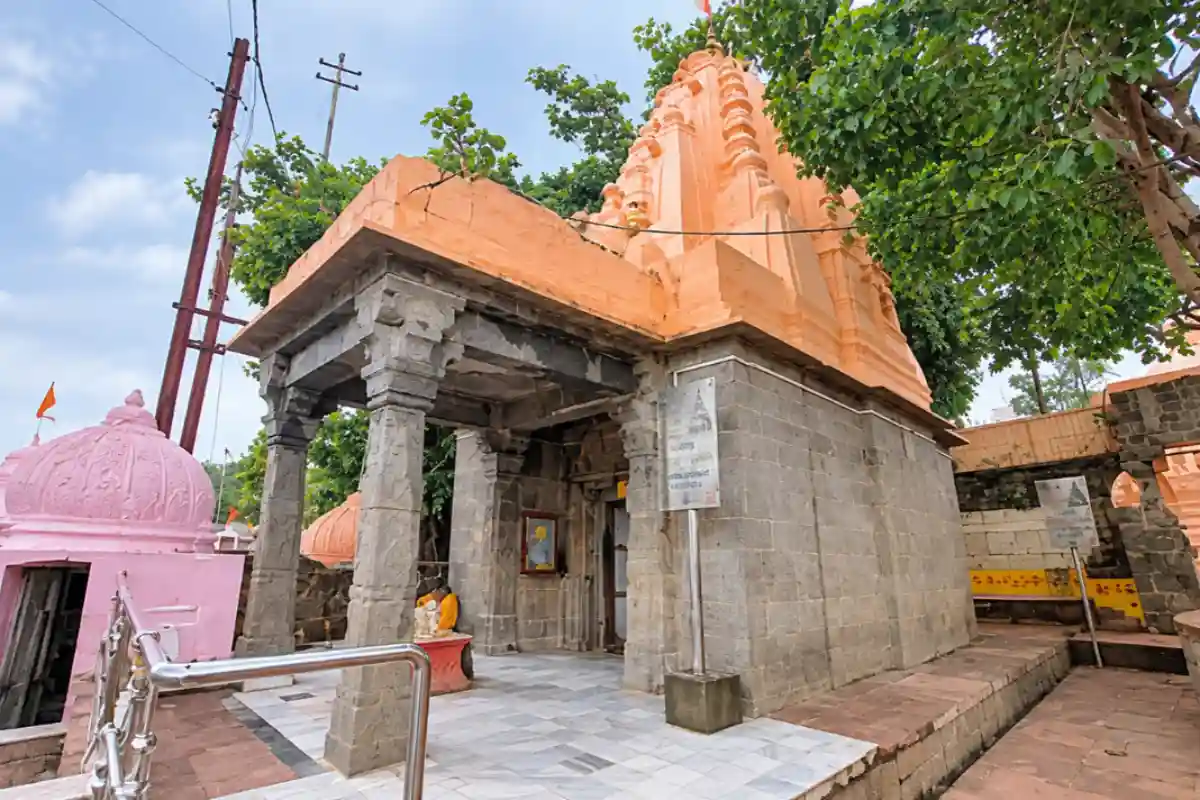
What is Kameshwar Mahadev in Ujjain?
Kameshwar Mahadev is the thirteenth of Ujjain's 84 Mahadev lingas, with its story in the Skanda Purana, Avantya Khanda, chapter 13 of the Chaturashiti Linga Mahatmya. After Shiva burned Kama, the bodiless Kama worshipped this linga in Avanti. The linga granted him boons and said it would be famous after his name, Kameshwar.
Locally the linga is called Mankameshwar or Manakamneshwar, and some retellings call it Kandarpeshwar. The Purana's own name is Kameshwar, "the lord of Kama," and this article uses it throughout.
Local tradition places the temple on Gandharva Ghat, on the Shipra.
At a glance
- Kama is born from Brahma's mind, and Brahma's curse says Shiva's eye will destroy him.
- Brahma gives him twelve places, a flower bow and five arrows.
- Shiva burns him, and a voice with no body tells his wife Rati not to cry.
- The linga in Avanti tells him he will be born as Krishna's son and promises its own name from his.
Kameshwar Mahadev: quick facts
| Topic | Detail |
|---|---|
| Meaning of the name | Lord (Shiva) of Kama, named after Kama |
| Deity | Shiva, in linga form |
| Source text | Skanda Purana, Avantya Khanda, Chaturashiti Linga Mahatmya, Chapter 13 (5.2.13) |
| Position among the 84 Mahadevs | Thirteenth |
| Narrator and listener | Shiva (Hara) speaking to Parvati |
| Place in the story | Avanti, where Kama sees the linga |
The tirtha name list (5.1.70) names a Kameshwar and a Manahkameshwar as separate lingas, apart from the one that appears right after Lokapaleshwar. Manahkameshwar is also an epithet of Ganesha in the same chapter. The local name Mankameshwar therefore cannot be traced to the Purana's Manahkameshwar. It may come from the folk meaning "lord of the wishes of the mind," since the text calls the linga one that bestowed desired benefits, but that is a guess, not a source.
What is the story of Kameshwar Mahadev in the Skanda Purana?
Kama is born from Brahma's mind
Brahma was deep in meditation, wanting to create beings, when a figure shining like the sun and decked with ornaments appeared. Brahma asked who he was and said he looked like Kandarpa, marked with the signs of Manmatha. The figure answered that he was born from Brahma's wish to create, from the power of his mind, and asked for orders.
Brahma's command and his curse
Brahma said the Prajapatis he had made could not produce offspring, and gave the command:
त्वमग्रणीः प्रजासर्गे त्वदधीनमिदं जगत् ।
कुरु सृष्टिं विचित्रां च कंदर्प मम शासनात् ॥
Meaning: you are the foremost in the creation of progeny, and this world depends on you; by my command, Kandarpa, make a varied creation (Skanda Purana 5.2.13.7).
On hearing the command, Smara vanished from sight. Angry, Brahma cursed him: "You will be destroyed by the fire from Bhava's eye." Kandarpa begged for forgiveness.
The twelve places, the bow and the arrows
Moved by his devotion, Brahma gave Kama twelve places to live in, along with the months Madhu and Madhava for the sake of love. He then gave Manmatha a bow of flowers and five arrows. With Rati and Priti, Kama conquered the three worlds.
Kama goes to Shiva
Kama then wondered who could disturb Shankara. He went with Rati and his friend Madhu (spring) to the place where Shiva was practising penance, and struck him with the arrow called Mohana. Shiva opened his third eye in anger, and Kandarpa was burned to ash.
Rati's lament and the voice
Rati was present. She wept, "O lord, O my life, why do you leave me?" A voice with no body answered: "O lady of wide eyes, do not cry. By the grace of Shiva, the lord of the gods, your husband will rise up alive again."
A prayer then went up to Shiva: creation had stopped on earth, so let her husband be returned.
Shiva's words and the linga in Avanti
Shiva told Rati that Kama would now move among beings without a body, as Ananga, and that he would be revived when he served the linga at Avanti. On the gods' direction, Kama went to Avanti and saw the great linga that bestowed desired benefits.
The linga was pleased and spoke to him, promising him boons. It said: "I shall be well known after your name, O Kama, for ever." That is why it is Kameshwar.
Kama's hermitage
Kama made his hermitage there, in the vicinity of the linga. The chapter closes by saying Shiva blessed him and gave him a place near himself, and the next chapter turns to Kutumbeshwar.
What does the Skanda Purana promise for worshipping Kameshwar Mahadev?
The closing verses of the chapter list these results:
- Merely visiting the linga brings splendid bliss and fortune (stated in the opening verse).
- Those who visit with devotion reach a state that gives eternal bliss.
- They live long, gain good form, and keep a spotless lineage.
- They gain great prosperity and the best happiness, wives endowed with divine arts, and children free of disease.
- Those who visit Shiva devoutly on the thirteenth lunar day of the bright half of Chaitra rejoice after reaching Devaloka. They become Yakshas, Ganeshvaras and Siddhas, and go to Rudraloka by aerial chariots.
- The chapter closes by calling this the sin-destroying power of Kameshwar.
The line on long life, form and lineage is addressed to Kama:
दीर्घायुषो भविष्यंति रूपं तेषां भविष्यति ।
कुलं च निर्मलं तेषां ये त्वां पश्यंति मन्मथ ॥
Meaning: those who see you, Manmatha, will have long lives, they will have beauty, and their lineage will be spotless (Skanda Purana 5.2.13.50).
Which popular claims about Kameshwar Mahadev don't match the text?
The story of Kameshwar Mahadev is often retold with changes. These are the claims that do not match the Skanda Purana.
| Popular claim | What the Skanda Purana says | Status |
|---|---|---|
| A heavenly voice told Kama to go to MahakalShree Mahakaleshwar Jyotirlinga, the heart of Ujjain. Vana | The voice only tells Rati not to cry; Shiva speaks of the linga at Avanti, and Kama goes on the gods' direction | Contradicts the text |
| Kama disturbed Shiva's meditation in Mahakal Vana | No place is named for the burning; Avanti appears only later, when Kama visits the linga | Not in the text |
| All twelve places are in a woman's body | Seven are body parts; the rest are young women, spring, the cuckoo's call, moonlight and the rains | Partly in the text |
| Kama directly broke Shiva's penance | He entered Shiva's heart in a tiny form and then shot the Mohana arrow from under a mango tree | Partly in the text |
| Kama saw the linga at Gandharvavati Ghat | The text says only Avanti; no ghat or river is named | Not in the text |
| Shiva made the place immortal | The linga stays famous after Kama's name, and Kama builds a hermitage near it | Contradicts the text |
| Visiting on the Chaitra bright-half thirteenth leads straight to Devaloka, if worship is done at the ghat | Devotees first rejoice in Devaloka, then become Yakshas, Ganeshvaras and Siddhas and go to Rudraloka; no "straight" and no ghat condition | Partly in the text |
| The linga gives peace of mind, positive energy and relief from troubles | The text names bliss, fortune, prosperity and the destruction of sin | Later wording |
| Monday, Pradosh and Mahashivratri are the special days | This chapter names none of them | Popular belief |
Tagare's own introduction warns that the author of this section sometimes modifies a Puranic legend to suit his purpose or adds a new one. The chapter takes the well-known story of Kama's burning and ends it at Ujjain's linga. It places the burning nowhere in particular, so it gives no basis for tying the event to a spot in Ujjain.
What else do people ask about Kameshwar Mahadev?
What were the twelve places Brahma gave Kama?
Brahma gave Kama twelve places because of his devotion. Seven are parts of a woman's body: the sidelong glance, hair, hips, breasts, navel, armpit and a lip like a sprout. The other five are young women, spring, the cuckoo's call, moonlight and the arrival of the rains. He also gave the months Madhu and Madhava for love.
How did Kama reach Shiva's heart?
Kama took a tiny form like a worm and entered Shiva's heart through a hole in his hand. Shiva says he thought of Parvati at that moment. He regained his calm and tried to burn Kama from within by withdrawing his senses and concentrating. Kama escaped and shot the arrow Mohana from under a mango tree.
Who is Kama reborn as in this chapter?
The linga tells Kama that he will be capable even without limbs. It says he will be born as Shambarasudana, the son of Krishna and Rukmini, whom tradition knows as Pradyumna. The chapter does not describe the birth itself. It ends the boons with the linga's promise to be known after Kama's name.
Is today's temple the spot the Purana describes?
The identity of today's Kameshwar shrine rests on tradition. The chapter names only Avanti and "the great linga." It gives no ghat, river or neighbourhood, so the text cannot be matched with Gandharva Ghat or any other present-day spot. Whether the shrine is the one in the story is a matter of faith.
Why is Kameshwar the thirteenth in Ujjain's 84 Mahadev order?
In the Avanti Khanda, chapter 12 is Lokapaleshwar, chapter 13 is Kameshwar and chapter 14 is Kutumbeshwar. The Skanda Purana's separate tirtha name list (5.1.70) carries the same run: Lokapaleshwar, one famous as Kameshwar, thereafter Kutumbeshwar.
Present-day lists of the 84 Mahadev also place Kameshwar thirteenth. For the full sequence, see the complete guide to Ujjain's 84 Mahadev temples.
Which linga comes after Kameshwar in the 84 Mahadevs?
The next chapter, 14, is Kutumbeshwar. Lokapaleshwar, the 12th, comes just before.
Comments
No comments yet. Be the first to share your thoughts!
Leave a Comment