

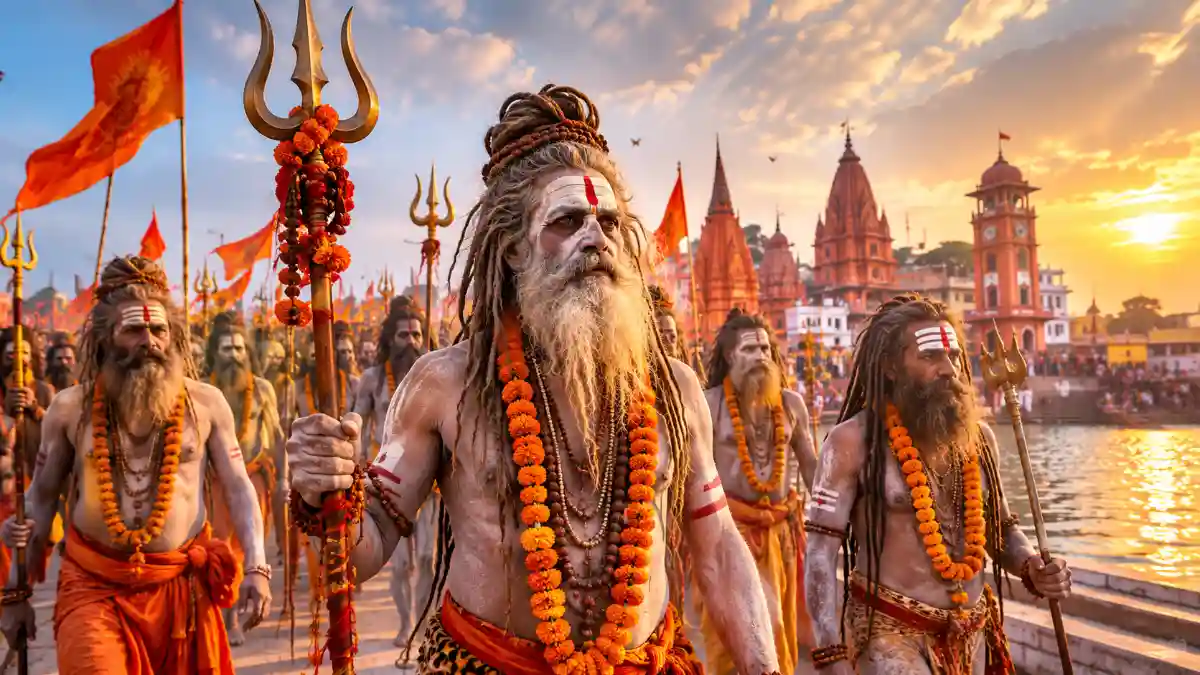
Who are Naga Sadhus?
Naga SadhusLearn about the mysterious Naga Sadhus of Kumbh Mela. are ascetic monks, mostly Shaiva (devotees of Shiva), who have formally renounced family, caste, property, and clothing as part of their spiritual path. The word "Naga" means naked, and it refers to their minimal or complete lack of clothing, a physical sign of their total detachment from worldly comfort and identity.
They're not a fringe group. They belong to formally organized monastic institutions called akharas, some of which trace their founding to the 8th century philosopher Adi Shankaracharya. Each akhara has its own guru lineage, its own internal hierarchy of mahants (abbots), and its own camp at every Kumbh Mela, including Simhastha in Ujjain.
Naga Sadhus spend most of the year away from public life entirely: in Himalayan caves, in forest ashrams, on the banks of the Ganga, or in fixed akhara headquarters in cities like Haridwar, Prayagraj, and Ujjain itself. The Kumbh Mela, held once every 3 years on rotation between the 4 sites, is one of the few times most of them appear together in public at all.
Key Highlights
- Naga Sadhus are ascetic monks, predominantly Shaiva, who renounce family, caste, and clothing as part of formal monastic initiation.
- They belong to 1 of 13 recognized akharas: 7 Shaiva, 3 Vaishnava, and 3 Udasin.
- Becoming a Naga Sadhu typically takes 6 to 12 years of training under a guru before final initiation.
- The final initiation includes performing one's own pind daan, the funeral rite normally performed for a deceased parent, symbolizing the death of the candidate's old identity.
- Women can take the same path and are called Naga Sadhvis, though their numbers are far smaller.
- At Simhastha 2028, Naga Sadhus lead the Shahi Snan (Amrit Snan) processions on April 9, April 23, and May 8, in a fixed order of precedence between akharas.
The 13 Akharas: the organizations behind every Naga Sadhu
Every Naga Sadhu belongs to one of 13 akharas recognized by the Akhil Bharatiya Akhara Parishad, the central body that coordinates akhara participation at every Kumbh Mela. The akharas fall into 3 traditions.
| Tradition | Number of akharas | Examples | What they follow |
|---|---|---|---|
| Shaiva | 7 | Juna, Niranjani, Mahanirvani, Atal, Avahan, Anand, Agni | Lord Shiva; home to most Naga Sadhus, including armed ascetic traditions |
| Vaishnava (Bairagi) | 3 | Nirmohi, Digambar, Nirvani | Lord Vishnu and his forms; sadhus wear saffron robes rather than going unclothed |
| Udasin | 3 | Udasin Bada, Udasin Naya, Nirmal | The lineage of Sri Chand, son of Guru Nanak; blends Hindu asceticism with Sikh philosophy |
Sources: Akhil Bharatiya Akhara Parishad records, Simhastha and Kumbh Mela pilgrimage guides — January 2026. Exact akhara camp locations and Shahi Snan order at Simhastha 2028 are set closer to the event; confirm with the Akhara Parishad or Ujjain administration before your visit.
Why Naga Sadhus specifically come from the Shaiva akharas
Naga Sadhus, in the strict sense, are almost always Shaiva. Vaishnava akhara ascetics follow a similarly rigorous path but call themselves Bairagi and wear saffron robes rather than going unclothed. Udasin akhara members blend both traditions and rarely take the "Naga" title at all. When you see the unclothed, ash-covered ascetics carrying tridents in Shahi Snan processions, they're almost certainly members of a Shaiva akhara like Juna, the largest of the 13.
A brief history of the akhara system
Tradition credits the 8th century philosopher Adi Shankaracharya with organizing the Shaiva akharas, largely to defend Hindu temples and pilgrimage routes during periods of conflict and forced conversion. That's the origin of the weapons training some Shaiva akharas still preserve today, even though akharas now function almost entirely as spiritual and ceremonial institutions rather than defensive ones.
The modern coordinating body, the Akhil Bharatiya Akhara Parishad, only came into existence in 1954, after nearly 800 people died in a stampede at that year's Kumbh Mela in Allahabad. The disputes between akharas over bathing order and precedence had gotten dangerous enough that the government pushed the akharas to form a single apex body to negotiate order and manage crowds. That body still governs which akhara bathes first, second, and so on at every Kumbh Mela today, including Simhastha.
The Kinnar Akhara: a newer, and newly included, presence at Simhastha 2028
In 2015 and 2016, transgender rights activist Laxmi Narayan Tripathi formed the Kinnar Akhara, giving transgender ascetics a formal religious institution of their own. The Akhara Parishad initially declined to recognize it as a 14th independent akhara, but Juna Akhara, the largest Shaiva akhara, chose to induct the Kinnar Akhara under its own umbrella, training its members in Juna's rituals and traditions and allowing them to take the sacred bath alongside Juna's own sadhus.
At Simhastha 2028, that inclusion reaches a new milestone: Juna Akhara has agreed to share its Shahi Snan at Dutt Ghat, a site on the Shipra traditionally reserved for Naga Sadhus, with the Kinnar Akhara, the first time this has happened at Ujjain's Simhastha. The Kinnar Akhara has also conferred the senior title of Mahamandaleshwar on several transgender spiritual leaders ahead of the event. If you visit the akhara camps at Simhastha 2028, you'll likely see the Kinnar Akhara's tent alongside Juna's, a visible sign of how the akhara system has grown to include it.
How someone actually becomes a Naga Sadhu
The process runs 6 to 12 years and involves stages that most outsiders never see, since much of it happens inside the akhara's private enclosures.
Naga Sadhvis: the women who take this path
Women can and do become Naga Sadhvis, following largely the same renunciation and training process, minus the weapons training that some Shaiva akharas give male candidates. Their numbers remain small compared to male Naga Sadhus, since the physical and social demands of the path fall even harder on women who take it. Naga Sadhvis maintain their own separate akhara enclosures and don't go unclothed in public the way male Naga Sadhus do, though the underlying renunciation is the same.
What a Naga Sadhu's daily life looks like outside the Kumbh
Most of the year, Naga Sadhus live away from cities and crowds entirely. Common bases include Himalayan caves, forest ashrams, and riverside camps in Uttarakhand, Kashi (Varanasi), and the akhara headquarters themselves. Many practice tapasya, extreme physical austerities sustained for years, and the specific forms have their own names. An Urdhwabahu holds 1 arm raised above the head continuously, for so long that the muscle eventually atrophies and the arm stays raised permanently. A Khadeshwari stands upright at all times, day and night, for years, resting only by leaning against a support. Others meditate seated through winters wearing nothing at all, drawing on breathing and concentration techniques developed specifically to withstand extreme cold.
Each Naga Sadhu tends a dhuni, a sacred fire kept burning continuously and worshipped daily with mantras and offerings. The ash from the dhuni, called vibhuti, is what they smear on their bodies, and it's also what they distribute to devotees as a blessing. During Holi at the Kumbh, some akharas mark a version of the festival called Masaan Holi, where sadhus play with the ash of cremation fires rather than colored powder, a practice built around the same theme of impermanence that runs through the entire ascetic path.
Naga Sadhus generally avoid entering towns and villages outside of a Kumbh gathering. Their appearance at a Kumbh Mela, moving in from wherever they've spent the previous 3 years, is genuinely one of the only times most Indians and travelers will see them at all. Kalpvas, an extended period of ritual residence on the riverbank during the mela, is when many sadhus and serious pilgrims alike stay put for the full length of the event rather than visiting for a single day.
Every akhara sets up 2 kinds of space at a Kumbh: a public camp where sadhus sit for darshan, answer questions, and give blessings, and a restricted inner enclosure where rituals like diksha actually happen. Visitors are welcome at the public camps. Don't assume you can walk into the inner sections just because the outer gate looks open. Akhara volunteers will direct you if you're in the wrong area, and it's worth listening the first time.
Naga Sadhus at Simhastha 2028: their role in the Shahi Snan
The most visible moment for Naga Sadhus at any Kumbh is the Shahi Snan, also called the Amrit Snan, the royal bath. At Simhastha 2028, the reported dates are April 9, April 23, and May 8, 2028, though these remain subject to final official confirmation closer to the event.
On each of these days, the 13 akharas process to the Shipra river in a fixed order of precedence, a sequence the Akhara Parishad has settled through negotiation and, at times, historical dispute. Naga-dominated Shaiva akharas like Juna and Mahanirvani traditionally lead the procession. Each akhara's mahants ride on decorated chariots or elephants, followed by the Naga Sadhus on foot, often carrying tridents and swords, a formation that echoes the historic Chaturanga Sena, the four-fold army tradition of Hindu warfare.
| Event | Simhastha 2028 dates | What you'll see |
|---|---|---|
| Shahi Snan / Amrit Snan (3 total) | April 9, April 23, May 8, 2028 | All 13 akharas process to the ghats in order; Naga Sadhus lead the Shaiva akhara processions. |
| Parva Snan (7 total) | March 27, April 4, April 14, April 19, May 1, May 5, May 15, 2028 | Individual pilgrim bathing; no akhara procession, lighter crowds, akhara camps still open for darshan. |
Sources: Madhya Pradesh government and Simhastha pilgrimage guides — January 2026. Treat these dates as the current consensus and confirm against official notification closer to March 2028.
Visiting a Naga Sadhu's camp: what to expect and how to behave
For most first-time pilgrims and travelers, the akhara camps are where you'll actually interact with Naga Sadhus, not the Shahi Snan procession itself, which moves fast and draws enormous crowds. Camps stay open for darshan on non-Shahi Snan days too, and the atmosphere there is far calmer.
What's generally welcomed
- Sitting quietly for darshan — approaching respectfully and waiting your turn is completely normal; sadhus give blessings freely to visitors who do this.
- Asking questions in a genuine, unhurried way — many Naga Sadhus are happy to discuss their path with sincerely curious visitors.
- Offering a small donation or food (bhandara) contribution — akharas run free community meals throughout the mela; contributing, even modestly, is appreciated.
What to avoid
- Photographing without asking first — some sadhus are comfortable with it, others aren't; always ask, and accept "no" without pushing.
- Treating a camp like a tourist photo backdrop — loud groups, staged poses, or filming for social media without consent reads as disrespectful and will get you asked to leave.
- Entering restricted inner enclosures — these are for initiated members and active rituals only, not public viewing.
A worked example: a first-time visitor's morning at an akhara camp
Situation
A foreign traveler visiting Simhastha 2028 for the first time wants to see Naga Sadhus up close but doesn't speak Hindi and has no personal connection to any akhara.
The practical approach: visit during a Parva Snan window rather than a Shahi Snan day, when camps are calmer and sadhus have more time for visitors. Arrive at the public darshan area of a larger, well-known akhara like Juna, which is used to hosting visitors and tends to have someone available who speaks some English. Sit at the back initially, observe how others approach, and only step forward once you understand the rhythm of the queue.
Key lesson: A quiet Parva Snan morning gives a first-time visitor a far better, calmer introduction to akhara life than trying to catch a glimpse during the chaos of a Shahi Snan procession.
Scenario 2: Wanting a photograph without causing offense
Situation
A visitor wants a photograph with a Naga Sadhu for their own memory of the trip, not for social media, but isn't sure how to ask.
The approach that works: make eye contact first, gesture toward the camera, and wait for a nod or spoken "haan" (yes) before raising it. A small offering, even just a few rupees placed respectfully, often smooths the exchange, though it should never feel like a payment for the photo itself. If the sadhu shakes his head or looks away, put the camera down immediately and move on without lingering.
Key lesson: The ask itself, made directly and without the camera already raised, matters more than any gesture or offering that follows it.
Common misunderstandings about Naga Sadhus
A few things get exaggerated or flattened in casual conversation and travel content. Naga Sadhus belong to some of the oldest formally governed monastic institutions in the world, with clear hierarchies, defined training periods, and a central coordinating body, not the loose, wandering structure some travel writing implies. Their nakedness is the end result of a specific, decades-long renunciation process with a formal ritual marking its completion, rather than a spontaneous or performative choice.
It's also worth knowing that Naga Sadhus historically trained in weapons because akharas once functioned as armed orders defending temples and pilgrim routes during periods of conflict. The trident and sword you'll see in the Shahi Snan procession today carry that history, even though the akharas' modern role is overwhelmingly spiritual and ceremonial rather than martial.
Final take
Naga Sadhus are members of formally organized monastic orders who've completed one of the most demanding renunciation paths in any living religious tradition. Simhastha 2028 is one of the few times most travelers will get to see them at all, whether in the Shahi Snan procession or, more accessibly, at their camps on quieter Parva Snan days. Approach with genuine curiosity and basic respect for their space, and most akharas welcome that completely.


Comments
No comments yet. Be the first to share your thoughts!
Leave a Comment